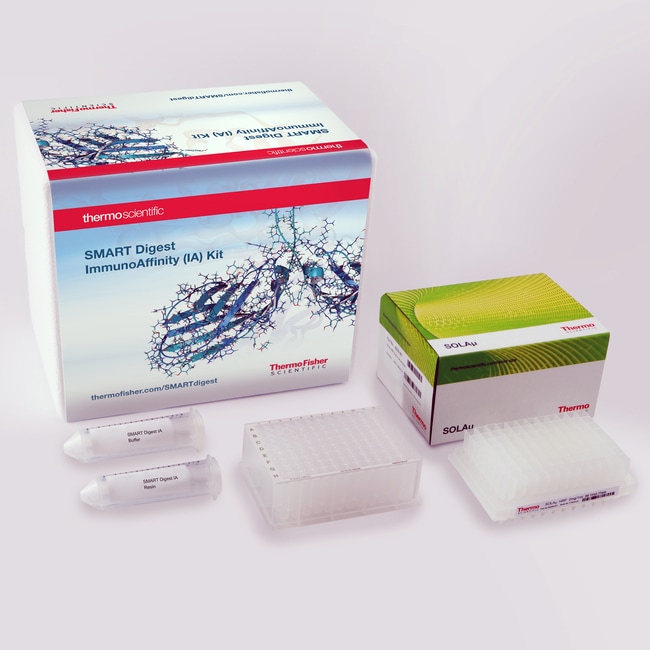
SMART Digest™ 免疫亲和 (IA) 蛋白质 G 试剂盒
Thermo Scientific™

SMART Digest™ 免疫亲和 (IA) 蛋白质 G 试剂盒

通过在单个孔中执行高度可重现的免疫捕获和蛋白质消化,可更快、更容易和更迅速地对低水平生物治疗药物和生物标记物进行定量。

Have Questions?
更改视图buttonViewtableView
货号描述
60112-104SMART Digest IA 试剂盒,蛋白质 G 磁性
60112-101SMART Digest IA 试剂盒,蛋白质 G 非磁性
60112-102SMART Digest IA 试剂盒,蛋白质 G 非磁性(含 SOLAµ SPE 和采集板)
60112-103SMART Digest IA 试剂盒,蛋白质 G 磁性(带 SOLAµ SPE 和采集板)
货号 60112-104
价格(CNY)
14,279.93
飞享价
Ends: 31-Dec-2025
20,124.48
共减 5,844.55 (29%)
Each
添加至购物车
描述:
SMART Digest IA 试剂盒,蛋白质 G 磁性
价格(CNY)
14,279.93
飞享价
Ends: 31-Dec-2025
20,124.48
共减 5,844.55 (29%)
Each
添加至购物车

使用 Thermo Scientific™ SMART Digest™ 免疫亲和 (IA) 试剂盒在单孔中实现快速、简单、高度可重现和灵敏的免疫捕获和蛋白消化。这些试剂盒旨在通过提供简单易用的捕获消化工作流程(仅需数小时,无需过夜)来消除生物标记物定量过程中经常遇到的挑战。SMART Digest IA 蛋白 G 试剂盒通过利用强亲和力结合分子的 Fab 和 Fc 部分对免疫球蛋白进行靶向纯化。

应对复杂基质中低水平样品定量的挑战

需要识别低水平生物标记物迫使分析行业面对极高水平的分析物和样品复杂度,这使得定量分析成为一项具有挑战性的工作。

由于这些蛋白通常以低水平存在于复杂生物基质中,因此常采用免疫亲和捕获步骤来纯化样品并提高灵敏度。该 IA 步骤通常后面会进行蛋白质消化。当前工艺通常耗时、步骤多、而且容易不可重现。SMART Digest IA 试剂盒可解决这些问题。

在单个孔中进行免疫捕获和蛋白质酶解

这些 IA 试剂盒提供了一种具有以下特点的工艺:

  • 快速
  • 简单
  • 高度重复性
  • 敏感
独特的设计可将工作流程减少到数小时

在 SMART Digest IA 试剂盒中,免疫捕获试剂和温度活化的热稳定性胰蛋白酶被共固定在树脂上。富集之后,在蛋白质变性条件下通过高温激活酶来加速消化,从而使工作流程耗时数小时,而不需过夜。

规格
描述SMART Digest IA 试剂盒,蛋白质 G 磁性
适用于(应用)肽定量
包括磁性 SMART Digest 树脂
捕获蛋白 G
切割赖氨酸和精氨酸的氨基酸 C 端
胰蛋白酶
产品规格SMART Digest 树脂,磁性
产品线SMART Digest
类型在单个微珠上组合进行免疫捕获 + 蛋白酶解
Unit SizeEach

常见问题解答 (FAQ)

How compatible are the SMART Digest ImmunoAffinity (IA) Kits with detergents (e.g. CHAPS, OGS, TWEEN and RIPA)?

We have observed the following effects with detergents:
• CHAPS – ~ 30% reduction in digest efficiency
• OGS – No reduction in digestion efficiency
• TWEEN – No reduction in digestion efficiency
• RIPA – The addition of RIPA, for ribonuclease A digestion, results in a concentration-dependent effect, where initial enzyme inhibition is overcome by improved substrate solubilization at higher concentrations only. 20% reduction in digestion efficiency.

We recommend compensating for reduction in digestion efficiency by extending the digestion time accordingly.

How much urea can I use with the SMART Digest ImmunoAffinity (IA) Kits?

The SMART Digest kits are not affected by concentrations of up to 0.5M of urea. If the concentration is higher than this, we recommend that the sample is diluted to <0.5 M of urea, prior to beginning digestion using the SMART Digest kit.

What is the composition of the SMART Digest IA buffer that comes in the SMART Digest ImmunoAffinity (IA) Kit?

The composition of the SMART Digest IA buffer is as follows:
Chemical Name (CAS No., EINECS No.): Kit Component Qty, Weight %
• Water (7732-18-5, 231-791-2): 2, 50-95%
• Glycerol (56-81-5, 200-289-5): 2, < 20%
• Tris Base (77-86-1, 201-064-4): 2, < 10%
• Tris-HCI (1185-53-1, 214-684-5): 2, < 10%
• Calcium Chloride (10043-52-4, 233-140-8): 2, < 10%
• Sodium Azide (26628-22-8, 247-852-1): 2, < 0.1%

Why don't I need to quantitate the total amount of protein and titer the enzyme when using the SMART Digest ImmunoAffinity (IA) Kits?

The SMART Digest IA Kits contain an excess of enzyme capable of digesting between 200 pg and 3.5 mg of protein. As most samples will fall within this range, it is not necessary to routinely quantitate protein concentration prior to digestion.

Why don't I need to use urea to unfold the protein when using SMART Digest ImmunoAffinity (IA) Kits?

The reason urea is needed as a first step in an in-solution protocol is to disrupt the sample and partially unfold the proteins. The proteins need to be partially unfolded so that the trypsin enzyme can have better access to the internal amino acid chain, not just the surface of the protein of interest. The reason the SMART Digest IA kits do not need urea is that it uses heat to unfold the protein.