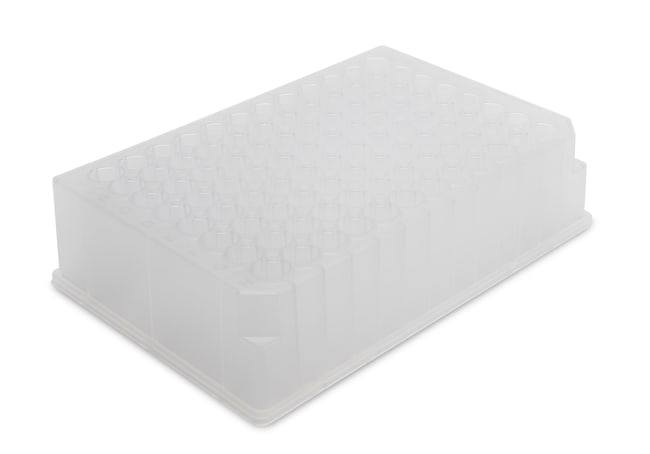
Are bar-coded WebSeal plates available?
Yes, bar-coded WebSeal plates are available as a catalog product for the famly of Thermo Scientific Vanquish UHPLC machines only. However, plates can be provided with a pre-printed adhesive label applied. Contact your sales representative to assist with completing a form where you can define the bar code information and location of application onto the plate. Additional information required includes the physical requirements for the label such as temperature stability, solvent stability, etc.
What is the best way to seal a WebSeal Plate plus or plates with glass or PTFE inserts that need to be incubated at elevated temperatures?
WebSeal Plate+ or plates with glass or PTFE inserts should never be sealed with tapes or adhesive foils. Silicone mats should be used with the WebSeal Plate&plus products, preferably with a protective PTFE film to give increased chemical protection.
The glass inserted plates are sealed with specific silicone plug mats or individual caps. Again, most have additional PTFE films of layers to give increased chemical protection.
These plates, inserts, and mats were originally designed for combinatorial chemistry techniques with in situ chemical derivatization. Use with elevated temperatures is possible with the inserts and plugs. These are the closest plate format equivalent to glass autosampler vial products.
How do the Thermo Scientific-WebSeal Plate plus products compare to standard and certified products?
The WebSeal Plate+ coating provides additional surface protection that further reduces the possibility of interactions with solvents, sample component, or other materials. WebSeal Plate+ microptates display ultra-low background extractable organics profiles that compare favorably to our mass spectrometry certified vial products.
How do WebSeal-Certified low bleed plates compare to others?
Well plates are manufactured in molds. In order to ''force'' the ready produced plate to come out of this mold for the next shot, some manufacturers use release agents (organic compounds that act as lubricants). These release agents can be detected in your chromatogram. The grade of polypropylene used by most plate manufacturers can contain monomers or other added ingredients that are susceptible to leaching on contact with organic solvents. WebSeal-Certified products are manufactured from high purity resins and use a process that does not require mold release agents and that is why they exhbit no significant background extractables.
Do standard WebSeal plates bleed with organic solvents, or is it better to purchase certified plates?
If you are using high concentrations of organic solvents in your sample, then you may be concerned about ''bleed''. This is a term which normally implies a constant loss of material from the column or separation system which leads to high background levels, increased noise, and loss of sensitivity. If using solutions with a high level of buffer or water, then this should not be a concern as such components will not leach under these conditions. All plates may be used.
The evaluation of the plastic resins used in the production of plates was also carried out by controlled extraction of leachable components with organic solvents associated with HPLC and GC operation. These included methanol, acetonitrile, and hexane. Standard plates showed low level of extractables when tested at the highest instrument sensitivity range. These extractables found are characteristic of the common materials used for microplates in the clinical market and plates that have been used for general purpose chromatography applications. This indicates that for many non-critical applications and with higher concentrations of sample, the standard quality plates will be acceptable. These plates are termed Chromatography Tested.
The very low levels of background extractables found during our testing of some plates showed for applications run at more sensitive instrument settings. Where higher purity of the plate is required, you should directly switch to the Certified plates as they are the lowest extraction PP plates currently available on the world market. For critical analysis with high organic solvent concentrations and low sample concentrations, the Certified product range should be the plates of choice.