Search


引用和文献 (5)
Invitrogen™
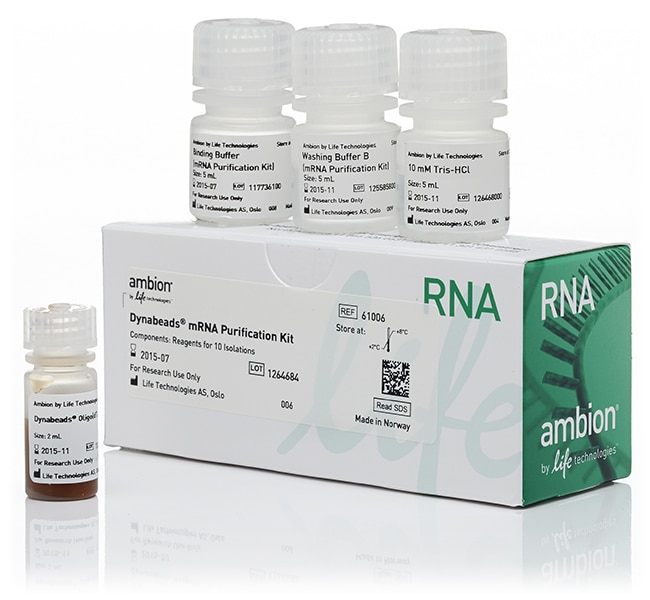
Dynabeads™ mRNA 纯化试剂盒(用于从总 RNA 制备液中纯化 mRNA)
Dynabeads™ mRNA 纯化试剂盒通常在15分钟内快速分离 mRNA 转录组,提供完整的纯 mRNA。试剂盒设计用于从总 RNA 制备物中特异性靶向、捕获和纯化了解更多信息
| 货号 | 数量 |
|---|---|
| 61006 | 2 mL |
货号 61006
价格(CNY)
5,731.00
飞享价
Ends: 31-Dec-2026
7,316.00共减 1,585.00 (22%)
Each
数量:
2 mL
价格(CNY)
5,731.00
飞享价
Ends: 31-Dec-2026
7,316.00共减 1,585.00 (22%)
Each
Dynabeads™ mRNA 纯化试剂盒通常在15分钟内快速分离 mRNA 转录组,提供完整的纯 mRNA。试剂盒设计用于从总 RNA 制备物中特异性靶向、捕获和纯化 mRNA 分子。使用 Dynabeads™ mRNA 纯化试剂盒的优势:
•通常在15分钟内获得纯 mRNA
• 高效回收和富集转录组
• 制备适用于几乎每个下游应用的 mRNA
快速纯 mRNA 分离
Dynabeads™ mRNA 纯化试剂盒含有磁珠,用于从任何总真核 RNA 制备液中分离 mRNA 转录组(参见图)。Dynabeads™ 磁珠尺寸均匀,在溶液中高度可移动(参见图)。这使得微珠捕获表面能够在 mRNA 捕获阶段与整个总 RNA 样品快速连续地相互作用。核糖体 RNA 和小 RNA 分子(转运 RNA、microRNA、小核仁 RNA 及小细胞质 RNA)不会与微珠结合,因此丢弃。仅捕获多腺苷酸化 RNA 物质(mRNA),从而获得更清洁、更灵敏的结果(参见图)。在约15分钟内即可分离出纯 mRNA,可随时用于下游应用。
直接可用富集程序
Dynabeads™ mRNA 纯化试剂盒采用稳健的亲和纯化原理,以富集多腺苷酸化 mRNA。首先用结合缓冲液平衡处理与寡核苷酸-(dT)25 偶联的超顺磁性 Dynabeads™,然后与纯化的总 RNA 混合。然后洗涤微珠以去除污染性 RNA 物质,然后用低至 5 µL 的 10 mM Tris-HCl 洗脱 mRNA。使用钕磁铁(单独购买)可促进整个过程,从而在缓冲液更换过程中快速、高效地固定磁珠。RNA 适用于所有下游分子应用,包括:
•基因克隆
• cDNA 合成、cDNA 文库构建
• RT-PCR、定量 RT-PCR
• RPA(核糖核酸酶保护测定)
• 消减杂交
• 斑点/狭线杂交
• 引物延伸
•通常在15分钟内获得纯 mRNA
• 高效回收和富集转录组
• 制备适用于几乎每个下游应用的 mRNA
快速纯 mRNA 分离
Dynabeads™ mRNA 纯化试剂盒含有磁珠,用于从任何总真核 RNA 制备液中分离 mRNA 转录组(参见图)。Dynabeads™ 磁珠尺寸均匀,在溶液中高度可移动(参见图)。这使得微珠捕获表面能够在 mRNA 捕获阶段与整个总 RNA 样品快速连续地相互作用。核糖体 RNA 和小 RNA 分子(转运 RNA、microRNA、小核仁 RNA 及小细胞质 RNA)不会与微珠结合,因此丢弃。仅捕获多腺苷酸化 RNA 物质(mRNA),从而获得更清洁、更灵敏的结果(参见图)。在约15分钟内即可分离出纯 mRNA,可随时用于下游应用。
直接可用富集程序
Dynabeads™ mRNA 纯化试剂盒采用稳健的亲和纯化原理,以富集多腺苷酸化 mRNA。首先用结合缓冲液平衡处理与寡核苷酸-(dT)25 偶联的超顺磁性 Dynabeads™,然后与纯化的总 RNA 混合。然后洗涤微珠以去除污染性 RNA 物质,然后用低至 5 µL 的 10 mM Tris-HCl 洗脱 mRNA。使用钕磁铁(单独购买)可促进整个过程,从而在缓冲液更换过程中快速、高效地固定磁珠。RNA 适用于所有下游分子应用,包括:
•基因克隆
• cDNA 合成、cDNA 文库构建
• RT-PCR、定量 RT-PCR
• RPA(核糖核酸酶保护测定)
• 消减杂交
• 斑点/狭线杂交
• 引物延伸
仅供科研使用。不可用于诊断程序。
规格
洗脱体积5 to 20 μL
最终产品类型mRNA
适用于(应用)逆转录酶 PCR (RT-PCR)
纯化时间10 min.
数量2 mL
运输条件室温
原始材料量≤100 μL
产量2 μg mRNA per 200 μL of beads (Binding capacity)
分离技术磁珠
样品类型总 RNA
Unit SizeEach
内容与储存
2-8°C
2 mL 微珠 + 缓冲液
2 mL 微珠 + 缓冲液
常见问题解答 (FAQ)
我在使用Dynabeads磁珠分离mRNA时出现了DNA污染,为什么会出现这种情况?
我的Dynabeads磁珠不能很好地吸附到磁力架上,对此你们有什么建议吗?
我想要分离较长的双链DNA片段,你们有什么产品可以推荐?
我能否使用Dynabeads磁珠分离单链DNA模板?
什么是磁化率?
引用和文献 (5)
引用和文献
Abstract
Identification of a novel glucose transporter-like protein-GLUT-12.
Journal:Am J Physiol Endocrinol Metab
PubMed ID:11832379
'Facilitative glucose transporters exhibit variable hexose affinity and tissue-specific expression. These characteristics contribute to specialized metabolic properties of cells. Here we describe the characterization of a novel glucose transporter-like molecule, GLUT-12. GLUT-12 was identified in MCF-7 breast cancer cells by homology to the insulin-regulatable glucose transporter GLUT-4. The GLUT-12 cDNA
Transcriptome analysis by strand-specific sequencing of complementary DNA.
Journal:Nucleic Acids Res
PubMed ID:19620212
High-throughput complementary DNA sequencing (RNA-Seq) is a powerful tool for whole-transcriptome analysis, supplying information about a transcript's expression level and structure. However, it is difficult to determine the polarity of transcripts, and therefore identify which strand is transcribed. Here, we present a simple cDNA sequencing protocol that preserves information about
Transcriptome sequencing to detect gene fusions in cancer.
Journal:Nature
PubMed ID:19136943
Recurrent gene fusions, typically associated with haematological malignancies and rare bone and soft-tissue tumours, have recently been described in common solid tumours. Here we use an integrative analysis of high-throughput long- and short-read transcriptome sequencing of cancer cells to discover novel gene fusions. As a proof of concept, we successfully
Widespread occurrence of antisense transcription in the human genome.
Journal:Nat Biotechnol
PubMed ID:12640466
An increasing number of eukaryotic genes are being found to have naturally occurring antisense transcripts. Here we study the extent of antisense transcription in the human genome by analyzing the public databases of expressed sequences using a set of computational tools designed to identify sense-antisense transcriptional units on opposite DNA
Phylogenomic analyses of lophophorates (brachiopods, phoronids and bryozoans) confirm the Lophotrochozoa concept.
Journal:Proc Biol Sci
PubMed ID:18495619
Based on embryological and morphological evidence, Lophophorata was long considered to be the sister or paraphyletic stem group of Deuterostomia. By contrast, molecular data have consistently indicated that the three lophophorate lineages, Ectoprocta, Brachiopoda and Phoronida, are more closely related to trochozoans (annelids, molluscs and related groups) than to deuterostomes.