Search


引用和文献 (6)
Invitrogen™
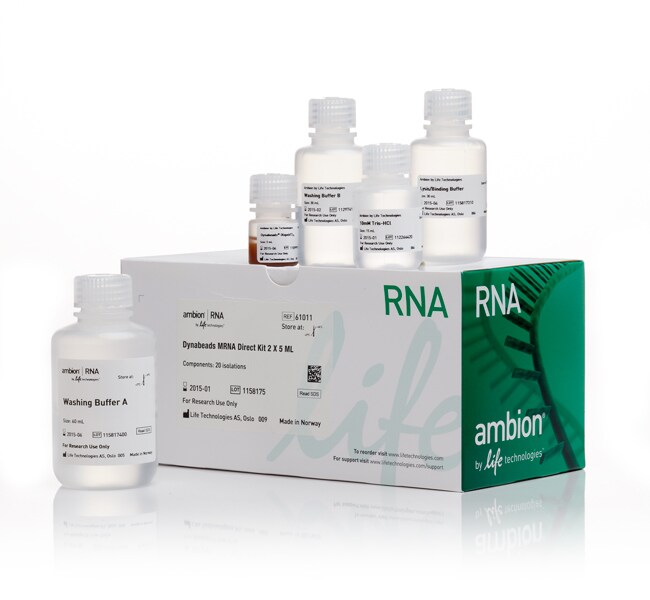
Dynabeads™ mRNA DIRECT™ 纯化试剂盒
设计用于直接从动物和植物细胞和组织的粗裂解液中简单、快速地分离纯净、完整的聚腺苷酸化 (polyA) mRNA
Have Questions?
更改视图

| 货号 | 数量 |
|---|---|
| 61012 | 10 mL |
| 61011 | 5 mL |
货号 61012
价格(CNY)
9,037.00
飞享价
Ends: 31-Dec-2026
12,307.00共减 3,270.00 (27%)
Each
数量:
10 mL
价格(CNY)
9,037.00
飞享价
Ends: 31-Dec-2026
12,307.00共减 3,270.00 (27%)
Each
The Dynabeads™ mRNA DIRECT™ Kit is designed for simple and rapid isolation of pure, intact polyadenylated (polyA) mRNA directly from the crude lysate of animal and plant cells and tissues. The isolated mRNA is suitable for use in all downstream applications.
Advantages of the Dynabeads mRNA DIRECT Kit:
- Fast – 15 minute procedure yields pure, intact mRNA
- Highly pure mRNA isolation – best choice upstream of cDNA synthesis
- Sensitive mRNA isolation – enables cDNA synthesis and cDNA library construction from ultra-small starting samples (enables cDNA library construction from a single cell)
Dynabeads® mRNA DIRECT™ 试剂盒,设计用于直接从动物和植物细胞和组织的粗裂解液中简单、快速地分离纯净、完整的聚腺苷酸化 (polyA) mRNA。分离出的 mRNA 适用于所有下游应用。
Dynabeads® mRNA DIRECT™ 试剂盒的优势:
•快速 — 15分钟的程序即可获得纯净、完整的 mRNA
• 高纯 mRNA 分离 — cDNA 合成上游的理想选择
• 灵敏的 mRNA 分离 — 可实现来自超小起始样品的 cDNA 合成和 cDNA 文库构建(支持从单个细胞构建 cDNA 文库)
系统概述
分离方案依赖于在大多数 mRNA 3' 端 polyA 残基与共价偶联到 Dynabeads® 表面的寡核苷酸 (dT)25 之间的碱基配对。其他缺乏 polyA 尾的 RNA 种类不会与微珠杂交,并且易于洗涤。核糖体 RNA、DNA、蛋白和小 RNA 分子(如转运 RNA、微小 RNA 和小核仁 RNA)不会与珠结合且会被丢弃。裂解/结合缓冲液中的 RNase 抑制剂以及严格的杂交和洗涤条件,可确保从富含 RNase 的粗制样品中分离出纯净、完整的 mRNA,而无需使用强离液剂。mRNA 纯化微珠,可以从极广泛的粗制起始样品中,特异性靶向捕获 mRNA 转录组(参见方案)。1 mg Dynabeads® 寡核苷酸 (dT)25 微珠 (200µL) 能够结合高达 2 µg mRNA。典型的哺乳动物细胞含有约 10–30 pg 的总 RNA,其中 1–5% 是 mRNA。
仅供科研使用。不可用于诊断程序。
规格
洗脱体积10 to 100 μL
最终产品类型mRNA
适用于(应用)实时荧光定量 PCR (qPCR)
适用于(设备)Automated Liquid Handling Systems
高通量能力高通量兼容性、手动方案、自动方案
数量10 mL
运输条件室温
原始材料量Cells: ≤106
Plant: ≤400 mg
Tissue: ≤200 mg
Plant: ≤400 mg
Tissue: ≤200 mg
产量2 μg mRNA per 200 μL of beads (Binding capacity)
分离技术磁珠
样品类型液体样本(例如血清)、植物样本、病毒样本、细胞、组织、FFPE & 固定样本、酵母、RNA、血液, Plants, Plasma, Serum, Tissue, Total RNA, Blood
Unit SizeEach
内容与储存
目录:
•10 ml Dynabeads 寡核苷酸 (dT)25
• 60 ml 裂解/结合缓冲液
• 120 ml 洗涤缓冲液 A
• 60 ml 洗涤缓冲液 B
• 15 ml 10 mM Tris-HCl(洗脱缓冲液)
包含足够进行40次标准分离的试剂。存储在 2°C 到 8°C。
•10 ml Dynabeads 寡核苷酸 (dT)25
• 60 ml 裂解/结合缓冲液
• 120 ml 洗涤缓冲液 A
• 60 ml 洗涤缓冲液 B
• 15 ml 10 mM Tris-HCl(洗脱缓冲液)
包含足够进行40次标准分离的试剂。存储在 2°C 到 8°C。
常见问题解答 (FAQ)
我在使用Dynabeads磁珠分离mRNA时出现了DNA污染,为什么会出现这种情况?
我的Dynabeads磁珠不能很好地吸附到磁力架上,对此你们有什么建议吗?
我想要分离较长的双链DNA片段,你们有什么产品可以推荐?
我能否使用Dynabeads磁珠分离单链DNA模板?
什么是磁化率?
引用和文献 (6)
引用和文献
Abstract
Extracellular plasma RNA from colon cancer patients is confined in a vesicle-like structure and is mRNA-enriched.
Journal:RNA
PubMed ID:18456845
'Little is yet known about the origin and protective mechanism of free nucleic acids in plasma. We investigated the possibility of these free nucleic acids being particle associated. Plasma samples from colon cancer patients and cell culture media were subjected to various antibody incubations, ultracentrifugation, and RNA extraction protocols for
Relationships and differentially expressed genes among pancreatic cancers examined by large-scale serial analysis of gene expression.
Journal:Cancer Res
PubMed ID:11830538
'Pancreatic adenocarcinoma is among the most fatal of cancers, in part because of late diagnosis and a lack of effective therapies. Comprehensive studies are needed to better understand and address the cellular mechanisms and pathways of tumorigenesis. Serial analysis of gene expression was used to analyze gene expression profiles of
Stem cell and epithelial-mesenchymal transition markers are frequently overexpressed in circulating tumor cells of metastatic breast cancer patients.
Journal:Breast Cancer Res
PubMed ID:19589136
The persistence of circulating tumor cells (CTC) in breast cancer patients might be associated with stem cell like tumor cells which have been suggested to be the active source of metastatic spread in primary tumors. Furthermore, these cells also may undergo phenotypic changes, known as epithelial-mesenchymal transition (EMT), which allows
The transcription factors SOX9 and SOX10 are vitiligo autoantigens in autoimmune polyendocrine syndrome type I.
Journal:J Biol Chem
PubMed ID:11423552
Vitiligo is common in the hereditary disorder autoimmune polyendocrine syndrome type I (APS I). Patients with APS I are known to have high titer autoantibodies directed against various tissue-specific antigens. Using sera from APS I patients for immunoscreening of a cDNA library from human scalp, we identified the transcription factors
Disease-associated mutations in human mannose-binding lectin compromise oligomerization and activity of the final protein.
Journal:J Biol Chem
PubMed ID:14764589
Deficiency of human mannose-binding lectin (MBL) caused by mutations in the coding part of the MBL2 gene is associated with increased risk and severity of infections and autoimmunity. To study the biological consequences of MBL mutations, we expressed wild type MBL and mutated MBL in Chinese hamster ovary cells. The