Search

Invitrogen™
Low Fluorescence PVDF Membranes
Invitrogen™ Low Fluorescence PVDF Membranes are optimized to provide exceptional performance in western blot, fluorescent total protein normalization, and dot blot applications.
Have Questions?
更改视图

| 货号 | 产品规格 | 尺寸 (长 x 宽) | 足够用于 |
|---|---|---|---|
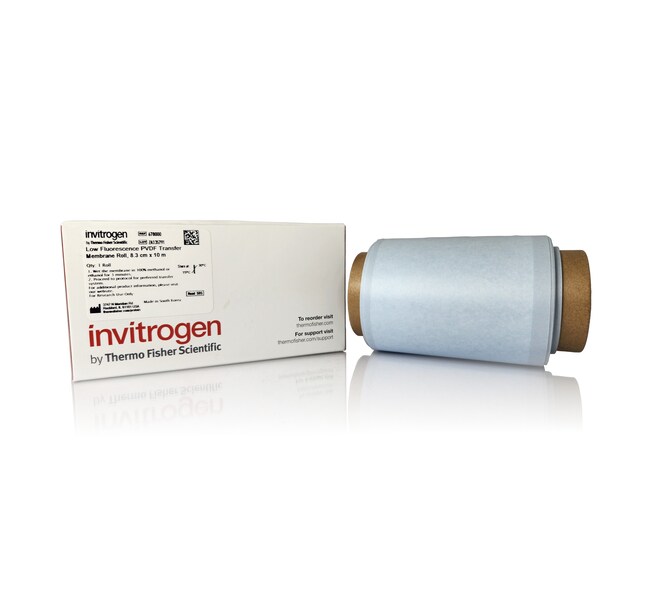
| 678000 | Roll | 8.3 cm x 10 m | 120 Mini-gel or 74 Midi-gel Blots |
| 678001 | Sandwich | 8.3 x 7.3 cm | 20 Blots |
| 678002 | Sandwich | 13.5 x 8.3 cm | 20 Blots |
| 678003 | Sheet | 8.3 x 7.3 cm | 10 Blots |
| 678004 | Sheet | 13.5 x 8.3 cm | 10 Blots |
货号 678000
价格(CNY)
4,202.00
飞享价
Ends: 31-Dec-2026
6,525.00共减 2,323.00 (36%)
Each
产品规格:
Roll
尺寸 (长 x 宽):
8.3 cm x 10 m
足够用于:
120 Mini-gel or 74 Midi-gel Blots
价格(CNY)
4,202.00
飞享价
Ends: 31-Dec-2026
6,525.00共减 2,323.00 (36%)
Each
Invitrogen Low Fluorescence PVDF membranes are specifically optimized to provide exceptional performance in western blot, fluorescent total protein normalization, and dot blot applications. These membranes maintain high protein binding characteristics while providing minimal auto-fluorescence across a wide range of excitation wavelengths (280–800 nm). As a result, Low Fluorescence PVDF membranes provide excellent multi-plexing capability and help achieve higher signal-to-noise ratios and improved detection limits across a broad spectrum of fluorescent dyes.
Features and benefits
- Low background autofluorescence—reduced background noise across multiple wavelengths, providing exceptional signal-to-noise
- Consistency and reproducibility—optimized pore size engineered to produce exceptional results, regardless of protein size and abundance
- Versatile formats—assortment of sizes and formats to match specific laboratory needs
Find the best format
Low Fluorescence PVDF membranes are available in rolls, pre-cut sheets, and pre-assembled membrane and filter paper sandwiches. The single-gel width roll can be easily cut to length for use with either mini or midi gel transfers. Precut sizes are available for both mini and midi gels, helping reduce handling effort and saving time. Compatible with wet tank transfer and semi-dry transfer systems, Low Fluorescence PVDF membranes pair with any preferred protein gel, helping improve data quality without changing the workflow.
Optimized pore size
Low Fluorescence PVDF membranes are manufactured with a narrower distribution of pore sizes compared to conventional PVDF membranes. The pore distribution of our 0.3 μm Low Fluorescence PVDF membranes is optimized to deliver consistent and reproducible results for western blotting applications, irrespective of target protein size. Low Fluorescence PVDF membranes facilitate uniform protein transfer and detection, helping ensure high-quality, reliable western blot data.
Applications
- Fluorescent western blotting with IR and RGB fluorophores
- Total protein normalization and quantitative western blotting
- Chemiluminescent western blotting
For Research Use Only. Not for use in diagnostic procedures.
规格
适用于(应用)Western Blotting
产品类型Transfer Membrane Roll
数量1 Roll
运输条件Room temperature
尺寸 (长 x 宽)8.3 cm x 10 m
产品规格Roll
长度(公制)10 m
材质PVDF
孔径0.3 μm
足够用于120 Mini-gel or 74 Midi-gel Blots
宽度(公制)8.3 cm
Unit SizeEach
内容与储存
Store at room temperature.