Search


引用和文献 (2)
Gibco™
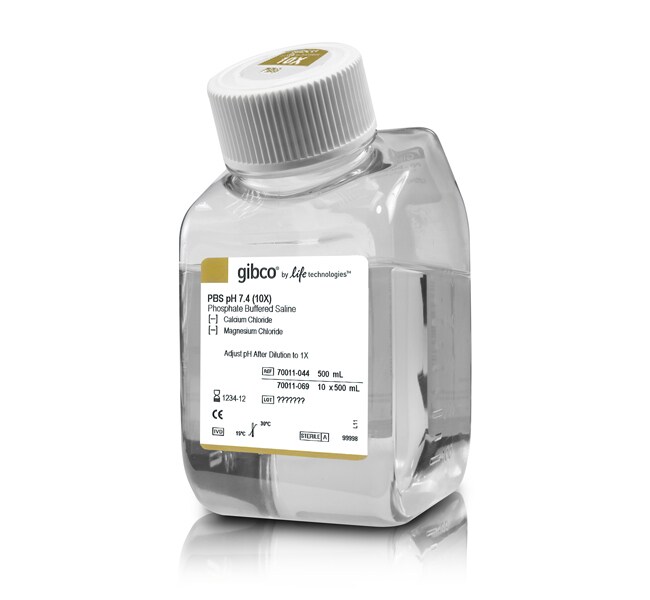
PBS (10X),pH 7.4
磷酸盐缓冲溶液 (PBS) 是一种平衡盐溶液,适用于各种细胞培养应用,例如解离前清洗细胞、运输细胞或组织样品、稀释细胞进行计数和制备试剂。在细胞解离之前,需采用配方中不含钙和镁的制剂从培养物中冲洗掉螯合剂。浓缩液形式的 Gibco™ PBS 在稀释时需要调整了解更多信息
Have Questions?
更改视图

| 货号 | 数量 |
|---|---|
| 70011069 | 10 x 500 mL |
| 70011044 | 500 mL |
货号 70011069
价格(CNY)
6,500.00
飞享价
Ends: 31-Dec-2026
8,125.00共减 1,625.00 (20%)
Each
数量:
10 x 500 mL
价格(CNY)
6,500.00
飞享价
Ends: 31-Dec-2026
8,125.00共减 1,625.00 (20%)
Each
磷酸盐缓冲溶液 (PBS) 是一种平衡盐溶液,适用于各种细胞培养应用,例如解离前清洗细胞、运输细胞或组织样品、稀释细胞进行计数和制备试剂。在细胞解离之前,需采用配方中不含钙和镁的制剂从培养物中冲洗掉螯合剂。浓缩液形式的 Gibco™ PBS 在稀释时需要调整 pH(详见实验方案)。
我们针对大量细胞培养应用提供了各种 Gibco™ PBS 制剂。
可提供完整配方。
cGMP 生产和质量体系
Gibco™ PBS 在位于纽约格兰德岛、符合 cGMP 要求的工厂生产。该工厂是在FDA登记的医疗器械生产商,且通过ISO 13485标准认证。为确保供应链的稳定,我们同时提供由我们的苏格兰工厂生产的相同 Gibco™ PBS 产品 (70011-036)。该工厂也是 FDA 认证医疗器械生产商,且通过 ISO 13485 标准认证。
我们针对大量细胞培养应用提供了各种 Gibco™ PBS 制剂。
此 PBS 的配制方式如下:
| 不含 |
| •钙 |
| •镁离子 |
| • 酚红 |
可提供完整配方。
cGMP 生产和质量体系
Gibco™ PBS 在位于纽约格兰德岛、符合 cGMP 要求的工厂生产。该工厂是在FDA登记的医疗器械生产商,且通过ISO 13485标准认证。为确保供应链的稳定,我们同时提供由我们的苏格兰工厂生产的相同 Gibco™ PBS 产品 (70011-036)。该工厂也是 FDA 认证医疗器械生产商,且通过 ISO 13485 标准认证。
仅用于研究和生产用途。不可用于临床诊断或直接用于人类或动物。
规格
化学名称或材料磷酸盐缓冲盐水 (PBS)
颜色白色
包括不含丙酮酸钠
生产质量cGMP-compliant under the ISO 13485 standard
渗透压2800 - 3100 mOsm/kg
建议的储存条件储存条件:15°C 至30°C
运输条件:室温
有效期:自生产之日起24个月
运输条件:室温
有效期:自生产之日起24个月
无菌无菌过滤
最大浓度10 X
适用于(应用)哺乳动物细胞培养
物理形态液体
产品线Gibco
数量10 x 500 mL
溶液类型磷酸盐缓冲盐水
pH7.4
Unit SizeEach
常见问题解答 (FAQ)
Are your PBS products tested for endotoxin levels?
Are your PBS products sterile and suitable for cell culture?
Are your PBS products DNase- and RNase-free?
Is a precipitate in PBS normal?
What is the difference between PBS and DPBS?
引用和文献 (2)
引用和文献
Abstract
Stiffness-controlled three-dimensional extracellular matrices for high-resolution imaging of cell behavior.
Journal:Nat Protoc
PubMed ID:23099487
Regulation of cell functions by the physical properties of the extracellular matrix (ECM) has emerged as a crucial contributor to development and disease. Two specific physical properties of the ECM, stiffness and dimensionality, each influence cell signaling and function. As these ECM physical properties are linked to other properties that
Optogenetic interrogation of neural circuits: technology for probing mammalian brain structures.
Journal:Nat Protoc
PubMed ID:20203662
Elucidation of the neural substrates underlying complex animal behaviors depends on precise activity control tools, as well as compatible readout methods. Recent developments in optogenetics have addressed this need, opening up new possibilities for systems neuroscience. Interrogation of even deep neural circuits can be conducted by directly probing the necessity