Search


引用和文献 (5)
Thermo Scientific™
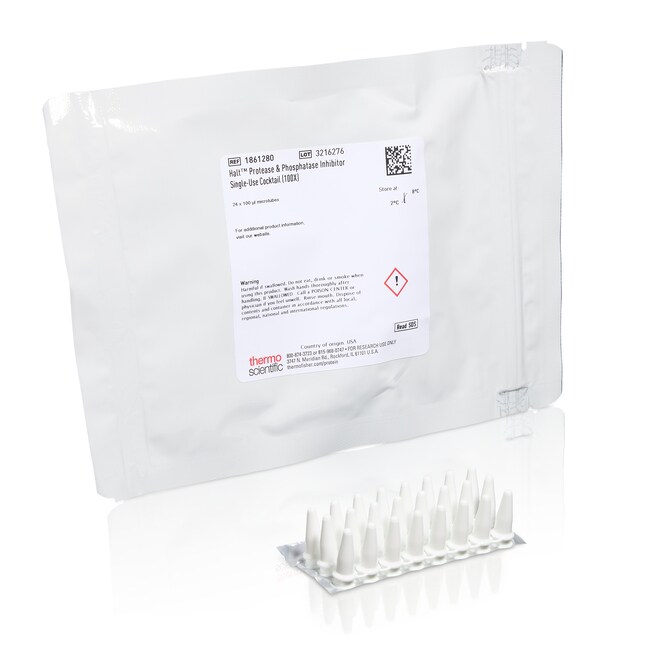
Halt™ 蛋白酶和磷酸酶抑制剂混合物无 EDTA (100X)
Thermo Scientific Halt蛋白酶和磷酸酶抑制剂一次性混合物(100X)可通过单一溶液为细胞和组织裂解产物提供蛋白样品保护。Halt蛋白酶及磷酸酶抑制剂一次性混合物(100X)的特点:• 全面保护— 多功能混合物,包含蛋白酶和磷酸酶抑制剂• 多种包装规格— 可方便地在四种规格中进行选择,符合几乎所有与规模实验的要求• 便捷—100x液体配方远比单片抑制剂或其他形式更加易用和高效• 易于储存—与基于DMSO的混合物相比,水相基础的形式便于储存于冷藏室中,而且不需要冷冻•了解更多信息
Have Questions?
更改视图

| 货号 | 数量 |
|---|---|
| 78443 | 24 x 100μL |
| 78441 | 1 mL |
| 78445 | 5 x 1 mL |
| 78447 | 10 mL |
货号 78443
价格(CNY)
2,908.00
飞享价
Ends: 27-Dec-2025
4,540.00共减 1,632.00 (36%)
Each
数量:
24 x 100μL
价格(CNY)
2,908.00
飞享价
Ends: 27-Dec-2025
4,540.00共减 1,632.00 (36%)
Each
Thermo Scientific Halt蛋白酶和磷酸酶抑制剂一次性混合物(100X)可通过单一溶液为细胞和组织裂解产物提供蛋白样品保护。
Halt蛋白酶及磷酸酶抑制剂一次性混合物(100X)的特点:
• 全面保护— 多功能混合物,包含蛋白酶和磷酸酶抑制剂
• 多种包装规格— 可方便地在四种规格中进行选择,符合几乎所有与规模实验的要求
• 便捷—100x液体配方远比单片抑制剂或其他形式更加易用和高效
• 易于储存—与基于DMSO的混合物相比,水相基础的形式便于储存于冷藏室中,而且不需要冷冻
• 兼容性强— 因不含会导致峰值偏移的 AEBSF 物质,可与质谱分析(MS)兼容
• 经验证— 与Thermo Scientific Pierce细胞裂解缓冲液完全兼容
Halt蛋白酶和磷酸酶抑制剂混合物经过了专门的优化,可以在抽提和纯化过程中保护蛋白质免受降解。该混合物包含主要类别的氨肽酶、半胱氨酸和丝氨酸蛋白酶、丝氨酸/苏氨酸以及酪氨酸蛋白磷酸酶抑制成分。
相关资源:
蛋白酶和磷酸酶抑制剂综述
相关产品:
所有蛋白酶和磷酸酶抑制剂混合物和片剂
Halt蛋白酶及磷酸酶抑制剂一次性混合物(100X)的特点:
• 全面保护— 多功能混合物,包含蛋白酶和磷酸酶抑制剂
• 多种包装规格— 可方便地在四种规格中进行选择,符合几乎所有与规模实验的要求
• 便捷—100x液体配方远比单片抑制剂或其他形式更加易用和高效
• 易于储存—与基于DMSO的混合物相比,水相基础的形式便于储存于冷藏室中,而且不需要冷冻
• 兼容性强— 因不含会导致峰值偏移的 AEBSF 物质,可与质谱分析(MS)兼容
• 经验证— 与Thermo Scientific Pierce细胞裂解缓冲液完全兼容
Halt蛋白酶和磷酸酶抑制剂混合物经过了专门的优化,可以在抽提和纯化过程中保护蛋白质免受降解。该混合物包含主要类别的氨肽酶、半胱氨酸和丝氨酸蛋白酶、丝氨酸/苏氨酸以及酪氨酸蛋白磷酸酶抑制成分。
相关资源:
蛋白酶和磷酸酶抑制剂综述
相关产品:
所有蛋白酶和磷酸酶抑制剂混合物和片剂
仅供科研使用。不可用于诊断程序。
规格
缓冲液裂解缓冲液
描述Halt 蛋白酶和磷酸酶抑制剂混合物,不含EDTA
抑制剂蛋白酶抑制剂、磷酸酶抑制剂
数量24 x 100μL
试剂类型蛋白酶抑制剂、磷酸酶抑制剂
形式液体
产品线Halt
产品类型抑制剂混合物
Unit SizeEach
内容与储存
接收后,在 4°C 下储存
常见问题解答 (FAQ)
Can I store the 1X solution of the Halt Protease and Phosphatase Inhbitor Cocktail and if so, for how long?
What are the concentrations of the various components of the combined Halt Protease and Phosphatase Inhibitor Cocktail?
Do you offer the components of the Halt Protease and Phosphatase Cocktail individually?
When do I need to add EDTA when using the Halt Protease and Phosphatase Cocktail?
How much of the Halt Protease and Phosphatase Cocktail do I use for my sample?
引用和文献 (5)
引用和文献
Abstract
Proteomic profiling across breast cancer cell lines and models.
Journal:Scientific data
PubMed ID:37542042
We performed quantitative proteomics on 60 human-derived breast cancer cell line models to a depth of ~13,000 proteins. The resulting high-throughput datasets were assessed for quality and reproducibility. We used the datasets to identify and characterize the subtypes of breast cancer and showed that they conform to known transcriptional subtypes,
Sting and p53 DNA repair pathways are compromised in Alzheimer's disease.
Journal:Scientific reports
PubMed ID:37221295
Alzheimer's disease (AD) is the most common cause of dementia. A common finding in AD is DNA damage. Double-strand DNA breaks (DSBs) are particularly hazardous to neurons because their post-mitotic state forces neurons to rely on error-prone and potentially mutagenic mechanisms to repair DNA breaks. However, it remains unclear whether
FMRP S499 is phosphorylated independent of mTORC1-S6K1 activity.
Journal:PloS one
PubMed ID:24806451
Hyperactive mammalian target of rapamycin (mTOR) is associated with cognitive deficits in several neurological disorders including tuberous sclerosis complex (TSC). The phosphorylation of the mRNA-binding protein FMRP reportedly depends on mTOR complex 1 (mTORC1) activity via p70 S6 kinase 1 (S6K1). Because this phosphorylation is thought to regulate the translation
Quantitative PCR analysis of DNA, RNAs, and proteins in the same single cell.
Journal:Clin Chem
PubMed ID:23014600
The single cell represents the basic unit of all organisms. Most investigations have been performed on large cell populations, but understanding cell dynamics and heterogeneity requires single-cell analysis. Current methods for single-cell analysis generally can detect only one class of analytes.
The Src inhibitor dasatinib accelerates the differentiation of human bone marrow-derived mesenchymal stromal cells into osteoblasts.
Journal:BMC Cancer
PubMed ID:20565769
The proto-oncogene Src is an important non-receptor protein tyrosine kinase involved in signaling pathways that control cell adhesion, growth, migration and differentiation. It negatively regulates osteoblast activity, and, as such, its inhibition is a potential means to prevent bone loss. Dasatinib is a new dual Src/Bcr-Abl tyrosine kinase inhibitor initially