Search


引用和文献 (12)
Thermo Scientific™
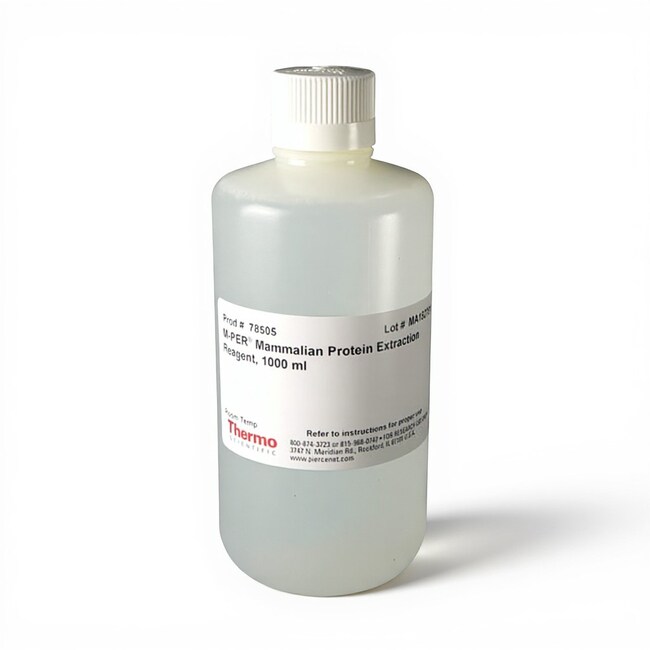
M-PER™ 哺乳动物蛋白提取试剂
Thermo Scientific M-PER哺乳动物蛋白质抽提试剂用于从培养的哺乳动物细胞中高效抽提总可溶性蛋白。M-PER哺乳动物蛋白抽提试剂的特点:• 作用温和— 温和的除垢剂裂解,产生的抽提物直接与考马斯(Bradford)和BCA蛋白定量分析试剂或SDS-PAGE兼容• 兼容性强— 抽提的可溶性蛋白处于非变性状态,可直接用于免疫沉淀反应和其他亲和纯化过程• 不含胺基并且可透析— 确保其与随后的分析系统兼容•了解更多信息
Have Questions?
更改视图

| 货号 | 数量 |
|---|---|
| 78505 | 1 L |
| 78501 | 250 mL |
| 78503 | 25 mL |
货号 78505
价格(CNY)
7,695.00
Each
数量:
1 L
价格(CNY)
7,695.00
Each
Thermo Scientific M-PER哺乳动物蛋白质抽提试剂用于从培养的哺乳动物细胞中高效抽提总可溶性蛋白。
M-PER哺乳动物蛋白抽提试剂的特点:
• 作用温和— 温和的除垢剂裂解,产生的抽提物直接与考马斯(Bradford)和BCA蛋白定量分析试剂或SDS-PAGE兼容
• 兼容性强— 抽提的可溶性蛋白处于非变性状态,可直接用于免疫沉淀反应和其他亲和纯化过程
• 不含胺基并且可透析— 确保其与随后的分析系统兼容
• 方便— 贴壁细胞直接在板上裂解或者在剥离和洗涤后悬浮于溶液中
• 非变性— 维持荧光素酶、β-半乳糖苷酶、CAT和其他报告基因的活性,与其他供应商的产品和冷冻/解冻方法一样好或更出色
这款完整的细胞裂解试剂是一种非变性除垢剂配方,可在短短5分钟内溶解细胞膜并抽提总可溶性细胞蛋白。M-PER试剂很少或根本不需要机械破碎,并且相比冷冻/解冻循环方法和超声波破碎方法可以获得更多的蛋白。这种哺乳动物细胞裂解试剂是如此有效,不需要从培养皿上剥离贴壁细胞,可以简单而直接地在生长细胞的24孔和96孔板上进行裂解和分析。最终无论是贴壁细胞还是悬浮细胞的裂解产物与很多下游分析都兼容,包括免疫分析、酶分析和各种常见的报告基因分析。
在任何蛋白质组学分析过程中,蛋白质抽提通常都是关键的第一步,首先细胞必须裂解,以便打开细胞并释放出感兴趣的蛋白质。常用的几种物理裂解细胞方法包括机械破坏、液体均质化、超声波裂解、冷冻/解冻循环和手工研磨。
相关资源:
细胞裂解和蛋白抽提综述
相关产品:
浏览所有细胞裂解及蛋白抽提试剂
蛋白酶和磷酸酶抑制剂混合物和片剂
M-PER哺乳动物蛋白抽提试剂的特点:
• 作用温和— 温和的除垢剂裂解,产生的抽提物直接与考马斯(Bradford)和BCA蛋白定量分析试剂或SDS-PAGE兼容
• 兼容性强— 抽提的可溶性蛋白处于非变性状态,可直接用于免疫沉淀反应和其他亲和纯化过程
• 不含胺基并且可透析— 确保其与随后的分析系统兼容
• 方便— 贴壁细胞直接在板上裂解或者在剥离和洗涤后悬浮于溶液中
• 非变性— 维持荧光素酶、β-半乳糖苷酶、CAT和其他报告基因的活性,与其他供应商的产品和冷冻/解冻方法一样好或更出色
这款完整的细胞裂解试剂是一种非变性除垢剂配方,可在短短5分钟内溶解细胞膜并抽提总可溶性细胞蛋白。M-PER试剂很少或根本不需要机械破碎,并且相比冷冻/解冻循环方法和超声波破碎方法可以获得更多的蛋白。这种哺乳动物细胞裂解试剂是如此有效,不需要从培养皿上剥离贴壁细胞,可以简单而直接地在生长细胞的24孔和96孔板上进行裂解和分析。最终无论是贴壁细胞还是悬浮细胞的裂解产物与很多下游分析都兼容,包括免疫分析、酶分析和各种常见的报告基因分析。
在任何蛋白质组学分析过程中,蛋白质抽提通常都是关键的第一步,首先细胞必须裂解,以便打开细胞并释放出感兴趣的蛋白质。常用的几种物理裂解细胞方法包括机械破坏、液体均质化、超声波裂解、冷冻/解冻循环和手工研磨。
相关资源:
细胞裂解和蛋白抽提综述
相关产品:
浏览所有细胞裂解及蛋白抽提试剂
蛋白酶和磷酸酶抑制剂混合物和片剂
仅供科研使用。不可用于诊断程序。
蛋白提取通常是任何蛋白质组学分析程序的第一个关键步骤,必须首先将细胞裂解以打开细胞并释放目标蛋白。通常使用各种方法自然地裂解细胞,包括机械破坏、液体均质化、超声处理、冻/融循环和人工研磨。
产品参考资料:
- López-Aranda, M.F.,et al.(2007).J.Cell Sci.120,2171-2178.
- Schilling, B.,et al.(2006).J.Biol.Chem.281,23686-23697.
- Singh, M.K.,et al.(2008).Mol.Biol.Cell 10,1091/mbc.E07-09-0953.
- Woeller, C.F.,et al.(2007).J.Biol.Chem.282,17623-17631.
规格
产品规格液体
数量1 L
容积(公制)1 L
产品线M-PER
产品类型蛋白提取试剂
Unit SizeEach
内容与储存
接收后将产品储存在室温下。
常见问题解答 (FAQ)
What are the standard lysis buffers used with mammalian cells for detection of protein expression by immunoprecipitation (IP) or Western blot analysis?
Is the M-PER Mammalian Protein Extraction Reagent (Cat. No. 78501, 78503, 78505) compatible with Mass spectrometry (MS)?
Can you provide the shelf-life for the M-PER Mammalian Protein Extraction Reagent?
Will M-PER Mammalian Protein Extraction Reagent extract membrane or cytoskeletal proteins?
When using the M-PER Mammalian Protein Extraction Reagent, is it necessary to remove cells from the plate? Should I use scraping or trypsinization to remove the cells from the plate?
引用和文献 (12)
引用和文献
Abstract
Aromatase promoter I.f is regulated by progesterone receptor in mouse hypothalamic neuronal cell lines.
Journal:J Mol Endocrinol
PubMed ID:21628418
'Aromatase catalyzes the conversion of C(19) steroids to estrogens. Aromatase and progesterone, both of which function at different steps of steroidogenesis, are crucial for the sexually dimorphic development of the fetal brain and the regulation of gonadotropin secretion and sexual interest in adults. The aromatase gene (Cyp19a1) is selectively expressed
Rab5 and class III phosphoinositide 3-kinase Vps34 are involved in hepatitis C virus NS4B-induced autophagy.
Journal:J Virol
PubMed ID:21835792
'Autophagy has been shown to facilitate replication or production of hepatitis C virus (HCV); nevertheless, how HCV induces autophagy remains unclear. Here, we demonstrate that HCV nonstructural protein 4B (NS4B) alone can induce autophagy signaling; amino acid residues 1 to 190 of NS4B are sufficient for this induction. Further studies
Dual-modality gene reporter for in vivo imaging.
Journal:
PubMed ID:24347640
'The ability to track cells and their patterns of gene expression in living organisms can increase our understanding of tissue development and disease. Gene reporters for bioluminescence, fluorescence, radionuclide, and magnetic resonance imaging (MRI) have been described but these suffer variously from limited depth penetration, spatial resolution, and sensitivity. We
Exploitation of conserved eukaryotic host cell farnesylation machinery by an F-box effector of Legionella pneumophila.
Journal:J Exp Med
PubMed ID:20660614
'Farnesylation involves covalent linkage of eukaryotic proteins to a lipid moiety to anchor them into membranes, which is essential for the biological function of Ras and other proteins. A large cadre of bacterial effectors is injected into host cells by intravacuolar pathogens through elaborate type III-VII translocation machineries, and many
Intestinal GUCY2C prevents TGF-ß secretion coordinating desmoplasia and hyperproliferation in colorectal cancer.
Journal:
PubMed ID:24085786
Tumorigenesis is a multistep process that reflects intimate reciprocal interactions between epithelia and underlying stroma. However, tumor-initiating mechanisms coordinating transformation of both epithelial and stromal components are not defined. In humans and mice, initiation of colorectal cancer is universally associated with loss of guanylin and uroguanylin, the endogenous ligands for