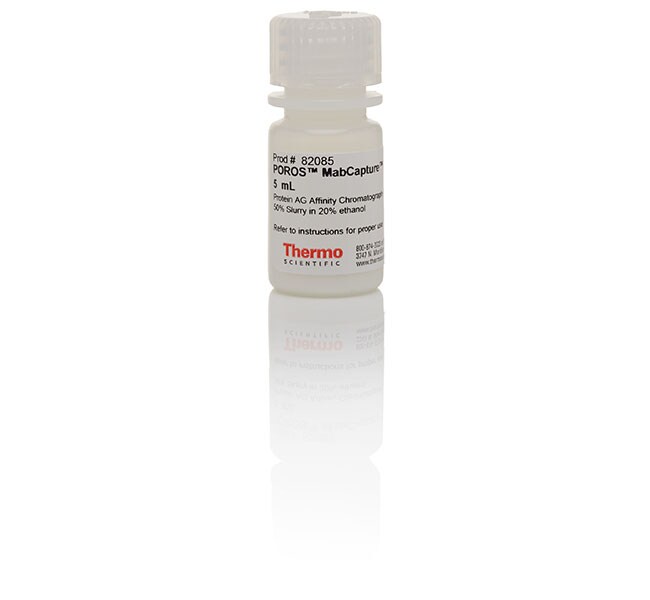
POROS™ MabCapture™ A/G Select 树脂
Thermo Scientific™

POROS™ MabCapture™ A/G Select 树脂

POROS™ MabCapture™ A/G Select Resin 是一款新型高通量蛋白 A/G 色谱树脂,其利用我们自己的蛋白 A/G 配体加工而成,以实现高通量纯化性能了解更多信息
Have Questions?
更改视图buttonViewtableView
货号数量
820855 mL
8208615 mL
8208750 mL
货号 82085
价格(CNY)
11,039.00
Each
添加至购物车
数量:
5 mL
请求批量或定制报价
价格(CNY)
11,039.00
Each
添加至购物车
POROS™ MabCapture™ A/G Select Resin 是一款新型高通量蛋白 A/G 色谱树脂,其利用我们自己的蛋白 A/G 配体加工而成,以实现高通量纯化性能。该树脂可在低线性流速下进行动态结合性能较高的抗体纯化,同时在其他色谱介质产品无法操作的高线性流速下仍能保持出色的结合容量。

POROS MabCapture A/G Select 树脂具备较通用的色谱功能组合,能够对多种哺乳动物血清样品全 IgG 进行高得率、高纯度的纯化。其可在低流速下进行动态结合性能较高的抗体纯化,同时在高线性流速下仍能保持出色的结合容量。

使用 POROS MabCapture A/G Select 亲和色谱树脂,您可以:
•在超过 700 cm/h 的线性流速下保持较高的动态结合容量
• 由于抗体结合效率得到提高,设计流程的灵活性更高(柱床高度更短、流速更快或两者兼有)
• 与基于传统琼脂糖或硅胶的蛋白 A 或蛋白 G 树脂相比,获得极高的抗体动态结合容量
• 从几乎任何哺乳动物物种中纯化多克隆 IgG
• 可使用用于其他色谱产品的标准试剂进行消毒和去热原处理
• 显著提高流程生产率并减少下游瓶颈

蛋白 A/G 是一种嵌合基因工程化蛋白,由蛋白 A 的五个 IgG 结合结构域和蛋白 G 的两个 IgG 结合结构域组合而成。蛋白 A/G 不像单独的蛋白 A 那样具有 pH 依赖性,但是具有蛋白 A 和蛋白 G 的累加特性。蛋白 A/G 可以结合血清、腹水、细胞培养物上清液和其他抗体样品中几乎所有同种型和哺乳动物物种的 IgG,从而可以有效地纯化抗体。

人源化单克隆抗体的发展持续促进生物治疗市场的增长。人们在设法满足单克隆抗体治疗需求的同时,极大地改进了用于生产这些蛋白质的基于细胞的表达系统。因此,这些改进已经使处理瓶颈从上游细胞表达进入下游纯化。POROS MabCapture A/G Select 色谱树脂能够为下游纯化平台提供改进所需的容量、效率和灵活性,同时显著提高处理生产率和抗体制备能力。

仅供科研使用。不可用于诊断程序。
规格
适用于(应用)IgG 纯化
产品规格Poros 微球
产品线POROS™
纯化目标IgG 抗体,Ig 抗体
数量5 mL
运输条件湿冰
标准组分蛋白 A/G
固定相蛋白 A/G
类型A/G Select 树脂
Unit SizeEach
内容与储存
冷藏储存 (2–8°C)。

常见问题解答 (FAQ)

Are POROS analytical columns compatible with HPLC systems from Waters or Agilent?

All of the pre-packed POROS columns, regardless of column size or resin, have the same 10-32 female fittings on the column. Columns are compatible with Waters and Agilent HPLC systems. You will need 1/16 inch male fittings for the HPLC to attach the column.

Find additional tips, troubleshooting help, and resources within our Protein Purification and Isolation Support Center.

For any POROS analytical column, is the column compatible with an AKTA or Avant purification system?

All of the pre-packed columns, regardless column size or resin, have the same 10-32 female fittings on the column. They are all compatible with the AKTA instrument platform, however due to the column volume of the 2.1 mmD x 30 mmL columns (0.1 mL), these will not perform well in AKTA or Avant purification systems due to the relative size of the hold- up volume in these systems. The smallest column (PEEK or SS) that could feasibly be used in these systems is the 4.6mmD x 50mmL (0.8 mL) format.

Find additional tips, troubleshooting help, and resources within our Protein Purification and Isolation Support Center.

What is the physical or mechanical stability of POROS resins?

The physical stability of POROS resins is high. Customers have agitated, with overhead mixing and or bottom gassing for long periods of time (5-10 hours) and have performed hundreds of diaphragm pump passes during stall packs. Keep in mind that agitation with any device that creates grinding and sheer, such as with a magnetic stir bar, is not recommended for any type of resin.

Find additional tips, troubleshooting help, and resources within our Protein Purification and Isolation Support Center.

What should I do if a POROS column dries out or air is pumped onto the column?

POROS resins rehydrate quite well. Here is the procedure that we recommend:

1. Flow 5% ethanol over the column at ?350 cm/hour for 3 CVs, followed by water or 0.1 M sodium chloride at 300 cm/hour for 3 CVs.
2. If baseline noise is still present, flow 20% ethanol over the column at 300 cm/hour for 3 CVs, followed by water or 0.1 M sodium chloride at 300 cm/hour for 3 CVs.
3. If you have established column qualification tests and specifications, perform the tests after rewetting.

Find additional tips, troubleshooting help, and resources within our Protein Purification and Isolation Support Center.

Can POROS resins be used to purify large biomolecules?

In general POROS resins have behaved better for large biomolecules such as viral particles, fusion proteins, and globular proteins, where shape (not size) matters due to its unique pore structure and large pore structure as compared to traditional resins. As the target molecule size increases, capacities obtained will decrease. The large pore structure of POROS resins, which allows for convective flow (and therefore enhanced diffusion) is especially well suited for the purification of large biomolecules. POROS resins offer the best blend of high capacity (associated with chromatography beads) and improved chromatography efficiency (typically associated with monoliths or membranes). The average pore size for POROS resins is 1,000-3,600 Angstrom (100-360 nm) depending on the base bead/chemistry being utilized. For example, the molecular weight of IgG is 150 kDa and the molecular radius is 55 Angstrom. The molecular weight of IgM is ~900 kDa (pentamer), and the molecular radius is 120 Angstrom. So both of these biomolecules can interact with the pore structure associated with POROS materials.

Find additional tips, troubleshooting help, and resources within our Protein Purification and Isolation Support Center.