Search

Thermo Scientific™
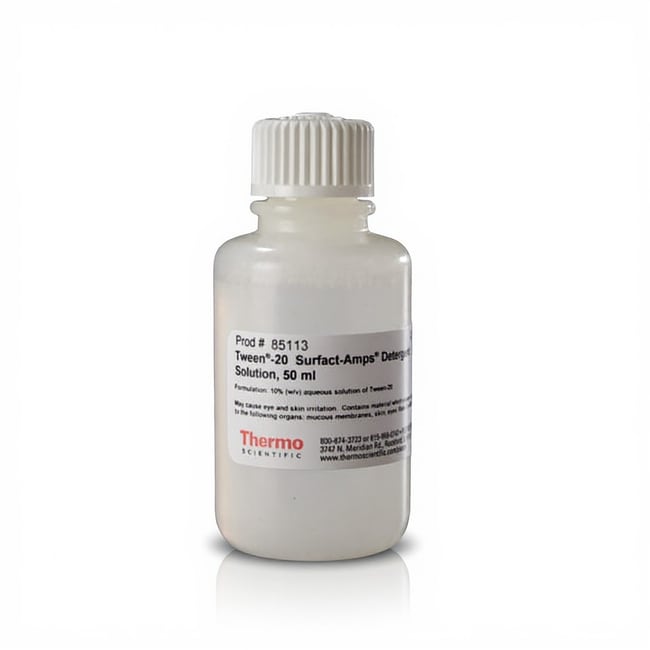
Tween™ 20 Surfact-Amps™ 去污剂溶液
Thermo Scientific Tween-20 Surfact-Amps 洗涤剂溶液是一种高度纯化的 Tween™ 20 洗涤剂,以 10% 溶液了解更多信息
Have Questions?
更改视图

| 货号 | 数量 |
|---|---|
| 85113 | 50 mL |
| 28320 | 6 x 10 mL |
| 85114 | 250 mL |
| 85115 | 500 mL |
| 28321 | 1 L |
货号 85113
价格(CNY)
1,298.00
飞享价
Ends: 31-Dec-2026
1,688.00共减 390.00 (23%)
Each
数量:
50 mL
价格(CNY)
1,298.00
飞享价
Ends: 31-Dec-2026
1,688.00共减 390.00 (23%)
Each
Thermo Scientific Tween-20 Surfact-Amps 洗涤剂溶液是一种高度纯化的 Tween™ 20 洗涤剂,以 10% 溶液 (w/v) 形式稳定,并包装在玻璃安瓿或非浸出 HDPE 瓶中的氮气下,确保其稳定性,并消除过氧化物和降解产物的积聚。
Tween-20 Surfact-Amps 洗涤剂溶液的特点:
•Tween 20—常用于 ELISA、蛋白质免疫印迹和其他免疫检测 PBS 或 TBS 洗涤缓冲液中的非离子洗涤剂
• 精确—溶于超纯水中的精确 10% 去污剂溶液
• 易于使用—溶液很容易分配和稀释以供使用
• 极纯—低于 1.0μeq/mL 过氧化物和碳酰基
• 稳定—包装在玻璃安瓿或 HDPE 瓶中的惰性氮气下
Tween 20 的属性:
• 分子量:1228g
• 去污剂等级:非离子聚环氧乙烷表面活性剂
• 积聚数量:未知
• 胶束分子量:未知
• 临界胶束浓度 (CMC):0.06 mM(0.0074%,w/v)
• 浊点:95°C
• 可透析:否
Tween 20 Surfact-Amps 去污剂溶液的规格:
• 外观:透明、浅黄色液体,不含微粒。
• 浓度:10.0±1.0%
• 氧化剂:≤1.0μ eq/mL
• 羰基:≤1.0μ eq/mL
• 悬浮固体:存在的残余物含量不得超过残余物参考值。
相关产品
Surfact-Amps™ 去污剂采样器
Tween-20 Surfact-Amps 洗涤剂溶液的特点:
•Tween 20—常用于 ELISA、蛋白质免疫印迹和其他免疫检测 PBS 或 TBS 洗涤缓冲液中的非离子洗涤剂
• 精确—溶于超纯水中的精确 10% 去污剂溶液
• 易于使用—溶液很容易分配和稀释以供使用
• 极纯—低于 1.0μeq/mL 过氧化物和碳酰基
• 稳定—包装在玻璃安瓿或 HDPE 瓶中的惰性氮气下
Tween 20 的属性:
• 分子量:1228g
• 去污剂等级:非离子聚环氧乙烷表面活性剂
• 积聚数量:未知
• 胶束分子量:未知
• 临界胶束浓度 (CMC):0.06 mM(0.0074%,w/v)
• 浊点:95°C
• 可透析:否
Tween 20 Surfact-Amps 去污剂溶液的规格:
• 外观:透明、浅黄色液体,不含微粒。
• 浓度:10.0±1.0%
• 氧化剂:≤1.0μ eq/mL
• 羰基:≤1.0μ eq/mL
• 悬浮固体:存在的残余物含量不得超过残余物参考值。
相关产品
Surfact-Amps™ 去污剂采样器
仅供科研使用。不可用于诊断程序。
规格
数量50 mL
试剂类型去污剂溶液
形式液体
产品线Surfact-Amps,吐温, Tween
产品类型去垢剂
Unit SizeEach
内容与储存
储存在阴凉、干燥且通风良好的区域