Search

Thermo Scientific™
Slide-A-Lyzer™ 透析瓶
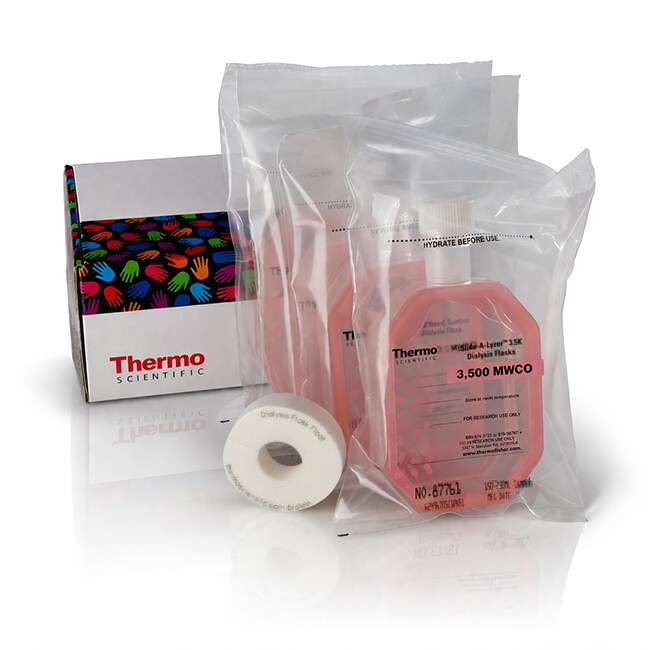
有助于在样品量多达 250 mL 的情况下从蛋白或大分子中去除盐和小污染物。每个 Slide-A-Lyzer 透析瓶都配有浮选盘,当其与瓶颈相连时,可使透析瓶竖直浮起以便简单、安全地处理。
Have Questions?
更改视图

| 货号 | 截留分子量 (MWCO) |
|---|---|
| 87761 | 3.5 kDa |
| 87760 | 2.0 kDa |
| 87762 | 10 kDa |
| 87763 | 20 kDa |
货号 87761
价格(CNY)
4,435.00
Each
截留分子量 (MWCO):
3.5 kDa
价格(CNY)
4,435.00
Each
Slide-A-Lyzer 透析瓶(2K、3.5K、10K 或 20K MWCO)有助于在样品量多达 250 mL 的情况下轻松、高效地去除缓冲盐和小污染物。易于使用:通过透析瓶顶部的螺旋盖广口,使用血清移液管或者通过直接倾倒的方式添加和移除样品。无需使用绳结或夹子密封设备。Slide-A-Lyzer 透析瓶是在洁净室条件下加工而成,它使用低蛋白结合率再生纤维素膜,可最大限度地提高样品回收率和纯度。
透析瓶有不同的颜色,对应于不同的透析膜孔径 (MWCO):紫色(20,000道尔顿)、橙色(10,000道尔顿)、粉色(3,500道尔顿)和蓝色(2,000道尔顿)。
Slide-A-Lyzer 透析瓶由两张低结合力再生纤维素透析膜构成,这些膜紧密封贴到惰性塑料瓶身的两侧。膜和瓶材料与大多数实验室缓冲液相容。
Slide-A-Lyzer 透析瓶的特点:
• 易于使用 — 只需用移液管将样品加入瓶中或直接倒入瓶中,即可开始透析
• 快速透析 — 透析瓶内室扁平,带两张透析膜,因而具有较高的表面积与体积比,可在8小时到一夜时间内透析 250 mL 样品
• 高回收率 — 矩形瓶设计通过瓶顶部开口极大程度地提高整个样品量的回收率
• 多种截留分子量 — 选择最适合样品分子量的膜 MWCO
透析膜规格:
• 成分:再生纤维素
• 厚度:0.9–1.2 mil (22.5-30 μm);2K MWCO = 2 mil (50 μm)
• 使用前需要的水合时间:2分钟
• 甘油含量:微量(10K MWCO 含量是 21%)
• 硫含量:0.04–0.17%
• 重金属含量:微量
使用 Slide-A-Lyzer 透析瓶,可以在8小时到一夜时间内完成典型的低分子量污染物去除、缓冲液置换和脱盐。透析速率取决于多种因素,其中包括样品量、所透析的分子大小和形状、搅拌以及温度。对于每个特定的系统,必须根据经验确定最短透析时间。
Slide-A-Lyzer 透析瓶由两张低结合力再生纤维素透析膜构成,这些膜紧密封贴到惰性塑料瓶身的两侧。膜和瓶材料与大多数实验室缓冲液相容。
Slide-A-Lyzer 透析瓶的特点:
• 易于使用 — 只需用移液管将样品加入瓶中或直接倒入瓶中,即可开始透析
• 快速透析 — 透析瓶内室扁平,带两张透析膜,因而具有较高的表面积与体积比,可在8小时到一夜时间内透析 250 mL 样品
• 高回收率 — 矩形瓶设计通过瓶顶部开口极大程度地提高整个样品量的回收率
• 多种截留分子量 — 选择最适合样品分子量的膜 MWCO
透析膜规格:
• 成分:再生纤维素
• 厚度:0.9–1.2 mil (22.5-30 μm);2K MWCO = 2 mil (50 μm)
• 使用前需要的水合时间:2分钟
• 甘油含量:微量(10K MWCO 含量是 21%)
• 硫含量:0.04–0.17%
• 重金属含量:微量
使用 Slide-A-Lyzer 透析瓶,可以在8小时到一夜时间内完成典型的低分子量污染物去除、缓冲液置换和脱盐。透析速率取决于多种因素,其中包括样品量、所透析的分子大小和形状、搅拌以及温度。对于每个特定的系统,必须根据经验确定最短透析时间。
For Research Use Only. Not for use in diagnostic procedures.
规格
膜纤维素膜,透析
产品线Slide-A-Lyzer
产品类型Dialysis Flasks
纯化目标缓冲液置换,蛋白质
数量4个烧瓶
产品规格细胞培养瓶 (T75)
截留分子量 (MWCO)3.5 kDa
样品体积(公制)250 mL
Unit SizeEach
内容与储存
在环境温度运输。收到后,请在室温下储存。