Search


引用和文献 (3)
Thermo Scientific™
去污剂去除离心柱与板
使用去污剂去除树脂可快速去除高浓度去污剂且样品损失极少。建议将 Thermo Scientific HiPPR(高蛋白和肽回收率)树脂用于浓度不超过 100 μg/mL 的蛋白,而 Thermo Scientific Pierce 树脂则适用于高于 100 μg/mL 的浓度。
Have Questions?
更改视图

| 货号 | 数量 | 产品线 | 产品类型 |
|---|---|---|---|
| 87780 | 10 mL | Pierce | 树脂 |
| 87776 | 25 x 125 μL 色谱柱 | Pierce | 离心柱 |
| 87777 | 25 x 500 μL 色谱柱 | Pierce | 离心柱 |
| 87778 | 5 x 2 mL 色谱柱 | Pierce | 离心柱 |
| 87779 | 5 x 4 mL 色谱柱 | Pierce | 离心柱 |
| 88304 | 2 个 96 孔板 | Pierce | 离心板 |
| 88305 | 5 mL | HiPPR | 去污剂去除试剂盒 |
| 88306 | 24 x 0.1 mL 色谱柱 | HiPPR | 离心柱 |
| 88307 | 2 个 96 孔板 | HiPPR | 离心板 |
货号 87780
价格(CNY)
4,649.00
飞享价
Ends: 31-Dec-2026
5,738.00共减 1,089.00 (19%)
Each
数量:
10 mL
产品线:
Pierce
产品类型:
树脂
价格(CNY)
4,649.00
飞享价
Ends: 31-Dec-2026
5,738.00共减 1,089.00 (19%)
Each
用于制备蛋白和肽样品的去污剂和表面活性剂可能干扰 ELISA、等电聚焦和质谱法 (MS) 分析。对于 MS 分析,去除肽样品中的去污剂尤其具有挑战性且至关重要。即使低浓度的去污剂也会污染仪器并干扰柱结合、洗脱和肽电离。Thermo Scientific HiPPR 和 Pierce 去污剂去除树脂适用于从胰蛋白酶酶切物中快速去除常见的去污剂,改善 LC-MS/MS 和 MALDI 分析的结果。
• 经优化 — 去除蛋白或肽样品中 >95% 的去污剂
• 快速 — 样品处理所需时间不到15分钟
• 有效 — 在 ELISA、等电聚焦和质谱分析等下游应用中消除去污剂干扰
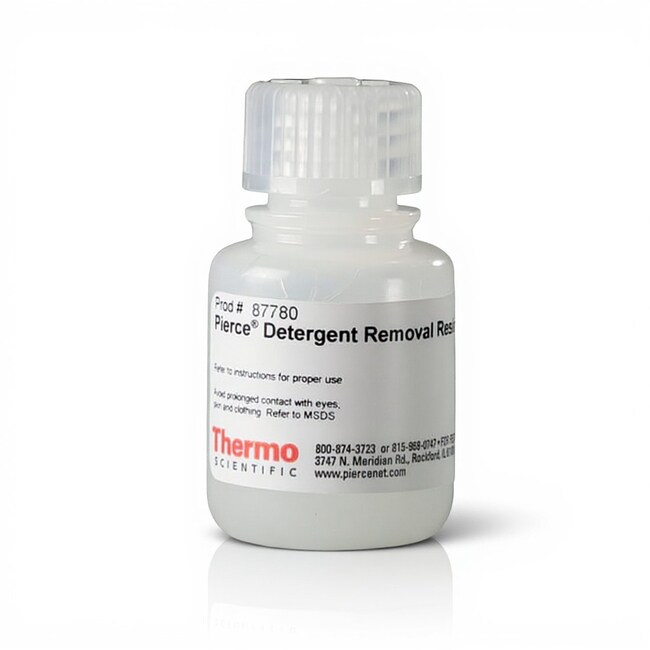
Pierce 去污剂去除树脂
Pierce 去污剂去除树脂可高效结合并去除 10 µL 至 1 mL 样品中的高浓度去污剂且样品损失极少。这些微量离心柱预装了不同体积的专有树脂,非常适合处理蛋白或肽浓度高于 100 µg/mL 的样品。
HiPPR 去污剂去除离心柱试剂盒
HiPPR 去污剂去除树脂已针对 1-100 µg/mL 的样品浓度进行优化,特别适合去除常用去污剂,包括浓度为 0.5-1% 的 SDS、Triton™ X-100、NP-40 和 CHAPS。树脂以预装离心柱、96孔过滤离心板和散装树脂(便于定制)形式提供。
可选规格:
• 树脂浆—散装树脂随 0.8 mL 空离心柱提供
• 离心柱—0.1 mL 微量离心柱
• 96孔离心板—预分配的96孔过滤板,与离心和真空歧管系统兼容,用于手动或自动纯化
• 快速 — 样品处理所需时间不到15分钟
• 有效 — 在 ELISA、等电聚焦和质谱分析等下游应用中消除去污剂干扰
Pierce 去污剂去除树脂
Pierce 去污剂去除树脂可高效结合并去除 10 µL 至 1 mL 样品中的高浓度去污剂且样品损失极少。这些微量离心柱预装了不同体积的专有树脂,非常适合处理蛋白或肽浓度高于 100 µg/mL 的样品。
HiPPR 去污剂去除离心柱试剂盒
HiPPR 去污剂去除树脂已针对 1-100 µg/mL 的样品浓度进行优化,特别适合去除常用去污剂,包括浓度为 0.5-1% 的 SDS、Triton™ X-100、NP-40 和 CHAPS。树脂以预装离心柱、96孔过滤离心板和散装树脂(便于定制)形式提供。
可选规格:
• 树脂浆—散装树脂随 0.8 mL 空离心柱提供
• 离心柱—0.1 mL 微量离心柱
• 96孔离心板—预分配的96孔过滤板,与离心和真空歧管系统兼容,用于手动或自动纯化
For Research Use Only. Not for use in diagnostic procedures.
规格
色谱柱类型具有专利技术的树脂、亲和性
描述瓶装
产品规格Bottle
纯化目标去污剂去除
数量10 mL
固定相具有专利技术的配体
足够用于1-2.5 mL 典型的含去污剂样品
形式Liquid
产品线Pierce
产品类型树脂
Unit SizeEach
内容与储存
接收后,储存在 4°C 下。将树脂储存于含 0.15 M NaCl 的 0.05% 叠氮化钠溶液中。
常见问题解答 (FAQ)
I still have detergent present in my sample after protein digestion. Is there anything I can do?
What is the best way to remove detergents from my sample for mass spectrometry analysis?
引用和文献 (3)
引用和文献
Abstract
Evaluation of the tert-butyl group as a probe for NMR studies of macromolecular complexes
Journal:J Biomol NMR
PubMed ID:34505210
The development of methyl transverse relaxation optimized spectroscopy has greatly facilitated the study of macromolecular assemblies by solution NMR spectroscopy. However, limited sample solubility and stability has hindered application of this technique to ongoing studies of complexes formed on membranes by the neuronal SNAREs that mediate neurotransmitter release and synaptotagmin-1,
BPP43_05035 is a Brachyspira pilosicoli cell surface adhesin that weakens the integrity of the epithelial barrier during infection.
Journal:Gut microbes
PubMed ID:39349383
The anaerobic spirochete Brachyspira causes intestinal spirochetosis, characterized by the intimate attachment of bacterial cells to the colonic mucosa, potentially leading to symptoms such as diarrhea, abdominal pain, and weight loss. Despite the clinical significance of Brachyspira infections, the mechanism of the interaction between Brachyspira and the colon epithelium is
Effects of GDF6 on active protein synthesis by cells of degenerated intervertebral disc.
Journal:European spine journal : official publication of the European Spine Society, the European Spinal Deformity Society, and the European Section of the Cervical Spine Research Society
PubMed ID:39920317
INTRODUCTION: Intervertebral disc degeneration (IVD) is a leading cause of low back pain, a prevalent musculoskeletal condition. IVD degeneration is characterized by the degradation of nucleus pulposus (NP), annulus fibrosus (AF), and cartilage endplates (EP). Growth Differentiation Factor 6 (GDF6), part of the bone morphogenetic protein family, has demonstrated potential