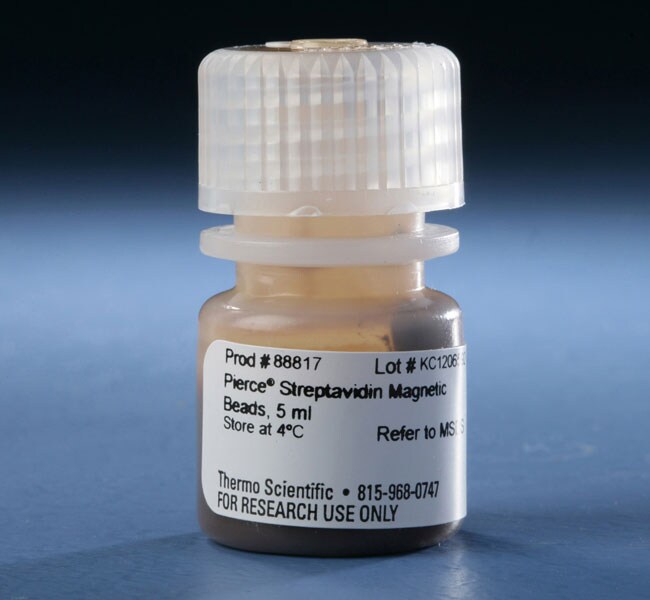
Pierce™ 链霉素亲和素包被磁珠
Invitrogen17万+抗体限时买二赠一,靶点广,灵活用!
Pierce™ 链霉素亲和素包被磁珠
Thermo Scientific™

Pierce™ 链霉素亲和素包被磁珠

Thermo Scientific Pierce链霉亲和素磁珠可提高生物素化分子的自动化磁性纯化效率。链霉亲和素磁珠的特点:• 高性能—无聚集、预封闭的超顺磁氧化铁微粒可为自动化高通量处理和手动操作提供超乎寻常的一致性• 稳定的交联技术—通过抗漏交联技术对链霉亲和素进行固化处理• 高结合能力—具有高结合能力,可对复杂样品中的生物分子快速进行高效纯化• 低非特异性结合—稳定的预封闭磁珠,可获得高纯度的产物(例如IP实验中使用生物素化抗体洗脱的抗原了解更多信息
Have Questions?
更改视图buttonViewtableView
货号数量
888175 mL
888161 mL
货号 88817
价格(CNY)
19,093.00
Each
添加至购物车
数量:
5 mL
请求批量或定制报价
价格(CNY)
19,093.00
Each
添加至购物车
Thermo Scientific Pierce链霉亲和素磁珠可提高生物素化分子的自动化磁性纯化效率。

链霉亲和素磁珠的特点:

高性能—无聚集、预封闭的超顺磁氧化铁微粒可为自动化高通量处理和手动操作提供超乎寻常的一致性
稳定的交联技术—通过抗漏交联技术对链霉亲和素进行固化处理
高结合能力—具有高结合能力,可对复杂样品中的生物分子快速进行高效纯化
低非特异性结合—稳定的预封闭磁珠,可获得高纯度的产物(例如IP实验中使用生物素化抗体洗脱的抗原),适用于质谱分析和其他下游分析应用
优异性能—结合能力是其他品牌磁珠产品的三倍左右,单次实验用量更低

应用:
• 使用生物素化抗体对多种来源的抗原进行免疫沉淀
• 使用生物素化抗体对互作复合物进行免疫沉淀
• 使用生物素化“诱饵”蛋白在Pull-Down实验中捕获蛋白互作物
• 从细胞或组织提取物中分离生物素标记的DNA-蛋白质复合物
• 捕获单链生物素化DNA寡核苷酸
• 分离生物素化PCR产物

Pierce链霉亲和素磁珠经过验证及优化,可用于高通量磁性平台,例如Thermo Scientific KingFisher 96及KingFisher Flex仪器等,另外还可使用合适的磁力架为简单的实验室手动操作提供更出色的性能。这种超顺磁氧化铁微粒比其他品牌的磁珠性能更出色(高结合能力及低非特异性结合)。

Pierce链霉亲和素磁珠使用了一种重组链霉亲和素,质量为53kDa,等电点(pI)接近中性。蛋白质是一种拥有4个生物素结合位点的四聚物。与亲和素不同,链霉亲和素不含糖基,因此,非特异性结合率非常低。链霉亲和素与生物素之间的高亲和结合只有在非常严苛的条件下才会被破坏,例如在SDS-PAGE上样缓冲液中,或者pH 1.5的8M的胍·HCl中煮沸。因此,通常在洗脱互作复合物中的捕获蛋白时,不会同时洗脱生物素化诱饵蛋白。

相关资源:
蛋白质组自动磁性分离综述(含选择指南)

相关产品:
其他Pierce磁珠

仅供科研使用。不可用于诊断程序。
规格
最大浓度Slurry: 10 mg/mL, 1% solids
配基类型链霉亲和素
蛋白质形式重组
数量5 mL
靶标生物素
容量(公制)5 mL
形式液体
粒径1 μm
产品线Pierce™
类型磁珠
Unit SizeEach
内容与储存
接收后,储存在 4°C 下。产品置于冰袋上运输。

常见问题解答 (FAQ)

Will the streptavidin-biotin bond be stable in ammonium carbonate buffer at 56 degrees C?

The streptavidin-biotin interaction is the strongest known non-covalent biological interaction between a protein and a ligand. Binding of biotin and streptavidin is very rapid and, once formed, the complex is unaffected by wide extremes of pH, temperature, organic solvents, and other denaturing agents. Normally, very harsh methods are required to dissociate the biotin from streptavidin, which will be irreversibly denatured by the procedure.

To dissociate biotinylated proteins from streptavidin, boil the beads in 0.1% SDS or SDS-PAGE buffer for 3 mins or incubate them in 8 M guanidinium hydrochloride, pH 1.5.

Find additional tips, troubleshooting help, and resources within our Protein Assays and Analysis Support Center.

I have a dsDNA biotinylated on streptavidin Dynabeads. How can I dissociate the non-biotinylated DNA strand from the biotinylated one?

There are two methods to dissociate the non-biotinylated DNA from the biotinylated DNA strand. The following protocols are based on using 20 µL of Dynabeads Streptavidin, but are scalable. Both methods may release very small amounts of complementary biotinylated strand from streptavidin. If it is critical that no biotinylated strand is released, either adopt a different biotin modification using dual biotin (two biotin groups in sequence) or covalently bind DNA to e.g., Dynabeads M-270 Carboxylic Acid.

Using heat:

- Wash the DNA coated Dynabeads in 50 µL 1 x SSC.*
- Resuspend the beads in another 50 µL of 1 x SSC Incubate at 95 degrees C for 5 mins.
- Quickly put the tube in magnet stand for 1-2 mins and transfer the supernatant to a new tube.
- The supernatant contains your non-biotinylated DNA strand.

Using NaOH:

- Wash the DNA coated Dynabeads in 50 µL 1 x SSC.*
- Resuspend the beads in 20 µl of freshly prepared 0.15 M NaOH.
- Incubate at room temperature for 10 mins. Put the tube in magnet stand for 1-2 mins and transfer the supernatant to a new tube.
- The supernatant contains your non-biotinylated DNA strand. Neutralize the probe by adding 2.2 µL 10 x TE, pH 7.5 and 1.3 µL 1.25 M acetic acid.

Wash the Dynabeads coated with biotinylated strand once with 50 µL 0.1M NaOH, once with 50 µL of B&W buffer and once with 50 µL TE buffer.

*1 x SSC (0.15 M NaCl, 0.015 M sodium citrate. Dissolve the reagents in 800 mL water. Adjust pH to 7.0 with NaOH. Adjust the volume to 1 liter with water).

Find additional tips, troubleshooting help, and resources within our Dynabeads Nucleic Acid Purification Support Center.

How do I measure the binding of biotinylated molecules on streptavidin Dynabeads?

Assay the supernatant for unbound molecules. This will determine the amount of molecule bound to the Dynabeads. For nucleic acids, the concentration can be checked by OD readings, or by running a gel. For proteins, the concentration in the supernatant can be determined by a spectrometer using a protein assay like BCA. Alternatively, you can label the molecule with radioactivity or fluorescence and measure the concentration of molecule directly on the beads (former) or in the supernatant (latter).

Find additional tips, troubleshooting help, and resources within our Dynabeads Nucleic Acid Purification Support Center.

How many biotin binding-sites are there per streptavidin molecule?

Streptavidin is a protein composed of four identical subunits, each containing a high affinity binding site for biotin (K-D = 10 -15 M) . Streptavidin has the same biotin binding properties as avidin, but it has a low isoelectric point (pI=5) and no carbohydrate groups, resulting in low non-specific binding.

Find additional tips, troubleshooting help, and resources within our Protein Assays and Analysis Support Center.

Is the streptavidin protein in Pierce Streptavidin Magnetic Beads His-tagged?

The streptavidin in Pierce Streptavidin Magnetic Beads is not His-tagged.

Find additional tips, troubleshooting help, and resources within our Protein Purification and Isolation Support Center.