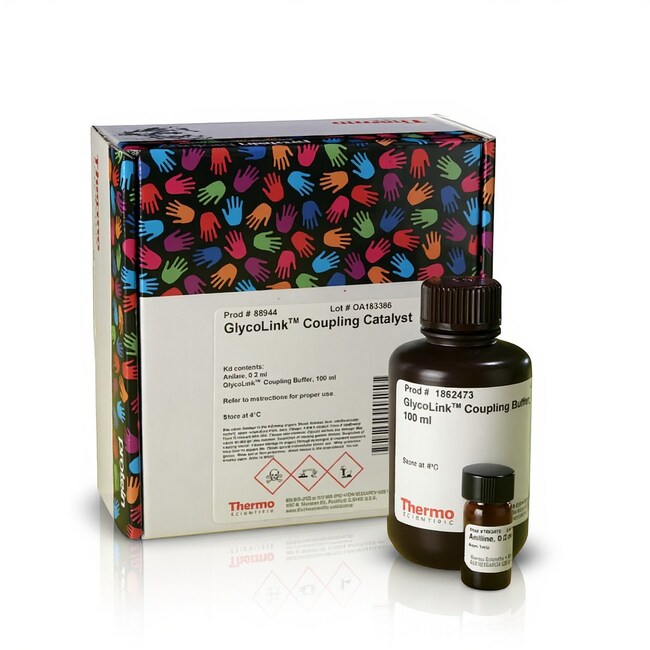
GlycoLink™ Coupling Catalyst
Thermo Scientific™

GlycoLink™ Coupling Catalyst

The Thermo Scientific GlycoLink Coupling Catalyst decreases reaction times and increases aldehyde-hydrazide coupling efficiency, resulting in greater than 90% couplingRead more
Have Questions?
Catalog NumberQuantity
88944100 mL
Catalog number 88944
Price (CNY)
934.00
Each
Add to cart
Quantity:
100 mL
Request bulk or custom format
Price (CNY)
934.00
Each
Add to cart
The Thermo Scientific GlycoLink Coupling Catalyst decreases reaction times and increases aldehyde-hydrazide coupling efficiency, resulting in greater than 90% coupling of glycoproteins in 4 hours.

Features of the GlycoLink Coupling Catalyst:

Optimized—catalyzes aldehyde-hydrazide and aldehyde-alkoxyamine conjugation reaction
Efficient—maximizes coupling efficiency and decreases required coupling reaction incubation time
Gentle—does not interfere with protein function and is easily removed by desalting or dialysis

The GlycoLink Coupling Catalyst is a two component kit composed of aniline and sodium acetate buffer. The catalyst accelerates the coupling rate of hydrazide and alkoxyamine moieties with reactive aldehydes that have been generated by periodate-oxidation of cis-diols in glycoproteins. The GlycoLink Coupling Catalyst increases the coupling efficiency of these reactions, decreasing the molar excess amounts of labeling reagents that are required for conjugation reactions. The catalyst is also useful for increasing the binding efficiency of oxidized glycoproteins or other carbohydrate-containing molecules to hydrazide resins.

Applications
• Labeling aldehyde-containing molecules with alkoxyamine-biotins
• Labeling aldehyde-containing molecules with hydrazide-biotins
• Increase coupling efficiency of aldehyde-containing molecules to hydrazide resin

Producing reactive aldehydes via sodium meta-periodate oxidation of cis-diols in glycoproteins is a useful technique for variety of protein labeling and detection methods. The GlycoLink Coupling Catalyst (aniline) increases the efficiency of these reactions by acting as a nucleophilic catalyst that accelerates bond formation through a Schiff base intermediate. The catalyst also reduces the amount (molar excess) of hydrazide or alkoxyamine required in labeling reactions, thereby eliminating the need for DMSO to solubilize high concentrations of labeling reagent.

More Product Data
Improved immobilization and conjugation of glycoproteins
For Research Use Only. Not for use in diagnostic procedures.
Specifications
FormLiquid
Product LineGlycoLink™
Quantity100 mL
Product TypeCoupling Catalyst
Unit SizeEach
Contents & Storage
Store at 4°C.

Frequently asked questions (FAQs)

What is the difference between GlycoLink and CarboxyLink Gels?

GlycoLink gel is hydrazide-activated crosslinked beaded agarose, and it is useful for coupling glycoproteins via aldehydes formed from their sugars by sodium meta-periodate oxidation. Reaction of aldehydes with hydrazide- activated resin is catalyzed by aniline resulting in >90% coupling in 4 hours or less. CarboxyLink gel on the other hand is crosslinked beaded agarose activated with diaminodipropylamine (DADPA) and is useful for immobilizing carboxyl- containing biomolecules after EDC activation. Actually, both resins can be used with EDC to couple ligands via carboxylic acids.

Note: Both immobilization chemistries are available on UltraLink Support as UltraLink Hydrazide and UltraLink DADPA respectively.

Find additional tips, troubleshooting help, and resources within our Protein Purification and Isolation Support Center.

Will Glycolink Gel work with chicken IgY?

Yes, Chicken IgY can be immobilized using GlycoLink Gel, due to the high level of glycosylation of the IgY.

Find additional tips, troubleshooting help, and resources within our Protein Purification and Isolation Support Center.

Will GlycoLink Gel work well for conjugating all types of antibodies?

No. Monoclonal antibodies are typically under-glycosylated, and coupling efficiency to CarboLink Gel may be low. However, many monoclonal antibodies can be immobilized using GlycoLink Gel. Try the Pierce Glycoprotein Carbohydrate Estimation Kit (Cat. No. 23260) to determine if your monoclonal antibody is glycosylated.

Find additional tips, troubleshooting help, and resources within our Protein Purification and Isolation Support Center.

What are the benefits of using a GlycoLink Coupling Resin?

The benefits include high-capacity immobilization of 1-10 mg of oxidized antibody or other glycoprotein per milliliter of resin. Immobilization is fast (in as few as 30 mins) and can achieve at least 90% coupling of most glycoproteins in less than 4 hours. The hydrazide-activated UltraLink resin conjugates only to purified glycoproteins whose sugar groups have been gently oxidized with periodate.

No stabilization step is required when using this resin, and antibody function is preserved as IgGs are immobilized via the Fc region, keeping both antigen binding sites available for capturing targets.

Find additional tips, troubleshooting help, and resources within our Protein Purification and Isolation Support Center.