Search


引用和文献 (4)
Thermo Scientific™
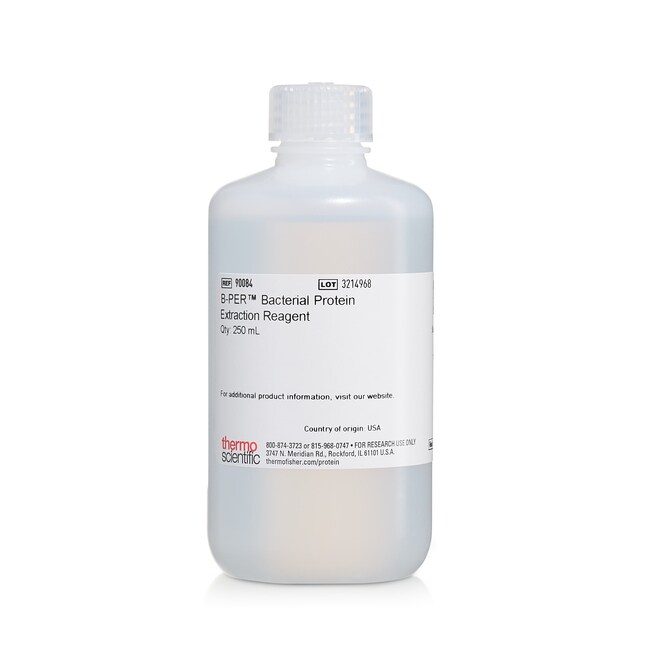
B-PER™ 细菌蛋白提取试剂
Thermo Scientific B-PER 试剂(溶于磷酸盐缓冲液中)是一种易于使用的细胞裂解试剂,作为一种含非离子去污剂的溶液,可有效破坏细胞并溶解天然或重组蛋白而不会变性。所有 B-PER 试剂与下游应用兼容,包括亲和色谱法(例如固定金属亲和色谱法了解更多信息
Have Questions?
更改视图

| 货号 | 数量 |
|---|---|
| 90084 | 250 mL |
| 78243 | 165 mL |
| 78248 | 500 mL |
货号 90084
价格(CNY)
3,906.00
Each
数量:
250 mL
价格(CNY)
3,906.00
Each
Thermo Scientific B-PER 试剂(溶于磷酸盐缓冲液中)是一种易于使用的细胞裂解试剂,作为一种含非离子去污剂的溶液,可有效破坏细胞并溶解天然或重组蛋白而不会变性。所有 B-PER 试剂与下游应用兼容,包括亲和色谱法(例如固定金属亲和色谱法、谷胱甘肽色谱法)、SDS-PAGE 和蛋白定量(例如 Pierce BCA 蛋白测定、Pierce 660nm 蛋白测定)。根据具体的应用,可以在试剂中添加蛋白酶抑制剂、盐、还原剂、变性剂和螯合剂。
B-PER 细菌蛋白提取试剂的特点:
•去污剂溶于磷酸钠缓冲液;无酶组分
•不含胺的配方,可与标记和交联反应直接兼容
所有 Thermo Scientific B-PER 蛋白提取试剂均具有以下特点:
•即用型—在 Tris 或磷酸盐缓冲液配方中使用温和的非离子去污剂(专有)对革兰氏阳性和革兰氏阴性细菌的一步法细胞裂解
• 快速且简便—只需将 B-PER 试剂加入细菌小球,通过混合 10 至 15 分钟进行孵育并在粒化细胞碎片后回收各种可溶蛋白
• 便利 – B-PER 全套试剂在储存于 4°C 条件下的单一配方中包含溶菌酶和通用核酸酶
• 出色的产量—从细菌裂解物中回收重组蛋白或将包涵体纯化到接近均匀的水平
• 灵活—B-PER 试剂适用于任何比例的蛋白提取并以含有或不含酶的磷酸盐和 1X 和 2X Tris 配方形式提供
• 可兼容—完全可与添加蛋白酶抑制剂兼容,所获得的蛋白提取物可被用于蛋白测定、各种常见的亲和纯化方法(如 GST、6xHis)和其他应用
便利的即用型配方
B-PER 细菌提取试剂比传统超声波降解法和各种常见的自制裂解缓冲液效率更高,很多这类缓冲液含去污剂和可与下游应用产生干扰的组分。B-PER 试剂在生理 pH 条件下的 Tris 或磷酸盐缓冲液中配制。它们可提取天然和可溶重组蛋白并产生裂解物,可直接与大多数下游工作流程(如电泳、亲和纯化、免疫沉淀、蛋白相互作用分析、交联和蛋白标记)兼容。
更多产品数据
•改进的一体式 B-PER 试剂,可用于细菌蛋白提取
相关产品
B-PER™ 细菌蛋白提取试剂
B-PER™ 完整细菌蛋白提取试剂
B-PER™ II 细菌蛋白提取试剂 (2X)
B-PER 细菌蛋白提取试剂的特点:
•去污剂溶于磷酸钠缓冲液;无酶组分
•不含胺的配方,可与标记和交联反应直接兼容
所有 Thermo Scientific B-PER 蛋白提取试剂均具有以下特点:
•即用型—在 Tris 或磷酸盐缓冲液配方中使用温和的非离子去污剂(专有)对革兰氏阳性和革兰氏阴性细菌的一步法细胞裂解
• 快速且简便—只需将 B-PER 试剂加入细菌小球,通过混合 10 至 15 分钟进行孵育并在粒化细胞碎片后回收各种可溶蛋白
• 便利 – B-PER 全套试剂在储存于 4°C 条件下的单一配方中包含溶菌酶和通用核酸酶
• 出色的产量—从细菌裂解物中回收重组蛋白或将包涵体纯化到接近均匀的水平
• 灵活—B-PER 试剂适用于任何比例的蛋白提取并以含有或不含酶的磷酸盐和 1X 和 2X Tris 配方形式提供
• 可兼容—完全可与添加蛋白酶抑制剂兼容,所获得的蛋白提取物可被用于蛋白测定、各种常见的亲和纯化方法(如 GST、6xHis)和其他应用
便利的即用型配方
B-PER 细菌提取试剂比传统超声波降解法和各种常见的自制裂解缓冲液效率更高,很多这类缓冲液含去污剂和可与下游应用产生干扰的组分。B-PER 试剂在生理 pH 条件下的 Tris 或磷酸盐缓冲液中配制。它们可提取天然和可溶重组蛋白并产生裂解物,可直接与大多数下游工作流程(如电泳、亲和纯化、免疫沉淀、蛋白相互作用分析、交联和蛋白标记)兼容。
更多产品数据
•改进的一体式 B-PER 试剂,可用于细菌蛋白提取
相关产品
B-PER™ 细菌蛋白提取试剂
B-PER™ 完整细菌蛋白提取试剂
B-PER™ II 细菌蛋白提取试剂 (2X)
仅供科研使用。不可用于诊断程序。
规格
描述B-PER 细菌蛋白提取试剂
数量250 mL
容积(公制)250 mL
产品线B-PER
产品类型细菌蛋白提取试剂
Unit SizeEach
内容与储存
B-PER 试剂可在环境温度下储存。在 -20°C 下储存溶菌酶和 DNaseI。
常见问题解答 (FAQ)
细菌无法用B-PER试剂裂解,这是什么原因所致?
What is the difference between B-PER and B-PER II Reagent?
What is the composition of B-PER Reagent?
What is the volume of B-PER Extraction Reagent to use per gram weight of wet cells?
Will my protein be in its native conformation after B-PER Reagent extraction?
引用和文献 (4)
引用和文献
Abstract
Evasion of Toll-like receptor 5 by flagellated bacteria.
Journal:Proc Natl Acad Sci U S A
PubMed ID:15956202
'Toll-like receptor 5 (TLR5) recognizes an evolutionarily conserved site on bacterial flagellin that is required for flagellar filament assembly and motility. The alpha and epsilon Proteobacteria, including the important human pathogens Campylobacter jejuni, Helicobacter pylori, and Bartonella bacilliformis, require flagellar motility to efficiently infect mammalian hosts. In this study, we
Metaproteomics: Evaluation of protein extraction from activated sludge.
Journal:
PubMed ID:25116144
Metaproteomic studies of full-scale activated sludge systems require reproducible protein extraction methods. A systematic evaluation of three different extractions protocols, each in combination with three different methods of cell lysis, and a commercial kit were evaluated. Criteria used for comparison of each method included the extracted protein concentration and the
Mutations of the gene encoding the protein kinase A type I-alpha regulatory subunit in patients with the Carney complex.
Journal:Nat Genet
PubMed ID:10973256
Carney complex (CNC) is a multiple neoplasia syndrome characterized by spotty skin pigmentation, cardiac and other myxomas, endocrine tumours and psammomatous melanotic schwannomas. CNC is inherited as an autosomal dominant trait and the genes responsible have been mapped to 2p16 and 17q22-24 (refs 6, 7). Because of its similarities to
Identification, expression, and substrate specificity of a mammalian beta-carotene 15,15'-dioxygenase.
Journal:J Biol Chem
PubMed ID:11092891
We have identified from mouse the first mammalian beta-carotene 15,15'-dioxygenase (beta-CD), a crucial enzyme in development and metabolism that governs the de novo entry of vitamin A from plant-derived precursors. beta-CD is related to the retinal pigment epithelium-expressed protein RPE65 and belongs to a diverse family that includes the plant