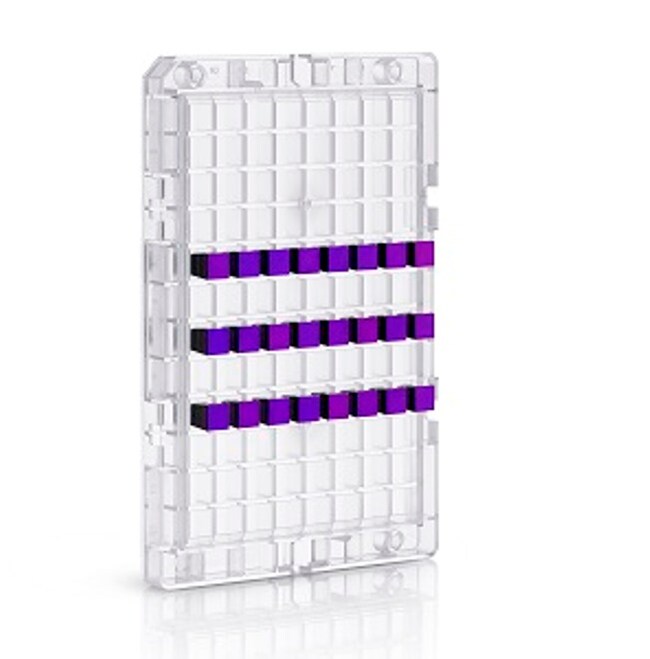
GeneChip™ Rice Gene 1.1 ST Array Plate, United States
Applied Biosystems™

GeneChip™ Rice Gene 1.1 ST Array Plate, United States

The GeneChip™ Rice (US) Gene 1.1 ST 24-Array Plate enables you to:• Measure expression, across the entire gene, with higherRead more
Have Questions?
Catalog NumberQuantity
9019891 plate
Catalog number 901989
Price (CNY)
-
Quantity:
1 plate
The GeneChip™ Rice (US) Gene 1.1 ST 24-Array Plate enables you to:
• Measure expression, across the entire gene, with higher resolution and accuracy than with classical 3'-biased microarray solutions
• Get accurate and reproducible data by using multiple independent measurements for each transcript
• Process up to 96 samples on a single array plate with the GeneTitan™ Instrument

Development of the Gene Expression Microarrays
Model and applied research organisms are valuable for comparative genomics research, evolutionary biology, and continue to play a critical role in deciphering the molecular mechanisms underlying human disease, and agricultural crop improvement. Gene 1.1 ST Array Plates have been developed for the analysis of a wide range of model and applied research organisms. These organisms are the latest additions to the growing family of Gene Expression Microarrays offering whole-transcript coverage. The Gene 1.1 ST Array Plates were designed in collaboration with influential researchers, such as Alan Archibald, Head of the Division of Genetics and Genomics at the Roslin Institute (Porcine Gene 1.1 ST Array design), Leonard Zon, Director of Stem Cell Research Program, and Yi Zhou, Genomic Core Director of the Stem Cell Research Program at Children's Hospital Boston and Harvard Medical School in Boston (Zebrafish Gene 1.1 ST Array design).

Key benefits
Highest transcript coverage — get confident expression measurements of well-annotated content with up to 26 probes per transcript
Whole-transcriptome analysis — capture the transcript isoforms you may miss with 3'-biased expression designs
High data correlation — achieve high inter- and intra-array strip signal correlation (R >0.99)
Convenient format — process up to 96 samples at the same time with minimal manual array handling

Proven performance from the industry standard
Gene 1.1 ST Array Plates offer whole-transcriptome coverage for selected model and applied research organisms. All designs are based on the most recent genomic content and offer the highest probe coverage (up to 26 probes across the full length of the gene). This allows for accurate detection for whole-transcriptome microarray analysis and provides higher resolution and accuracy than other classical 3'-biased microarray solutions on the market. The whole-transcriptome analysis approach enables researchers to detect multiple transcript isoforms, including those that might be missed using a 3'-biased expression design, such as splice variants, non-polyadenylated transcripts, transcripts with alternative polyadenylation sites, and truncated transcripts.

Content profile
Gene 1.1 ST Array Plates provide the latest coverage of the transcribed genome. We use a comprehensive collection of information sources to design probes that interrogate up to 26 unique sequences of each transcript. Together these 26 unique 25-mer probes interrogate up to 650 bases per transcript. This high probe coverage across the entire transcript results in superior performance and data confidence as well as the ability to update your experimental data as the understanding of each genome and transcriptome grows.
For Research Use Only. Not for use in diagnostic procedures.
Specifications
Product LineGeneChip™
Quantity1 plate
TypeRice Gene 1.1 ST Array Plate
ArrayTranscriptome Profiling
Format24-array Plate
Number of Arrays24 arrays
SpeciesRice
Unit SizeEach

Frequently asked questions (FAQs)

What is contained in the tab-delimited format of the GeneChip probe sequence download file?

The tab-delimited probe sequence file contains the following information:
-Probe Set Name
-Probe X: The X coordinate of the probe sequence on the GeneChip probe array.
-Probe Y: The Y coordinate of the probe sequence on the GeneChip probe array.
-Probe Interrogation Position: The base position on the consensus/exemplar sequence where the central base of the probe aligns, which is the 13th base of a 25mer probe.
-Probe Sequence: The 25-base perfect match sequence.
-Target Strandedness: The sense/antisense orientation of the target sequence that can hybridize with the probe sequence.

Find additional tips, troubleshooting help, and resources within our Microarray Analysis Support Center.

What is the NetAffx Analysis Center?

The NetAffx Analysis Center used to contain information and files regarding array content, probe sets, and functional annotations. However, the NetAffx Analysis Center has been retired. Much of the content provided by the NetAffx Analysis Center can now be accessed on the arrays’ thermofisher.com product pages or by contacting Technical Support (techsupport@thermofisher.com).

Find additional tips, troubleshooting help, and resources within our Microarray Analysis Support Center.

Is the hybridization mix for cartridges the same as the hybridization mix for PEG arrays (array plates)?

The hybridization mix for PEG arrays is different from the hybridization mix for cartridges. The concentrations of the hybridization mix are different and in addition, DMSO is not added into the hybridization mix for PEG arrays because it can affect the glue that holds the PEG to the plate.

What is an Event Score in TAC 4.0 Software?

TAC 4.0 includes two algorithms for identifying alternative splicing events: the TAC 2.0 algorithm and the new EventPointer. Algorithmic determination of alternate splicing remains a challenging problem. TAC 4.0 supports two different approaches that have different sets of strengths and weaknesses. After considerable testing, the new TAC 4.0 “'Event Score” leverages both previous TAC 2.0 event estimation score and Event Pointer p-value and sorts the most likely alternative splicing events to the top. Of course, the TAC 2.0 event score and EventPointer p-values remain individually available.

Find additional tips, troubleshooting help, and resources within our Microarray Analysis Support Center.

What are the new software components of TAC 4.0?

LIMMA: LIMMA stands for Linear Models for MicroArray data. It is an R/Bioconductor software package that provides an integrated solution for analyzing data from gene expression experiments. It contains rich features for handling complex experimental designs and for information borrowing to overcome the problem of small sample sizes. Over the past decade, LIMMA has been a popular choice for gene discovery through differential expression analyses of microarray data. There are ˜8000 citations using LIMMA and Affymetrix arrays. The TAC 4.0 interface exposes the core differential expression analysis functionality including real covariates and random factors. In addition, the interface simplifies the creation of the design and contrast matrices that specify the experimental design and comparisons for the analysis.

Batch Effect Adjustment: Batch effects are systematic changes in microarray sample intensities that reflect changes in the assay sometimes found in different batches. These effects occur more commonly in larger studies in which all of the samples cannot be processed at the same time. TAC 4.0 enables the interface to the ComBat batch adjustment algorithm, which can remove the batch effects from the signals.

EventPointer: EventPointer is a Bioconductor package that identifies alternative splicing events in microarray data. TAC 4.0 incorporates an interface to this package.

Exploratory Grouping Analysis: Exploratory Grouping Analysis (EGA) is an interface to a set of R packages that offer the ability to examine the relationships between multiple microarray samples. While the scientist typically has a preconceived idea regarding the classification of the samples in an experiment, the resulting data often show additional substructure due to unexpected biological differences or batch effects. The EGA interface enables the identification of this substructure. Biological differences can be further explored using LIMMA differential expression analysis. Batch effects can be removed using ComBat to prevent them from obscuring the biology of interest.

Find additional tips, troubleshooting help, and resources within our Microarray Analysis Support Center.