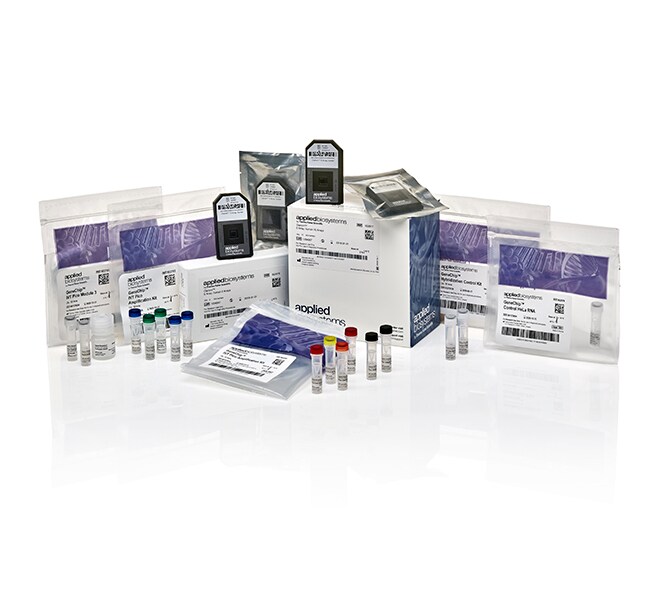
Clariom™ S Pico 测定试剂盒,人
Actual product may vary
Applied Biosystems™

Clariom™ S Pico 测定试剂盒,人

通过 Clariom S Pico 人样品测定试剂盒,可获得人转录组的基因水平视图。Clariom S Pico Assay 作为下一代全转录组基因水平表达谱分析工具,为您的研究提供较快速了解更多信息
Have Questions?
货号阵列数量
90292930 阵列
货号 902929
价格(CNY)
-
阵列数量:
30 阵列
通过 Clariom S Pico 人样品测定试剂盒,可获得人转录组的基因水平视图。Clariom S Pico Assay 作为下一代全转录组基因水平表达谱分析工具,为您的研究提供较快速、简单、可扩展的所需结果生成途径。新型 Human Clariom S Assay 基于业内领先的微阵列技术,可广泛涵盖所有已知的带注释基因,并与研究样品类型、可扩展格式和灵活的数据分析软件兼容。Clariom S Pico Assay 是用于快速、简单且经济地发现具有已知功能的表达生物标记物的工具。

找到答案,继续前行
虽然近年来已知转录基因数量迅速扩大,但对每个基因功能的了解仍在不断进展。数据库中发现的许多基因和转录本的注释不正确或未注释,可能会使数据分析和解释复杂化并延长其时间。Clariom S Pico 人测定试剂盒专注于充分注释的基因,使得研究人员可以执行基因水平表达谱分析研究并快速评估关键基因和通路的变化。Clariom S Pico 人测定试剂盒所需的数据分析时间更短,可帮助研究人员更快地得出结论。

简单、快速发现生物标记物
•准确测量 > 20,000 个良好注释基因的基因水平表达,从而快速得出结果。
• 选择一种符合处理量需求的规格,处理量范围从每日 1 至 192 份样品。
•采用专为生物学家设计的直观、高度可视化、免费分析软件,在数分钟内即可从数据获得结果

当有珍贵样品时,一次获得正确结果
• 从总 RNA 量低至 100 pg 的样品中–低至 10 个细胞样品,生成具有可靠性的表达谱。
• 使用来自不同样品类型的 RNA,包括血液、细胞、新鲜/新鲜冷冻或 FFPE 组织。
•通过无需去除球蛋白或 rRNA 步骤的测定,保持样品完整性并降低数据差异性。
•采用全自动样品制备选项,可节省时间和成本。

Clariom S 解决方案可用于在 GeneChip ™ 3000 仪器系统上进行单样品(检测盒阵列)处理和 GeneTitan ™ 微阵列系统上进行高通量自动处理(板阵列),从而提供适合小型和大型队列研究的灵活性。完整溶液包含试剂和快速简单的转录组分析控制台 (TAC) 软件,可在数分钟内分析和显示基因、通路和网络相互作用的整体表达模式。

获取更真实的基因表达水平
为了进行更稳健的基因水平表达谱分析,Human Clariom S Assay 仅检测存在于所有已知转录本亚型中的外显子,这些外显子由单个基因位点所组成的外显子表达。这与其他基因水平的阵列技术和浅层 RNA 测序不同,后者提供了对基因表达的偏倚或因转录本变体表达变化而复杂的数据。Human Clariom S Assay 只能测定每个已知基因长度的组成型外显子,从而生成目前更准确、真实的基因表达测量结果。

Clariom S Pico 人测定试剂盒简单、迅速地识别转录组中的生物标记物,使您获得所需要的覆盖范围、所需的重现性以及您希望针对发现采取措施的见解。
仅供科研使用。不可用于诊断程序。
规格
阵列转录组谱分析
芯片格式过柱
适用于(应用)微阵列分析
反应次数30 次反应
阵列数量30 阵列
产品类型S Pico 测定
数量30 reactions
种属
样品类型RNA
Unit SizeEach

常见问题解答 (FAQ)

What reagent kit should I use with my array?

Please refer to the Microarray Reagent Guide for Arrays and Expression Kits to match the correct reagents your array.

Find additional tips, troubleshooting help, and resources within our Microarray Analysis Support Center.

What is an Event Score in TAC 4.0 Software?

TAC 4.0 includes two algorithms for identifying alternative splicing events: the TAC 2.0 algorithm and the new EventPointer. Algorithmic determination of alternate splicing remains a challenging problem. TAC 4.0 supports two different approaches that have different sets of strengths and weaknesses. After considerable testing, the new TAC 4.0 “'Event Score” leverages both previous TAC 2.0 event estimation score and Event Pointer p-value and sorts the most likely alternative splicing events to the top. Of course, the TAC 2.0 event score and EventPointer p-values remain individually available.

Find additional tips, troubleshooting help, and resources within our Microarray Analysis Support Center.

What are the new software components of TAC 4.0?

LIMMA: LIMMA stands for Linear Models for MicroArray data. It is an R/Bioconductor software package that provides an integrated solution for analyzing data from gene expression experiments. It contains rich features for handling complex experimental designs and for information borrowing to overcome the problem of small sample sizes. Over the past decade, LIMMA has been a popular choice for gene discovery through differential expression analyses of microarray data. There are ˜8000 citations using LIMMA and Affymetrix arrays. The TAC 4.0 interface exposes the core differential expression analysis functionality including real covariates and random factors. In addition, the interface simplifies the creation of the design and contrast matrices that specify the experimental design and comparisons for the analysis.

Batch Effect Adjustment: Batch effects are systematic changes in microarray sample intensities that reflect changes in the assay sometimes found in different batches. These effects occur more commonly in larger studies in which all of the samples cannot be processed at the same time. TAC 4.0 enables the interface to the ComBat batch adjustment algorithm, which can remove the batch effects from the signals.

EventPointer: EventPointer is a Bioconductor package that identifies alternative splicing events in microarray data. TAC 4.0 incorporates an interface to this package.

Exploratory Grouping Analysis: Exploratory Grouping Analysis (EGA) is an interface to a set of R packages that offer the ability to examine the relationships between multiple microarray samples. While the scientist typically has a preconceived idea regarding the classification of the samples in an experiment, the resulting data often show additional substructure due to unexpected biological differences or batch effects. The EGA interface enables the identification of this substructure. Biological differences can be further explored using LIMMA differential expression analysis. Batch effects can be removed using ComBat to prevent them from obscuring the biology of interest.

Find additional tips, troubleshooting help, and resources within our Microarray Analysis Support Center.

If I have TAC 3.1 .TAC files (TAC analysis files), can I load these into TAC 4.0 Software or will I need to reanalyze?

TAC 3.1 .TAC files cannot be opened in TAC 4.0 Software. Studies will need to be reprocessed in TAC 4.0. The new analysis can be run from .CEL files or .CHP files.

Find additional tips, troubleshooting help, and resources within our Microarray Analysis Support Center.

In TAC 4.0 Software, can I measure the quality of a single hybridization without the rest of the experiment?

We do not recommend this. In large-scale expression experiments using similar sample types, researchers are likely to develop their own single-array guidelines on what metric values are predictive of high- or poor-quality samples. However, these guidelines are likely to be dependent on sample type and we are unable to recommend such guidelines for all possible situations. Note that the trend toward favoring model-based signal estimation algorithms (for all microarray experiments even beyond the Thermo Fisher platform) makes single-array quality determination very difficult due to the necessity of simultaneously analyzing multiple arrays to calculate signal estimates.

Find additional tips, troubleshooting help, and resources within our Microarray Analysis Support Center.