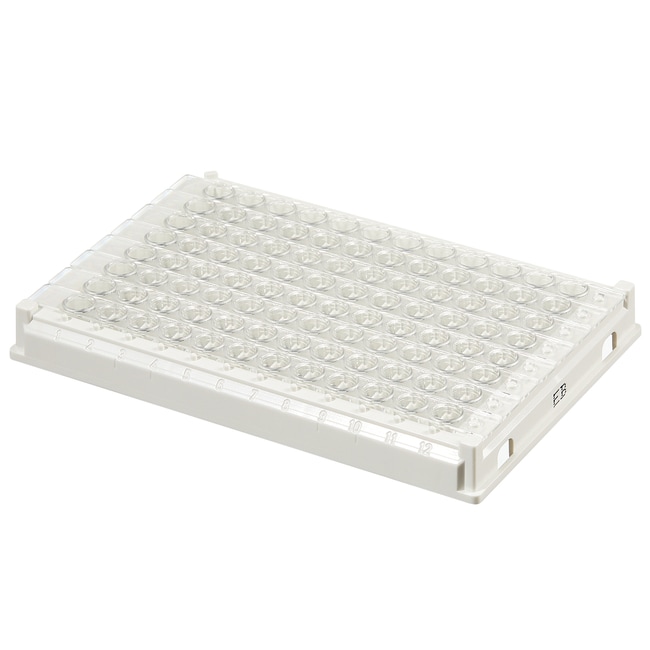
Are your Thermo Scientific 8-Well Strip Caps for Immuno Standard Modules compatible with all Nunc MicroWell 96-Well Microplates and Nunc Immuno 96-Well Plates?
Our Thermo Scientific 8-Well Strip Caps for Immuno Standard Modules were designed to provide a positive seal for flat and round bottom wells of our Nunc MicroWell 96-Well Microplates and Nunc Immuno 96-Well Plates.
8-Well Strip Caps for Immuno Standard Modules are not compatible with C or V bottom wells of the Nunc Microwell 96-Well Microplates and Nunc Immuno 96-Well Plates.
For Nunc Immuno plates and modules, what are the advantages of one well geometry type over another? Which types should I use for various applications?
The following list describes the geometries of wells available for Nunc Immuno-plates and modules:
- Flat bottom (F): Allows maximum transmission of light. These plates can be read on a monochromatic reader.
- Round bottom (U): This geometry optimizes washing and coating. These plates can be read using a dual wavelength reader.
- "C" bottom (C): This design of the well is a combination of both flat and round bottoms. Basically, it is a flat bottomed well with curved edges at the bottom. These plates also can be read using a monochromatic reader combining optimal reading and washing.
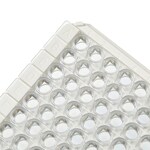
- StarWell: These wells have a modified "C" shape geometry with eight fins strategically placed at the bottom. This feature increases surface area, allowing more molecules to become immobilized which reduces incubation times.
Which Nunc immunodiagnostic passive surface should I choose: PolySorp, MediSorp, MaxiSorp, or MultiSorp?
Our passive immunodiagnostic surfaces are based on a series of treatments that modify the polystyrene surface to different final levels of hydrophilicity. Selection of one of these surfaces for ELISA development should be based on the characteristics of the biomolecule you seek to immobilize. PolySorp is fairly hydrophobic and should be used for biomolecules that have hydrophobic domains, e.g., lipids, lipoproteins, and large proteins. MediSorp is slightly hydrophilic and can be used for biomolecules with hydrophilic and hydrophobic properties, e.g., medium-to-large proteins such as albumin, or amphiphilic biomolecules such as LPS. MaxiSorp is quite hydrophilic, optimized for binding of IgG (and any other molecule with similar characteristics) and thus is a popular choice for sandwich ELISA and similar protocols. MultiSorp is very hydrophilic, and in turn will immobilize very hydrophilic biomolecules such as glycoproteins. Some optimization will always be necessary, and in many cases screening for binding optimization may involve a few surface types.
Find additional tips, troubleshooting help, and resources within our Antibodies and Immunoassays Support Center.
What is the difference between a certified and an uncertified immunodiagnostic plate, e.g., Cat. No. 439454 vs. 442404?
There is no difference in the manufacturing process. Certified plates are performance tested (using an antibody binding protocol) during quality control, whereas uncertified plates are not. This test is expensive for us to perform, so we offer the uncertified version at cost savings customers for whom antibody binding testing results are not critical.
Find additional tips, troubleshooting help, and resources within our Antibodies and Immunoassays Support Center.