Search


引用和文献 (3)
Gibco™
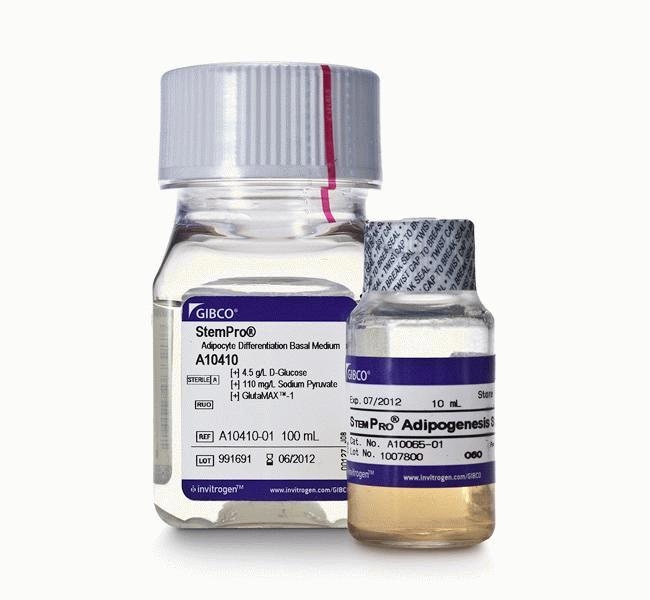
StemPro™ 脂肪生成分化试剂盒
StemPro™ 脂肪生成分化试剂盒
| 货号 | 数量 |
|---|---|
| A1007001 | 1 Kit |
货号 A1007001
价格(CNY)
-
数量:
1 Kit
用于将人间充质干细胞完全分化为脂肪细胞
StemPro™ 脂肪生成分化试剂盒开发用于在组织培养容器中实现间充质干细胞 (MSC) 的脂肪生成分化。该试剂盒包含诱导 MSC 定向至脂肪生成途径并生成脂肪细胞所需的所有试剂。StemPro™ 脂肪生成分化试剂盒与 StemPro™ MSC SFM 或 MesenPRO RS™ 培养基相结合,为 MSC 分离、扩增并分化为形成脂质囊泡的脂肪细胞提供了一个标准化的培养工作流程解决方案。
StemPro™ 脂肪生成分化试剂盒开发用于在组织培养容器中实现间充质干细胞 (MSC) 的脂肪生成分化。该试剂盒包含诱导 MSC 定向至脂肪生成途径并生成脂肪细胞所需的所有试剂。StemPro™ 脂肪生成分化试剂盒与 StemPro™ MSC SFM 或 MesenPRO RS™ 培养基相结合,为 MSC 分离、扩增并分化为形成脂质囊泡的脂肪细胞提供了一个标准化的培养工作流程解决方案。
仅供科研使用。不可用于诊断程序。
规格
细胞类型间充质干细胞
培养环境CO2
内毒素水平≤50 EU/mL, ≤ 50 EU/mL
产品规格液体
葡萄糖高糖
谷氨酰胺GlutaMAX™-I
HEPES 缓冲液不含 HEPES
无机盐钙、磷酸钠
酚红指示剂无酚红
纯度或质量等级研究级
数量1 Kit
血清水平标准血清
碳酸氢钠缓冲液碳酸氢钠
丙酮酸钠添加剂丙酮酸钠
种属人
补充剂脂肪生成添加剂
适用于(应用)干细胞分化
产品线Gibco、StemPro
产品类型脂肪生成分化试剂盒
Unit SizeEach
内容与储存
本套装分为两部分,分别具有不同的储存要求。这些组分不单独出售:
•StemPro™ 脂肪细胞分化基础培养基(100 mL;在黑暗环境中于 2°C 至 8°C 下储存)
• StemPro™ 脂肪生成补充剂(10 mL;在黑暗环境中于 -5°C 至 -20°C 下储存)
基础培养基在室温下运输,而补充剂在干冰上运输。
•StemPro™ 脂肪细胞分化基础培养基(100 mL;在黑暗环境中于 2°C 至 8°C 下储存)
• StemPro™ 脂肪生成补充剂(10 mL;在黑暗环境中于 -5°C 至 -20°C 下储存)
基础培养基在室温下运输,而补充剂在干冰上运输。
常见问题解答 (FAQ)
间充质干细胞(MSC)研究中一般使用何种生长因子?
我如何在体外培养间充质干细胞(MSC)?
你们如何鉴定人间充质干细胞(MSC)?
什么是间充质干细胞(MSC)?
What kinds of growth factors are used in mesenchymal stem cell (MSC) research?
引用和文献 (3)
引用和文献
Abstract
Optimization of human mesenchymal stem cell manufacturing: the effects of animal/xeno-free media.
Journal:
PubMed ID:26564250
'Due to their immunosuppressive properties, mesenchymal stem cells (MSC) have been evaluated for the treatment of immunological diseases. However, the animal-derived growth supplements utilized for MSC manufacturing may lead to clinical complications. Characterization of alternative media formulations is imperative for MSC therapeutic application. Human BMMSC and AdMSC were expanded in
Alginate-Encapsulation for the Improved Hypothermic Preservation of Human Adipose-Derived Stem Cells.
Journal:Stem Cells Transl Med
PubMed ID:26826163
: Despite considerable progress within the cell therapy industry, unmet bioprocessing and logistical challenges associated with the storage and distribution of cells between sites of manufacture and the clinic exist. We examined whether hypothermic (4°C-23°C) preservation of human adipose-derived stem cells could be improved through their encapsulation in 1.2% calcium
Human Synovial MSC Good Manufacturing Practices for Articular Cartilage Regeneration.
Journal:Tissue Eng Part C Methods
PubMed ID:30412046
cartilage restoration is a desperately needed bridge for patients with symptomatic cartilage lesions. Chondral lesion is a pathology with high prevalence, reaching as much as 63% of general population and 36% among athletes. Despite Autologous Chondrocyte Implantation (ACI) versatility, it still fails to fully reproduce hyaline articular cartilage characteristics. Mesenchymal