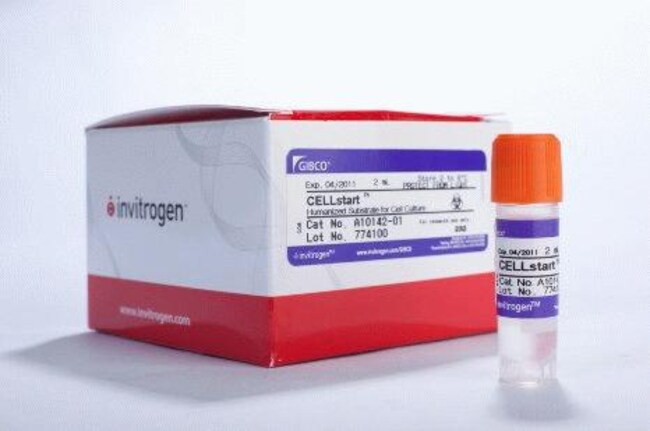
CELLstart™ Substrate
Gibco™

CELLstart™ Substrate

CELLstart Substrate is a defined substrate that supports human embryonic stem cell (hESC) attachment and expansion of undifferentiated colonies inRead more
Have Questions?
Catalog NumberQuantity
A10142012 mL
Catalog number A1014201
Price (CNY)
4,701.71
Online Exclusive
Ends: 31-Dec-2025
5,667.00
Save 965.29 (17%)
Each
Add to cart
Quantity:
2 mL
Price (CNY)
4,701.71
Online Exclusive
Ends: 31-Dec-2025
5,667.00
Save 965.29 (17%)
Each
Add to cart

CELLstart Substrate is a defined substrate that supports human embryonic stem cell (hESC) attachment and expansion of undifferentiated colonies in serum-free medium without the need for feeder cells. It can also be used with mesenchymal and neural stem cells and for the attachment of human feeder cells (e.g., foreskin fibroblasts).

  • Defined substrate for stem cell culture
  • cGMP manufactured to help ensure manufacturability and traceability

GIBCO products are of high quality and are supplied with harmonized documentation such as certificates of analysis and certificates of origin.

For Research Use Only. Not for use in diagnostic procedures.
Specifications
Cell TypeStem Cells (Neural), Stem Cells (iPS - Induced Pluripotent Stem), Stem Cells (Embryonic), Stem Cells (Mesenchymal)
ClassificationSerum-Free
Endotoxin Level≤50 EU/mL, ≤ 50 EU/mL
FormatTube(s)
Phenol Red IndicatorNo Phenol Red
Product LineGibco
Purity or Quality GradehESC-Qualified
Quantity2 mL
Shipping ConditionRoom Temperature
FormLiquid
Unit SizeEach
Contents & Storage
Store at 2°C to 8°C.

Frequently asked questions (FAQs)

How do I prepare the StemPRO hESC SFM complete medium?

We recommend to thaw the supplement in the 37°C water bath, aliquot and freeze at -5°C to -20°C. Thaw each aliquot only one additional time. To make 100 ml complete medium, mix 90.8 ml DMEM/F-12 with GlutaMax matrix, 2 ml StemPRO hESC supplement, 7.2 ml 25% BSA solution, 80 ul bFGF (at 10 ug/ml), and 182 ul 2-mercaptoethanol (at 55mM). Store at 2°C-8°C until ready to use, but use the same day.

Find additional tips, troubleshooting help, and resources within our Cell Culture Support Center.

Can StemPRO hESC SFM be used to culture mouse ESCs?

No, we don't recommend StemPro hESC SFM for mouse cells because they showed poor growth and some differentiation. We recommend KnockOut DMEM and KnockOut SR for mouse ESC cultures (catalog numbers 10829-018 and 10828-028 respectively).

Find additional tips, troubleshooting help, and resources within our Cell Culture Support Center.

Can StemPRO hESC SFM be used for new cell line derivations?

Yes, derivations using StemPro hESC SFM have been carried out using either a basement membrane extract (like Geltrex growth factor) or feeder cells.

Find additional tips, troubleshooting help, and resources within our Cell Culture Support Center.

What cell lines has StemPRO hESC SFM been tested with?

StemPro hESC SFM has been tested with the following hESC: H1, H9, BG01, BG02, BG03, HUES6, HUES9, Cyth203, CyT49, BG01v, HES-2, HES-3, KhES-1, and TE06. The medium has also been used with the Rhesus monkey line R336.4. Some cells may require a short adaptation time but most do not.

Find additional tips, troubleshooting help, and resources within our Cell Culture Support Center.

Does StemPRO hESC SFM require the use of a basement membrane matrix?

Yes, we recommend using Geltrex hESC-qualified Reduced Growth Factor basement membrane (catalog number A10480-02), CELLstart (catalog number A10142-01) or similar matrix.

Find additional tips, troubleshooting help, and resources within our Cell Culture Support Center.

Citations & References (3)

Citations & References
Abstract
CD133-enriched Xeno-Free human embryonic-derived neural stem cells expand rapidly in culture and do not form teratomas in immunodeficient mice.
Authors:Haus DL, Nguyen HX, Gold EM, Kamei N, Perez H, Moore HD, Anderson AJ, Cummings BJ
Journal:
PubMed ID:25082219
'Common methods for the generation of human embryonic-derived neural stem cells (hNSCs) result in cells with potentially compromised safety profiles due to maintenance of cells in conditions containing non-human proteins (e.g. in bovine serum or on mouse fibroblast feeders). Additionally, sufficient expansion of resulting hNSCs for scaling out or up ... More
Optimization of human mesenchymal stem cell manufacturing: the effects of animal/xeno-free media.
Authors:Oikonomopoulos A, van Deen WK, Manansala AR, Lacey PN, Tomakili TA, Ziman A, Hommes DW,
Journal:
PubMed ID:26564250
'Due to their immunosuppressive properties, mesenchymal stem cells (MSC) have been evaluated for the treatment of immunological diseases. However, the animal-derived growth supplements utilized for MSC manufacturing may lead to clinical complications. Characterization of alternative media formulations is imperative for MSC therapeutic application. Human BMMSC and AdMSC were expanded in ... More
Xeno-free defined conditions for culture of human embryonic stem cells, neural stem cells and dopaminergic neurons derived from them.
Authors:Swistowski A, Peng J, Han Y, Swistowska AM, Rao MS, Zeng X,
Journal:PLoS One
PubMed ID:19597550
BACKGROUND: Human embryonic stem cells (hESCs) may provide an invaluable resource for regenerative medicine. To move hESCs towards the clinic it is important that cells with therapeutic potential be reproducibly generated under completely defined conditions. METHODOLOGY/PRINCIPAL FINDINGS: Here we report a four-step scalable process that is readily transferable to a ... More