Search


引用和文献 (33)
Invitrogen™
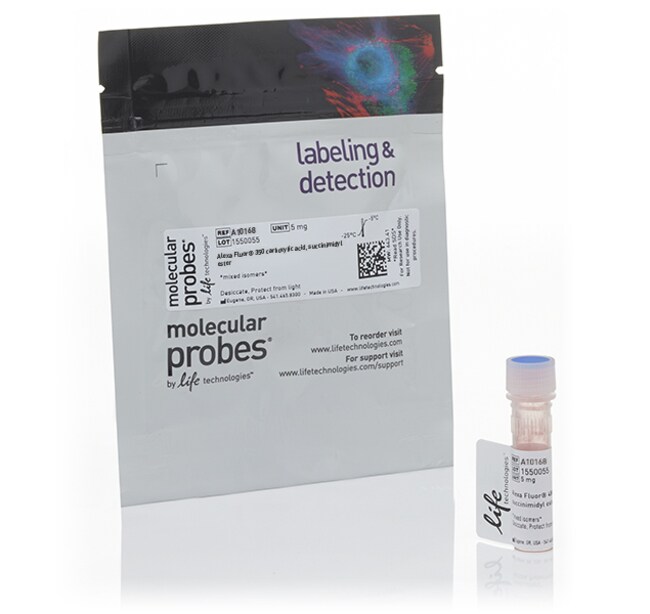
Alexa Fluor™350 NHS 酯(琥珀酰亚胺酯)
Alexa Fluor™ 350 是一种蓝色荧光染料。Alexa Fluor™ 350 染料用于成像和流式细胞分析中稳定信号的生成,具有水溶性和 pH 值不敏感性了解更多信息
| 货号 | 数量 |
|---|---|
| A10168 | 5 mg |
货号 A10168
价格(CNY)
5,028.00
Each
数量:
5 mg
价格(CNY)
5,028.00
Each
Alexa Fluor™ 350 是一种蓝色荧光染料。Alexa Fluor™ 350 染料用于成像和流式细胞分析中稳定信号的生成,具有水溶性和 pH 值不敏感性(pH 值 4 至 pH 值 10)。除反应性染料制剂外,我们还提供可与多种抗体、肽、蛋白、示踪剂和扩增底物偶联并且针对细胞标记和检测进行优化的 Alexa Fluor™ 350 染料(了解更多信息)。
Alexa Fluor™ 350 的 NHS 酯(或琥珀酰亚胺酯)是将该染料与蛋白或抗体偶联的较常用工具。NHS 酯可用于标记蛋白、胺修饰的寡核苷酸和其他含胺分子的伯胺 (R-NH2)。所得 Alexa Fluor™ 偶联物将显示出比其他光谱相似荧光基团的偶联物更亮的荧光和更高的光稳定性。
关于该 AlexaFluor™ NHS 酯的详细信息:
荧光基团标记:Alexa Fluor™ 350 染料
反应性基团:NHS 酯
反应性:蛋白和配体、胺修饰的寡核苷酸上的伯胺
偶联物的 Ex/Em:346/445 nm
消光系数:19,000 cm-1M-1
光谱类似染料:Marina 蓝色
分子量:410.4
典型偶联反应
您可以将胺反应性试剂与几乎任何蛋白或肽偶联(提供的方案针对 IgG 抗体进行了优化)。您可以针对任何量的蛋白按比例缩放反应,但为了获得最佳结果,蛋白的浓度应至少为 2 mg/mL。我们建议使用三种不同的反应性试剂/蛋白摩尔比进行三种不同程度的标记。
Alexa Fluor™ NHS 酯通常溶于高质量的无水二甲基甲酰胺 (DMF) 或二甲亚砜 (DMSO) (D12345) 中,并在 0.1–0.2 M 碳酸氢钠缓冲液(pH 值 8.3)中于室温下进行反应,持续 1 小时。由于末端胺的 pKa 低于赖氨酸 ε-氨基基团的 pKa,您可以使用接近中性 pH 值的缓冲液对胺末端进行更具选择性的标记。
偶联物纯化
通常使用凝胶过滤柱(如 Sephadex™ G-25、BioGel™ P-30 或等效柱)将标记抗体与游离 Alexa Fluor™ 染料分离。对于更大或更小的蛋白,选择具有适当分子量滤除点的凝胶过滤介质或通过透析纯化。我们提供了多种优化的纯化试剂盒,可用于不同量抗体偶联物:
0.5-1 mg 用抗体偶联物纯化试剂盒 (A33086)
20-50 µg 用抗体偶联物纯化试剂盒 (A33087)
50-100 µg 用抗体偶联物纯化试剂盒 (A33088)
了解关于蛋白和抗体标记的更多信息
我们提供一系列 Molecular Probes™ 抗体和蛋白标记试剂盒,旨在满足您的起始材料和实验设置需求。参见我们的抗体标记试剂盒或使用我们的标记化学选择工具进行其他选择。欲了解有关我们标记试剂盒的更多信息,请参阅 Molecular Probes™ 手册中第 1.2 节—蛋白和核酸标记试剂盒。
我们还’可为您定制偶联物
如果您’无法在我们的在线目录中找到’想要的产品,我们还’可为您定制抗体或蛋白偶联物。我们的定制偶联服务是高效和保密的,我们保证我们的工作质量。我们经过ISO 9001:2000认证。
Alexa Fluor™ 350 的 NHS 酯(或琥珀酰亚胺酯)是将该染料与蛋白或抗体偶联的较常用工具。NHS 酯可用于标记蛋白、胺修饰的寡核苷酸和其他含胺分子的伯胺 (R-NH2)。所得 Alexa Fluor™ 偶联物将显示出比其他光谱相似荧光基团的偶联物更亮的荧光和更高的光稳定性。
关于该 AlexaFluor™ NHS 酯的详细信息:
荧光基团标记:Alexa Fluor™ 350 染料
反应性基团:NHS 酯
反应性:蛋白和配体、胺修饰的寡核苷酸上的伯胺
偶联物的 Ex/Em:346/445 nm
消光系数:19,000 cm-1M-1
光谱类似染料:Marina 蓝色
分子量:410.4
典型偶联反应
您可以将胺反应性试剂与几乎任何蛋白或肽偶联(提供的方案针对 IgG 抗体进行了优化)。您可以针对任何量的蛋白按比例缩放反应,但为了获得最佳结果,蛋白的浓度应至少为 2 mg/mL。我们建议使用三种不同的反应性试剂/蛋白摩尔比进行三种不同程度的标记。
Alexa Fluor™ NHS 酯通常溶于高质量的无水二甲基甲酰胺 (DMF) 或二甲亚砜 (DMSO) (D12345) 中,并在 0.1–0.2 M 碳酸氢钠缓冲液(pH 值 8.3)中于室温下进行反应,持续 1 小时。由于末端胺的 pKa 低于赖氨酸 ε-氨基基团的 pKa,您可以使用接近中性 pH 值的缓冲液对胺末端进行更具选择性的标记。
偶联物纯化
通常使用凝胶过滤柱(如 Sephadex™ G-25、BioGel™ P-30 或等效柱)将标记抗体与游离 Alexa Fluor™ 染料分离。对于更大或更小的蛋白,选择具有适当分子量滤除点的凝胶过滤介质或通过透析纯化。我们提供了多种优化的纯化试剂盒,可用于不同量抗体偶联物:
0.5-1 mg 用抗体偶联物纯化试剂盒 (A33086)
20-50 µg 用抗体偶联物纯化试剂盒 (A33087)
50-100 µg 用抗体偶联物纯化试剂盒 (A33088)
了解关于蛋白和抗体标记的更多信息
我们提供一系列 Molecular Probes™ 抗体和蛋白标记试剂盒,旨在满足您的起始材料和实验设置需求。参见我们的抗体标记试剂盒或使用我们的标记化学选择工具进行其他选择。欲了解有关我们标记试剂盒的更多信息,请参阅 Molecular Probes™ 手册中第 1.2 节—蛋白和核酸标记试剂盒。
我们还’可为您定制偶联物
如果您’无法在我们的在线目录中找到’想要的产品,我们还’可为您定制抗体或蛋白偶联物。我们的定制偶联服务是高效和保密的,我们保证我们的工作质量。我们经过ISO 9001:2000认证。
仅供科研使用。不可用于诊断程序。
规格
化学反应性胺
发射445 nm
激发346 nm
标签或染料Alexa Fluor™ 350
产品类型染料
数量5 mg
反应一部分活性酯、琥珀酰亚胺酯
运输条件室温
标签类型Alexa Fluor 染料
产品线Alexa Fluor
Unit SizeEach
内容与储存
储存在冰箱(-5 至 -30°C)中并避光。
常见问题解答 (FAQ)
I am labeling a protein with Alexa Fluor 488 SDP ester. The manual recommends using a sodium bicarbonate buffer at pH 8.3. Can I use a different buffer instead?
I am not going to use all of my Alexa Fluor succinimidyl ester reactive dye. Can I just make it up in DMSO and store aliquots at -20 degrees C?
What are the signal intensity differences between Alexa Fluor 350 dye and Alexa Fluor 488 dye?
引用和文献 (33)
引用和文献
Abstract
Coumarin tags for analysis of peptides by MALDI-TOF MS and MS/MS. 2. Alexa Fluor 350 tag for increased peptide and protein Identification by LC-MALDI-TOF/TOF MS.
Journal:Anal Chem
PubMed ID:15801742
The goal of this study was the development of N-terminal tags to improve peptide identification using high-throughput MALDI-TOF/TOF MS. Part 1 of the study was focused on the influence of derivatization on the intensities of MALDI-TOF MS signals of peptides. In part 2, various derivatization approaches for the improvement of
Micron-scale spatially patterned, covalently immobilized vascular endothelial growth factor on hydrogels accelerates endothelial tubulogenesis and increases cellular angiogenic responses.
Journal:Tissue Eng Part A
PubMed ID:20712418
'Spontaneous formation of endothelial tubules was restricted to patterned micron-scale regions presenting cell adhesion ligands and angiogenic signaling protein on poly(ethylene glycol) hydrogels. Arginine-glycine-aspartic acid-serine (RGDS), an integrin ligand, and vascular endothelial growth factor (VEGF), a rate-limiting signaling protein involved in angiogenesis, were covalently bound through photopolymerization via laser scanning
Simultaneous red/green dual fluorescence detection on electroblots using BODIPY TR-X succinimidyl ester and ELF 39 phosphate.
Journal:Proteomics
PubMed ID:11987124
'A two-color fluorescence detection method is described based upon covalently coupling the succinimidyl ester of BODIPY TR-X dye to proteins immobilized on polyvinylidene difluoride membranes, followed by detection of target proteins using the fluorogenic, precipitating substrate ELF 39-phosphate in combination with alkaline phosphatase conjugated reporter molecules. This results in all
Polar localization of virulence-related Esx-1 secretion in mycobacteria.
Journal:PLoS Pathog
PubMed ID:19180234
'The Esx-1 (type VII) secretion system is critical for virulence of both Mycobacterium tuberculosis and Mycobacterium marinum, and is highly conserved between the two species. Despite its importance, there has been no direct visualization of Esx-1 secretion until now. In M. marinum, we show that secretion of Mh3864, a novel
Pulsed fluorescence measurements of trapped molecular ions with zero background detection.
Journal:J Am Soc Mass Spectrom
PubMed ID:12056569
'Sensitive methods have been developed to measure laser-induced fluorescence from trapped ions by reducing the detection of background scattering to zero levels during the laser excitation pulse. The laser beam diameter has been reduced to approximately 150 microm to eliminate scattering on trap apertures and the resulting laser-ion interaction is