Search


引用和文献 (9)
Gibco™
嘌呤霉素盐酸盐
嘌呤霉素盐酸盐是一种由白黑链霉菌产生的氨基苷类抗生素。嘌呤霉素的作用机制为抑制原核和真核核糖体上的肽基转移;耐药性取决于 pac 基因的表达水平。嘌呤霉素在细胞生物学领域被广泛用作哺乳动物细胞培养系统中的筛选抗生素。建议的工作浓度介于 0.2–5.0 µg/mL 之间,但其在浓度低至 1了解更多信息
Have Questions?
更改视图

| 货号 | 数量 |
|---|---|
| A1113803 | 10 样品瓶 |
| A1113802 | 1瓶 |
货号 A1113803
价格(CNY)
3,770.00
Special offer
Online exclusive
Ends: 27-Nov-2026
5,095.00共减 1,325.00 (26%)
Each
数量:
10 样品瓶
价格(CNY)
3,770.00
Special offer
Online exclusive
Ends: 27-Nov-2026
5,095.00共减 1,325.00 (26%)
Each
嘌呤霉素盐酸盐是一种由白黑链霉菌产生的氨基苷类抗生素。嘌呤霉素的作用机制为抑制原核和真核核糖体上的肽基转移;耐药性取决于 pac 基因的表达水平。
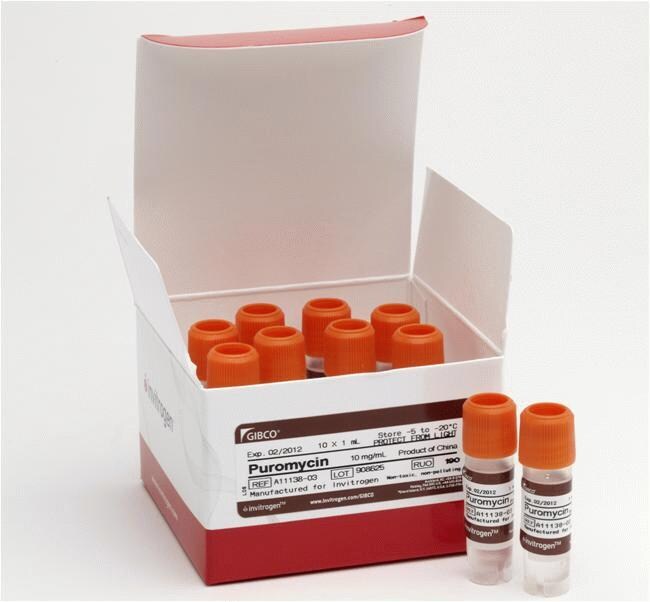
嘌呤霉素在细胞生物学领域被广泛用作哺乳动物细胞培养系统中的筛选抗生素。建议的工作浓度介于 0.2–5.0 µg/mL 之间,但其在浓度低至 1 µg/mL 时也可能对真核细胞有毒害。Gibco™ 嘌呤霉素二盐酸盐的供货浓度为 10 mg/mL,溶剂为 20 mM HEPES 缓冲液(pH 值 6.2–6.8),包装为 10 瓶,每瓶容量为 1 mL。
其他选择和更多信息
我们提供多种粉末和液体规格的抗生素和抗真菌药。
请参见完整列表,或查找以下专题的相关产品:
•污染控制
• 真核细胞和细菌筛选
参见筛选抗生素工作浓度的建议。
进一步了解抗生素和抗真菌剂在细胞培养中的应用,并查看关于排除培养污染的指南。
嘌呤霉素在细胞生物学领域被广泛用作哺乳动物细胞培养系统中的筛选抗生素。建议的工作浓度介于 0.2–5.0 µg/mL 之间,但其在浓度低至 1 µg/mL 时也可能对真核细胞有毒害。Gibco™ 嘌呤霉素二盐酸盐的供货浓度为 10 mg/mL,溶剂为 20 mM HEPES 缓冲液(pH 值 6.2–6.8),包装为 10 瓶,每瓶容量为 1 mL。
其他选择和更多信息
我们提供多种粉末和液体规格的抗生素和抗真菌药。
请参见完整列表,或查找以下专题的相关产品:
•污染控制
• 真核细胞和细菌筛选
参见筛选抗生素工作浓度的建议。
进一步了解抗生素和抗真菌剂在细胞培养中的应用,并查看关于排除培养污染的指南。
仅供科研使用。不可用于诊断程序。
规格
最大浓度10 mg/mL
培养类型哺乳动物细胞培养,昆虫细胞培养
适用于(应用)真核细胞选择⁄稳定细胞系生成
产品线Gibco
数量10 样品瓶
有效期12 个月
运输条件干冰
形式液体
产品类型Geneticin
无菌无菌过滤
加有添加剂HEPES:
Unit SizeEach
内容与储存
储存条件:-5 至 -20°C
运输条件:冷冻
有效期:自生产之日起12个月
运输条件:冷冻
有效期:自生产之日起12个月
常见问题解答 (FAQ)
哺乳动物细胞的稳转筛选过程中可一起使用哪些种类的抗生素(Geneticin,Zeocin,潮霉素B,杀稻瘟素和嘌呤霉素)?
我该如何对我的培养物去污染?
你们提供哪些抗生素来帮助用户控制或减少细胞培养中的污染情况?
Which of your antibiotics (Geneticin, Zeocin, Hygromycin B, Blasticidin, and Puromycin) can be used together for stable selection in mammalian cells?
How light-sensitive is Puromycin Dihydrochloride?
引用和文献 (9)
引用和文献
Abstract
Trop2 Promotes Multidrug Resistance by Regulating Notch1 Signaling Pathway in Gastric Cancer Cells.
Journal:Med Sci Monit
PubMed ID:31964857
'BACKGROUND Chemotherapy is widely used in gastric cancer treatment, but multidrug resistance remains a leading cause of chemotherapy failure. Trop2 is highly expressed in gastric tumor tissues and greatly influences cancer progression. However, little is known about the relationship between Trop2 and drug resistance in gastric cancer. MATERIAL AND METHODS
mTORC2 contributes to the metabolic reprogramming in EGFR tyrosine-kinase inhibitor resistant cells in non-small cell lung cancer.
Journal:Cancer Lett
PubMed ID:30036610
Non-small cell lung cancer (NSCLC) patients with activating EGFR mutations are often successfully treated with EGFR tyrosine kinase inhibitor (TKI) such as erlotinib; however, treatment resistance inevitably occurs. Given tumor metabolism of glucose and therapeutic response are intimately linked, we explored the metabolic differences between isogenic erlotinib-sensitive and -resistant NSCLC
The Plasmodium falciparum cytoplasmic translation apparatus: a promising therapeutic target not yet exploited by clinically approved anti-malarials.
Journal:Malar J
PubMed ID:30541569
The continued spectre of resistance to existing anti-malarials necessitates the pursuit of novel targets and mechanisms of action for drug development. One class of promising targets consists of the 80S ribosome and its associated components comprising the parasite translational apparatus. Development of translation-targeting therapeutics requires a greater understanding of protein
Modulating eIF6 levels unveils the role of translation in ecdysone biosynthesis during Drosophila development.
Journal:Dev Biol
PubMed ID:31283922
During development, ribosome biogenesis and translation reach peak activities, due to impetuous cell proliferation. Current models predict that protein synthesis elevation is controlled by transcription factors and signalling pathways. Developmental models addressing translation factors overexpression effects are lacking. Eukaryotic Initiation Factor 6 (eIF6) is necessary for ribosome biogenesis and efficient
Cardiac glycosides decrease influenza virus replication by inhibiting cell protein translational machinery.
Journal:Am J Physiol Lung Cell Mol Physiol
PubMed ID:30892074
Cardiac glycosides (CGs) are used primarily for cardiac failure and have been reported to have other effects, including inhibition of viral replication. Here we set out to study mechanisms by which CGs as inhibitors of the Na-K-ATPase decrease influenza A virus (IAV) replication in the lungs. We found that CGs