Search

Thermo Scientific™
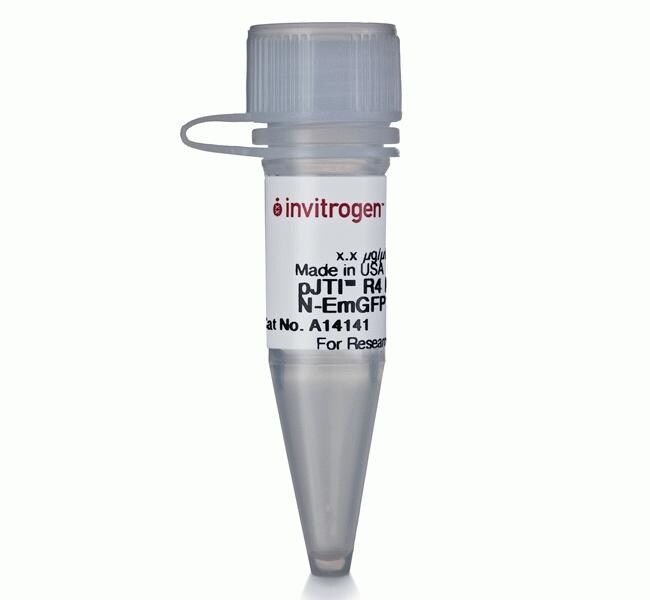
pJTI™ R4 Dest CMV N-EmGFP pA 载体
The pJTI™ R4 Dest CMV N-EmGFP pA vector allows a gene of interest to be expressed as an N-terminal Emerald Green Fluorescent Protein (EmGFP) fusion in a Jump-In™ parental cell line.
| 货号 | 数量 |
|---|---|
| A14141 | 100 μg |
货号 A14141
价格(CNY)
17,452.00
Each
数量:
100 μg
价格(CNY)
17,452.00
Each
The pJTI™ R4 Dest CMV N-EmGFP pA vector allows a gene of interest to be expressed as an N-terminal Emerald Green Fluorescent Protein (EmGFP) fusion in a Jump-In™ parental cell line. When used in combination with a Jump-In™ parental cell line kit such as the Jump-In™ GripTite™ HEK293 cell line (Cat. No. A14150), an isogeneic stable cell line can be created with less effort and in less time than traditional cell engineering methods. In addition, Gateway™ technology increases the efficiency of the cloning steps to introduce your GOI into the Gateway™-ready pJTI™ R4 Dest CMV N-EmGFP pA vector. The high retargeting efficiency, made possible by the R4 sites in the Jump-In™ parental cell line, allows the use of the isogenic pool for additional experiments without the need for clonal selection. Alternatively, the high retargeting efficiency allows for easy selection of a positive stable clone for expressing your gene of interest with an N-terminal EmGFP.
pJTI™ R4 Dest CMV N-EmGFP pA 载体可在 Jump-In™ 亲本细胞系中以 N 端祖母绿荧光蛋白 (EmGFP) 融合形式表达目的基因。当与 Jump-In™ 亲本细胞系试剂盒(如 Jump-In™ GripTite™ HEK293 细胞系 (A14150))联合使用时,与传统细胞工程方法相比,可以更少的工作量和更短的时间创建同基因稳定的细胞系。此外,Gateway™ 技术提高了克隆步骤的效率,将您的 GOI 导入 Gateway™ 即用型 pJTI™ R4 Dest CMV N-EmGFP pA 载体。通过 Jump-In™ 亲本细胞系中的 R4 位点实现高重定向效率允许使用同基因池进行额外实验,无需克隆选择。或者,高重定向效率可使用 N 端 EmGFP 易于选择用于表达您的目的基因的阳性稳定克隆。
Jump-In™ 载体和亲本细胞系可使您:
•与传统细胞工程方法相比,在大约一半的时间内快速有效地开发出稳定的工程改造同基因细胞池。
•利用确定基因组位点的同基因表达作为比较性分析基因家族、亚型或直接同源的理想溶液。
•由于工作流程简化,可并行传代多个细胞系。
•轻松访问 Jump-In™ 技术,能够传代无限数量的细胞系,无需复杂的许可证或解释限制。
使用快速有效地传代工程改造细胞系来节省时间
使用 Gateway™ 技术,您可以使用 pJTI R4 DEST CMV N-EmGFP pA 目的载体传代用于重定向的表达构建体。与 Jump-In™ 亲本细胞系试剂盒联合使用,将表达盒有效且特异性地插入基因组靶 R4 位点,可在短短 2 周内传代功能细胞池,无需繁琐的克隆分离和分析。由于阳性克隆的百分比较高,即使传代克隆细胞系,需要的时间和精力也减少。
扩展您的实验能力
pJTI™ R4 Dest CMV N-EmGFP pA 载体与 Jump-In™ 亲本细胞系一起提供了理想的解决方案,适用于瞬态工程技术有问题的细胞和试验,以及难以“工程化”的细胞系。该试剂盒还提供了一种创建基因家族、亚型或直接同源靶标检测组合的方便方法。编码大蛋白或多单元蛋白的基因不是问题,因为 Gateway™ 目的载体可接受较大插入物。
仅供研究使用。不得用于任何动物或人类的治疗或诊断。
Jump-In™ 载体和亲本细胞系可使您:
•与传统细胞工程方法相比,在大约一半的时间内快速有效地开发出稳定的工程改造同基因细胞池。
•利用确定基因组位点的同基因表达作为比较性分析基因家族、亚型或直接同源的理想溶液。
•由于工作流程简化,可并行传代多个细胞系。
•轻松访问 Jump-In™ 技术,能够传代无限数量的细胞系,无需复杂的许可证或解释限制。
使用快速有效地传代工程改造细胞系来节省时间
使用 Gateway™ 技术,您可以使用 pJTI R4 DEST CMV N-EmGFP pA 目的载体传代用于重定向的表达构建体。与 Jump-In™ 亲本细胞系试剂盒联合使用,将表达盒有效且特异性地插入基因组靶 R4 位点,可在短短 2 周内传代功能细胞池,无需繁琐的克隆分离和分析。由于阳性克隆的百分比较高,即使传代克隆细胞系,需要的时间和精力也减少。
扩展您的实验能力
pJTI™ R4 Dest CMV N-EmGFP pA 载体与 Jump-In™ 亲本细胞系一起提供了理想的解决方案,适用于瞬态工程技术有问题的细胞和试验,以及难以“工程化”的细胞系。该试剂盒还提供了一种创建基因家族、亚型或直接同源靶标检测组合的方便方法。编码大蛋白或多单元蛋白的基因不是问题,因为 Gateway™ 目的载体可接受较大插入物。
仅供研究使用。不得用于任何动物或人类的治疗或诊断。
仅供科研使用。不可用于诊断程序。
规格
构成或诱导系统组成型
输送类型转染
适用于(应用)稳定的细胞系开发、靶向整合
产品类型哺乳动物表达载体
蛋白标记位置(至您的基因)N-端
数量100 μg
选择试剂(真核生物)无
运输条件干冰
载体Jump-In 载体
克隆方法Gateway™
最大浓度1.5 μg/μL
产品线Jump-In
促进剂CMV
蛋白标记GFP (EmGFP)
Unit SizeEach
内容与储存
接收后立即将载体储存于 -20°C 下