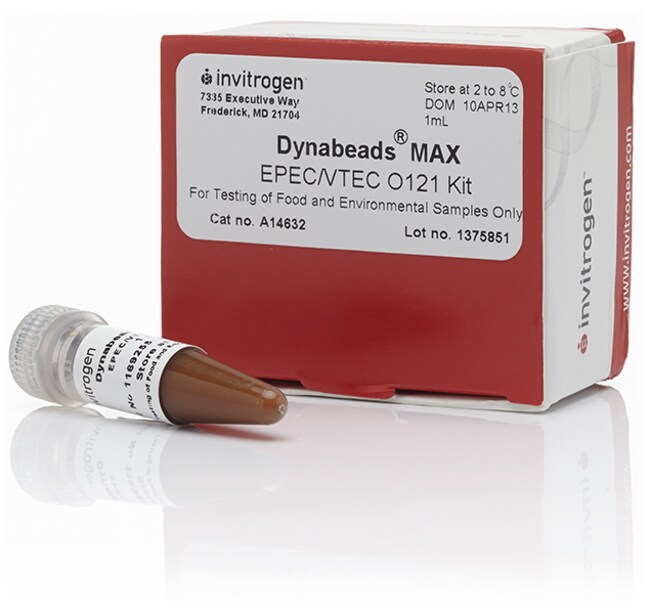
Dynabeads™ MAX EPEC/VTEC O121 试剂盒
Applied Biosystems™

Dynabeads™ MAX EPEC/VTEC O121 试剂盒

Dynabeads MAX EPEC/VTEC O121 分选试剂盒可通过 PCR 或培养方法快速、选择性地浓缩食品和环境样品中的大肠杆菌 O121 血清群细菌,以改善下游检测了解更多信息
Have Questions?
更改视图buttonViewtableView
货号数量
A14684200 Reactions
A14632100 Reactions
货号 A14684
价格(CNY)
-
数量:
200 Reactions
Dynabeads MAX EPEC/VTEC O121 分选试剂盒可通过 PCR 或培养方法快速、选择性地浓缩食品和环境样品中的大肠杆菌 O121 血清群细菌,以改善下游检测。

•提高 PCR 样品分析的检测灵敏度
• 降低选择性琼脂检测的背景
• 使用 Thermo Scientific KingFisher mL 食品保护纯化系统手动或自动执行方法

提高灵敏度并降低背景
附着于顺磁珠的高度特异性抗体与富集前样品等份试液一起孵育。磁珠结合并浓缩来自非靶生物体的靶细菌。清洗步骤有助于限制抑制剂和基质相关颗粒的残留。这些步骤相结合可提高基于 PCR 检测的灵敏度,同时减少平板接种方法的背景。

手动或自动处理
免疫磁分离 (IMS) 步骤可结合磁体和混合器手动执行,或者使用 Thermo Scientific KingFisher mL 食品保护纯化系统进行自动处理。

灵敏度
在遵循 Dynabeads MAX EPEC/VTEC O121 方案的情况下,如果一个大肠杆菌 O121 细胞能够复制且不被驻留的背景菌群遮盖,则可在所述的样品量中确定是否存在这个大肠杆菌 O121 活细胞。

注:本产品批次 1375851 仅含有 1 样品瓶足以进行 100 次反应的顺磁珠(各 1 mL)。该批次遵循略微修改的方案(参见文件产品编号 MAN0007304 修订版 1.0 中的使用说明)。
仅用于检测食品和环境样品。
规格
适用于(设备)Dynabeads™ MPC™,KingFisher mL 食品防护纯化系统
制备规模150 µL 输出(自动制备)、100 µL 输出(手动制备)
产品线Dynabeads™
数量200 Reactions
产品类型EPEC/VTEC 试剂盒
Unit SizeEach
内容与储存
在冷藏冰箱 (2–8°C) 中储存。切勿冷冻。

常见问题解答 (FAQ)

什么是Dynabeads磁珠?

Dynabeads磁珠是一种大小均一、无孔、超顺磁的、单分散的、高度交联的聚苯乙烯微球,整个磁珠由均匀分散的磁性材料构成。该磁性材料由磁赤铁矿(γ-Fe2O3)和磁铁矿(Fe3O4)的混合物组成。在Dynabeads磁珠M-280和M-450中,铁(Fe)分别占磁珠重量的12%和20%。Dynabeads磁珠表面覆盖有一层薄的聚苯乙烯外壳,将磁性材料包裹在内,可防止磁珠泄漏或在内部捕获配体。此外,该外壳也可避免目标分子直接接触铁,同时为每次实验提供特定的表面来吸附或偶联各种分子。
磁珠尺寸和形状均一,确保物理和化学性质稳定一致,进而提高实验结果的质量和可重复性。
Dynabeads磁珠分为3种不同尺寸:4.5 μm (M-450磁珠),2.8 μm (M-270/M-280磁珠)和1 μm (MyOne磁珠)。

Dynabeads磁珠微生物富集产品有何优势?

Dynabeads 磁珠微生物富集产品具有下列优势:

•实验方案简单
•经济实惠
•可稳定储存
•易于质控
•高灵敏度
•节约时间(对于加工食品中的Salmonella,由于免疫磁性分析(IMS)代替了传统的选择性富集的方法,该检测比标准方法快了24小时;同时由于已经获得了分离的菌落,也节约了确认步骤的时间)

What are Dynabeads magnetic beads?

Dynabeads magnetic beads are uniform, non-porous, superparamagnetic, monodispersed and highly cross-linked polystyrene microspheres consisting of an even dispersion of magnetic material throughout the bead. The magnetic material within the Dynabeads magnetic beads consists of a mixture of maghemite (gamma-Fe2O3) and magnetite (Fe3O4). The iron content (Fe) of the beads is 12% by weight in Dynabeads magnetic beads M-280 and 20% by weight in Dynabeads magnetic beads M-450. The Dynabeads magnetic beads are coated with a thin polystyrene shell which encases the magnetic material, and prevents any leakage from the beads or trapping of ligands in the bead interior. The shell also protects the target from exposure to iron while providing a defined surface area for the adsorption or coupling of various molecules.

Uniformity of bead size and shape provides consistent physical and chemical properties. These uniform physical characteristics lead to high-quality, reproducible results.

The Dynabeads magnetic beads are available in three different sizes: 4.5 µm (M-450 beads), 2.8 µm (M-270/M-280 beads) and 1 µm (MyOne beads).

Find additional tips, troubleshooting help, and resources within our Dynabeads Nucleic Acid Purification Support Center as well as our Protein Immunoprecipitation (IP), Co-Immunoprecipitation (Co-IP), and Pulldown Support Center.

What are the benefits of the Dynabeads magnetic beads microbiology enrichment products?

Dynabeads magnetic beads microbiology enrichment products offer the following advantages:

Simple protocol
Cost effective
Shelf-stable reagents
Easy QC
High sensitivity
Saves time (for Salmonella in processed food, the assay is 24 hours faster compared to standard methods because immunomagnetic separation (IMS) replaces conventional selective enrichment; also saves time in confirmation procedure because you already have the colony isolated)

Find additional tips, troubleshooting help, and resources within our Cell Analysis Support Center.

What do the designations M-280, M-270, and MyOne mean on Dynabeads magnetic beads?

The M stands for magnetic. M-280 refers to hydrophobic 2.8 micron beads, while M-270 refers to hydrophilic 2.8 micron beads. MyOne refers to 1 micron beads.

Find additional tips, troubleshooting help, and resources within our Dynabeads Nucleic Acid Purification Support Center as well as our Protein Immunoprecipitation (IP), Co-Immunoprecipitation (Co-IP), and Pulldown Support Center.