I'm using the TaqMan hPSC Scorecard Analysis Software. My sample has a red flag on it, or is not showing any results. What does that mean?
The hPSC Scorecard Analysis Software performs a set of quality control checks upon data import to ensure the quality of the results.
You may see one of the following red flag warnings:
- Internal positive control: The expression levels of the housekeeping genes were low, signifying that there was an issue with the qRT-PCR. The sample is excluded from analysis and must be repeated.
- Bad Rox: The ROX dye is used as a passive reference during the qPCR. If the ROX dye is not detected, it is suggestive that some of the assay wells may not have received the proper amount of Master Mix. This may explain why a particular assay is not showing the anticipated gene expression level.
- Sendai Virus Detected (SEV): The hPSC Scorecard Panel includes a control to look for Sendai virus expression. A flag will appear if a Ct value of greater than 30 is observed for this control. On some rare occasions, the SEV oligonucleotides will cross react with other genes resulting in a false SEV flag in differentiated cells. If you see this flag, and did not anticipate Sendai virus detection, you may want to repeat the sample or look at the amplification plot (In the 96 well plate: well B9; in the 384 well plate: wells D3, D9, D15, and D21) to see if the automated Ct value call is real, or just an error.
- Insufficient Data: The analysis software requires a minimum number of genes to be amplified in each the four categories (i.e., self-renewal (“pluri”), ectoderm, mesoderm, and endoderm) to accurately analyze your data. If the minimum number of genes in each category does not amplify, or if data has been omitted by the user, the Insufficient Data flag will appear and the sample is excluded from analysis. The sample should be repeated.
Find additional tips, troubleshooting help, and resources within our Real-Time PCR and Digital PCR Applications Support Center
How does the LanthaScreen technology compare to other TR-FRET assay formats?
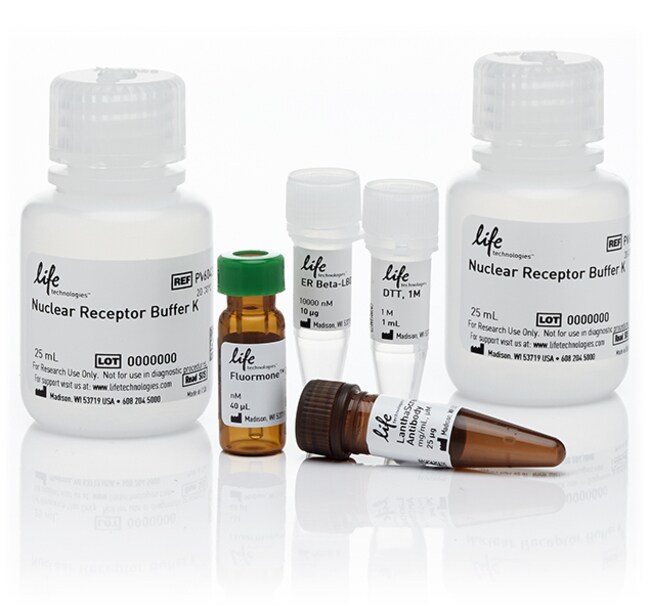
We performed a comparison between the LanthaScreen assay and other commercially available TR-FRET assays from 2 different suppliers for the PKC kinase target. Our data revealed that the assays performed comparably, but that the LanthaScreen assay was simpler to optimize and contained fewer components that required optimization. The LanthaScreen assay is a two component system, whereas the other assay formats utilize a trimolecular mechanism which is more time consuming to optimize and has added costs.
For my kinase assay, can I pre-mix the Tb-Ab and EDTA so that I can stop the kinase assay and begin detection with a single reagent addition?
Yes, this is possible depending on the concentrations of reagents used and the time for which they are mixed. We recommend developing and optimizing the assay by using separate reagent additions, because this method will work under the widest range of conditions. Once the assay is optimized, the performance of the assay using pre-mixed antibody and EDTA can be evaluated. We have successfully developed robust assays in which the antibody and EDTA were pre-mixed and then stored overnight at 4 degrees C prior to use the following day. A loss of signal intensity was observed in this case, however, by using the ratiometric readout, this effect was minimal.
Are the LanthaScreen reagents stable to interference from Mg2+, Mn2+, and EDTA?
The chelate is completely stable to Mg2+. The amount of Mn2+ or EDTA that the chelate can tolerate depends largely on how long they are mixed together and the combination of additives used in the reaction. If a reaction requires either Mg2+ or Mn2+ for activation, it is best to stop the reaction by adding an equimolar amount (or slight excess) of EDTA to chelate the metal ions present. This will then essentially eliminate any interference on the terbium chelate by EDTA or Mn2+. Regardless, when LanthaScreen assays are performed using a ratiometric readout (division of the acceptor signal by the donor signal), any interference caused by Mn2+ or EDTA is largely cancelled out.
What is the optimal and/or maximum distance for a Tb-fluorescein pair?
The Förster radius, the distance at which energy transfer efficiency is half-maximal, is around 50-angstroms for the terbiumÆ fluorescein pair. However, the Förster radius does not give a complete indication of energy transfer efficiency when using long lifetime fluorophores such as terbium chelates. When using terbium chelates, energy transfer efficiency is determined by the distance of closest approach between the donor and acceptor during the excited state lifetime of the donor. In many assay systems, such as those designed using antibodies or peptides, there is a large degree of conformational freedom that allows the donor and acceptor to approach one another, effectively enhancing the FRET signal. Additionally, it is important to note that as the donor/acceptor pair approach one another and the efficiency of energy transfer increases, the fluorescent lifetime decreases to a comparable extent. From a practical standpoint, this means that when energy transfer is extremely efficient, FRET cannot be measured in time-resolved mode (because the energy transfer is complete before the measurement is made). This is another reason why TR-FRET assays based around terbium-labeled antibodies or streptavidin perform so well, because there exist a range of donor/acceptor distances, several of which are optimal for measuring FRET.