Search

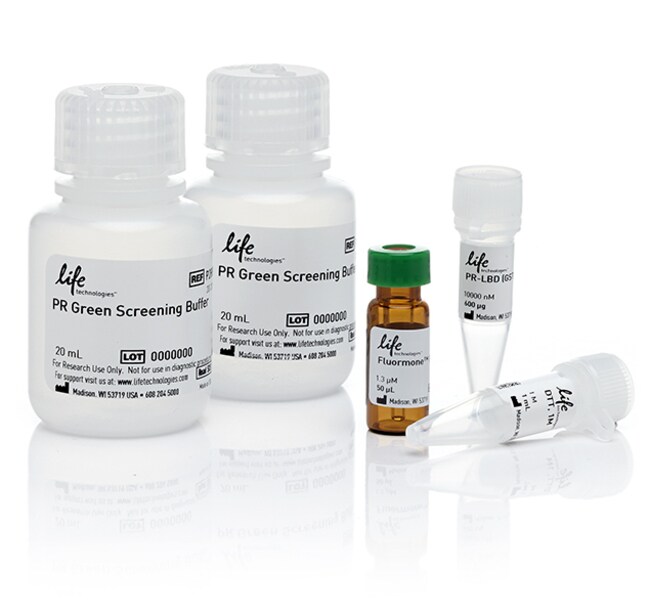
PolarScreen™ 孕激素受体竞争剂检测试剂盒,绿色
PolarScreen™ 孕激素受体竞争剂检测试剂盒(绿色)为高通量荧光偏振法筛选潜在孕激素受体(PR)配体提供了灵敏高效的方法。该试剂盒采用带有谷胱甘肽-S-转移酶 (GST) 标签的昆虫细胞表达的人 PR了解更多信息
| 货号 | 数量 |
|---|---|
| A15905 | 400 x 20 μL assays |
货号 A15905
价格(CNY)
15,820.00
Each
数量:
400 x 20 μL assays
价格(CNY)
15,820.00
Each
PolarScreen™ 孕激素受体竞争剂检测试剂盒(绿色)为高通量荧光偏振法筛选潜在孕激素受体(PR)配体提供了灵敏高效的方法。该试剂盒采用带有谷胱甘肽-S-转移酶 (GST) 标签的昆虫细胞表达的人 PR 配体结合结构域(也可单独购买),以及均一混合读数检测形式的新型高亲和力荧光孕激素受体配体 (Fluormone™ PL Green)。
该试剂盒产生绿色读数;也有“红色”试剂盒可供选择。 两种试剂盒均适合测定竞争性化合物的 IC50。颜色选择取决于待筛选化合物的光谱特性和可用的仪器。如需更多信息或帮助,请通过 drugdiscoverytech@lifetech.com 联系我们。
PolarScreen 孕激素受体竞争剂检测试剂盒为:
•全套、即开即用—包含所有试剂,只需添加测试化合物即可
•适合高通量—可以用384孔板进行荧光偏振检测
•方便—可提供大规格的组分,以满足更大的筛选需求
检测原理
在微孔板中存在竞争性测试化合物的情况下,将谷胱甘肽转移酶与人孕激素受体配体结合结构域的N末端融合体 (PR-LBD(GST)) 添加到荧光标签孕激素配体 (Fluormone PL Green) 中。有效竞争剂的存在会阻止 PL Green/PR-LBD(GST) 复合物的形成,从而降低偏振度。测试化合物存在情况下的偏振度变化可用于测定测试化合物与 PR-LBD(GST) 的相对亲和力。
如需大包装规格或帮助满足从检测方法开发到文库筛选等其他核受体检测需求,请联系我们。
该试剂盒产生绿色读数;也有“红色”试剂盒可供选择。 两种试剂盒均适合测定竞争性化合物的 IC50。颜色选择取决于待筛选化合物的光谱特性和可用的仪器。如需更多信息或帮助,请通过 drugdiscoverytech@lifetech.com 联系我们。
PolarScreen 孕激素受体竞争剂检测试剂盒为:
•全套、即开即用—包含所有试剂,只需添加测试化合物即可
•适合高通量—可以用384孔板进行荧光偏振检测
•方便—可提供大规格的组分,以满足更大的筛选需求
检测原理
在微孔板中存在竞争性测试化合物的情况下,将谷胱甘肽转移酶与人孕激素受体配体结合结构域的N末端融合体 (PR-LBD(GST)) 添加到荧光标签孕激素配体 (Fluormone PL Green) 中。有效竞争剂的存在会阻止 PL Green/PR-LBD(GST) 复合物的形成,从而降低偏振度。测试化合物存在情况下的偏振度变化可用于测定测试化合物与 PR-LBD(GST) 的相对亲和力。
如需大包装规格或帮助满足从检测方法开发到文库筛选等其他核受体检测需求,请联系我们。
仅供科研使用。不可用于诊断程序。
规格
适用于(应用)竞争性结合检测,核受体检测
配体PR
检测数量400 x 20 μL assays
产品类型检测试剂盒
数量400 x 20 μL assays
产品线PolarScreen
Unit SizeEach
内容与储存
1管孕激素受体配体结合结构域重组蛋白(-68至 -85°C 储存)
1管 Fluormone PL Green(-5至 -30°C 储存)
2瓶 PR 筛选缓冲液(-5至 -30°C 储存)
1管1M DTT(-5至 -30°C 储存)
1管 Fluormone PL Green(-5至 -30°C 储存)
2瓶 PR 筛选缓冲液(-5至 -30°C 储存)
1管1M DTT(-5至 -30°C 储存)