Search


引用和文献 (18)
Gibco™
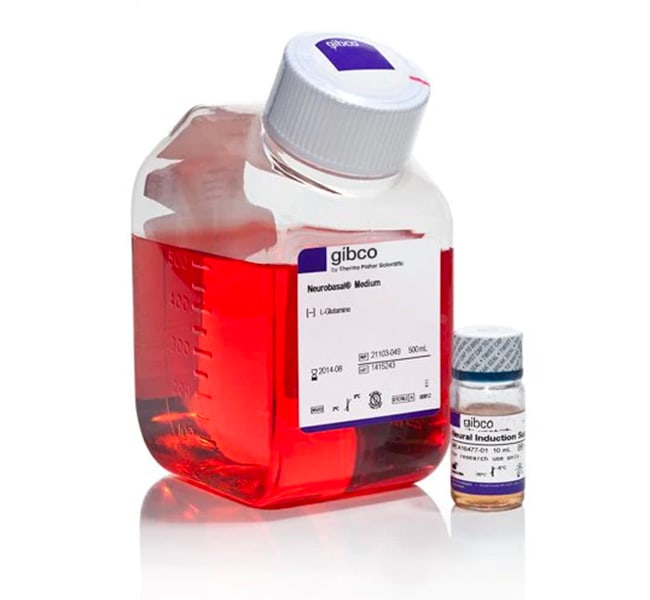
PSC 神经诱导培养基
Gibco™ PSC 神经诱导培养基是一种无血清培养基,仅在 7 天内即可对人多能干细胞 (PSC) 进行高效的神经诱导。与现有方法不同,使用 PSC 神经诱导培养基不需要胚状体了解更多信息
| 货号 | 数量 |
|---|---|
| A1647801 | 500 mL |
货号 A1647801
价格(CNY)
7,062.60
飞享价
Ends: 31-Dec-2026
8,940.00共减 1,877.40 (21%)
Each
数量:
500 mL
价格(CNY)
7,062.60
飞享价
Ends: 31-Dec-2026
8,940.00共减 1,877.40 (21%)
Each
Gibco™ PSC 神经诱导培养基是一种无血清培养基,仅在 7 天内即可对人多能干细胞 (PSC) 进行高效的神经诱导。与现有方法不同,使用 PSC 神经诱导培养基不需要胚状体 (EB) 形成的中间步骤,从而避免了增加时间、劳动力和可变性。使用 PSC 神经诱导培养基生成的神经干细胞 (NSC) 具有高表达的 NSC 标志物,并且可以进一步分化为其他神经细胞类型。
PSC 神经诱导培养基可实现:
• 快速诱导 NSC—仅在 7 天内即可进行高效的神经诱导,无 EB 形成
• 可扩展 NSC 生产:—从 1 百万个 PSC 开始生成 >2 千万个 NSC
• 生成高质量 NSC—使 NSC 可进行冷冻保存、扩增和分化
快速诱导 NSC
PSC 神经诱导培养基通过消除 EB 或玫瑰花结形成来简化 NSC 的生成工作流程。通过去除这一步骤,PSC 神经诱导培养基仅在 7 天内即可进行高效的神经诱导,且该过程具备再现性。
可扩展 NSC 生产
PSC 神经诱导培养基是一种强大的培养基,已证实能够从 1 百万个 PSC 中生成超过 2 千万个 NSC。该培养基经多个 hPSC 细胞系测试,包括使用附着体 iPSC 重编程载体和 CytoTune™-iPS 仙台病毒重编程试剂盒来源的 hiPSC。
生成高质量 NSC
使用 PSC 神经诱导培养基生成的神经干细胞的 Sox1、Sox2 和巢蛋白(NSC 标志物)表达 >80%,以及 Oct4(多能性标志物)表达 <1%。此外,扩增的 NSC 维持表型,表现出正常的核型,可分化为神经元、星形胶质细胞和少突胶质细胞。
PSC 神经诱导培养基可实现:
• 快速诱导 NSC—仅在 7 天内即可进行高效的神经诱导,无 EB 形成
• 可扩展 NSC 生产:—从 1 百万个 PSC 开始生成 >2 千万个 NSC
• 生成高质量 NSC—使 NSC 可进行冷冻保存、扩增和分化
快速诱导 NSC
PSC 神经诱导培养基通过消除 EB 或玫瑰花结形成来简化 NSC 的生成工作流程。通过去除这一步骤,PSC 神经诱导培养基仅在 7 天内即可进行高效的神经诱导,且该过程具备再现性。
可扩展 NSC 生产
PSC 神经诱导培养基是一种强大的培养基,已证实能够从 1 百万个 PSC 中生成超过 2 千万个 NSC。该培养基经多个 hPSC 细胞系测试,包括使用附着体 iPSC 重编程载体和 CytoTune™-iPS 仙台病毒重编程试剂盒来源的 hiPSC。
生成高质量 NSC
使用 PSC 神经诱导培养基生成的神经干细胞的 Sox1、Sox2 和巢蛋白(NSC 标志物)表达 >80%,以及 Oct4(多能性标志物)表达 <1%。此外,扩增的 NSC 维持表型,表现出正常的核型,可分化为神经元、星形胶质细胞和少突胶质细胞。
仅供科研使用。不可用于诊断程序。
规格
细胞类型胚胎干细胞 (ESC)、诱导多能干细胞 (iPSC)、人类干细胞
产品类型PSC 神经诱导培养基
数量500 mL
血清水平无血清
Unit SizeEach
内容与储存
• 500 mL 基础培养基(储存在 2–8°C 下并避光)
• 10 mL 添加剂(储存在 -5 至 -20°C 下并避光)
• 10 mL 添加剂(储存在 -5 至 -20°C 下并避光)
常见问题解答 (FAQ)
我的Gibco PSC神经诱导培养基(货号A1647801)无法成功诱导出神经细胞?
将iPSC向NSC进行神经诱导后,我能使用Gibco StemPro NSC SFM(货号 A1050901)扩增NSCs么?
我能否将Gibco Essential 8 Flex培养基中长期培养的PSC用于后续的分化操作?
Can PSC Neural Induction Medium be used to differentiate hPSCs into neurospheres or neurons?
Have you performed flow cytometry or qPCR studies to determine the expression of NKX2.1 in NSCs generated from iPSC using PSC Neural Induction Medium?
引用和文献 (18)
引用和文献
Abstract
A comprehensive protocol for efficient differentiation of human NPCs into electrically competent neurons.
Journal:Journal of neuroscience methods
PubMed ID:39053772
Efficient and rapid derivation of primitive neural stem cells and generation of brain subtype neurons from human pluripotent stem cells.
Journal:
PubMed ID:24113065
'Human pluripotent stem cells (hPSCs), including human embryonic stem cells and human induced pluripotent stem cells, are unique cell sources for disease modeling, drug discovery screens, and cell therapy applications. The first step in producing neural lineages from hPSCs is the generation of neural stem cells (NSCs). Current methods of
New type of Sendai virus vector provides transgene-free iPS cells derived from chimpanzee blood.
Journal:
PubMed ID:25479600
'Induced pluripotent stem cells (iPSCs) are potentially valuable cell sources for disease models and future therapeutic applications; however, inefficient generation and the presence of integrated transgenes remain as problems limiting their current use. Here, we developed a new Sendai virus vector, TS12KOS, which has improved efficiency, does not integrate into
Differentiation of Human Neural Stem Cells into Motor Neurons Stimulates Mitochondrial Biogenesis and Decreases Glycolytic Flux.
Journal:
PubMed ID:25892363
Differentiation of human pluripotent stem cells (hPSCs) in vitro offers a way to study cell types that are not accessible in living patients. Previous research suggests that hPSCs generate ATP through anaerobic glycolysis, in contrast to mitochondrial oxidative phosphorylation (OXPHOS) in somatic cells; however, specialized cell types have not been
Induced pluripotent stem cell - derived neurons for the study of spinocerebellar ataxia type 3.
Journal:Stem Cell Res
PubMed ID:27596958
'The neurodegenerative disease spinocerebellar ataxia type 3 (SCA3) is caused by a CAG-repeat expansion in the ATXN3 gene. In this study, induced pluripotent stem cell (iPSC) lines were established from two SCA3 patients. Dermal fibroblasts were reprogrammed using an integration-free method and the resulting SCA3 iPSCs were differentiated into neurons.