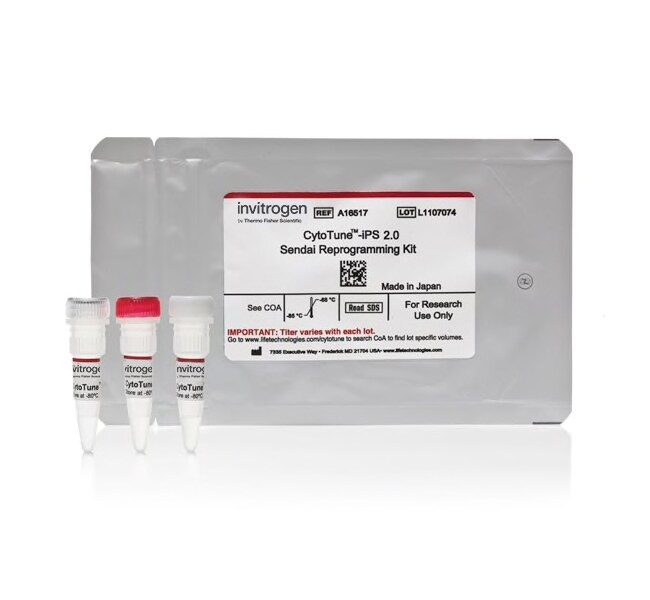
What is the shelf life of the CytoTune-iPS 2.0 Sendai Reprogramming Kit?
The shelf life for the CytoTune-iPS 2.0 Sendai Reprogramming Kit is 2 years when stored at -80 degrees C with no repeated freeze-thaw cycles.
Find additional tips, troubleshooting help, and resources within our Cell Culture Support Center.
What is the optimal passage number for reprogramming patient fibroblasts using the CytoTune-iPS 2.0 Sendai Reprogramming Kit?
We recommend reprogramming patient cells at the earliest passage possible. However, it is important to have the cells growing and healthy, which can take between 1-4 weeks. The cells are usually ready to reprogram once they have gone through a total of 3-4 passages.
Find additional tips, troubleshooting help, and resources within our Cell Culture Support Center.
Can I scale down my CytoTune-iPS 2.0 Sendai reprogramming experiments?
Yes. Initial experiments with fibroblasts have shown that scaling down to a 12-well or 24-well works, but at a potentially reduced efficiency. Cell seeding densities may need to be optimized.
Find additional tips, troubleshooting help, and resources within our Cell Culture Support Center.
How many cells do I need to start my reprogramming experiment with the CytoTune-iPS 2.0 Sendai Reprogramming Kit?
We recommend seeding approximately 50,000-100,000 fibroblast cells per well of a 6-well to yield 200,000-300,000 cells two days later. This equals a confluency of 50-80% on the day of transduction. Overly confluent cells will result in a decreased transduction efficiency. When cells are overly confluent (>80% confluent), we recommend re-plating the cells to achieve a range of 50-80% confluency on the day of transduction.
Find additional tips, troubleshooting help, and resources within our Cell Culture Support Center.
What is the difference between the CTS CytoTune-iPS 2.1 Sendai Reprogramming Kit and the CytoTune-iPS 2.0 Sendai Reprogramming Kit?
The CTS CytoTune-iPS 2.1 Sendai vector formulation does not contain the bovine serum albumin carrier protein. Additionally, the preparation contains no animal-derived components at the primary component level. Each virus (i.e., KOS, L-Myc, and Kfl4) comes in a volume of 200 µL instead of 100 µL. The titer of the CTS CytoTune-iPS 2.1 Sendai Reprogramming Kit can range from 0.5 x 10E8 to 2.0 x 10E8 virus particles per mL whereas the titer of the CytoTune-iPS 2.0 Sendai Reprogramming Kit is typically around 1.0 x 10E8 virus particles per mL.
Find additional tips, troubleshooting help, and resources within our Cell Culture Support Center.