Search


引用和文献 (57)
Invitrogen™
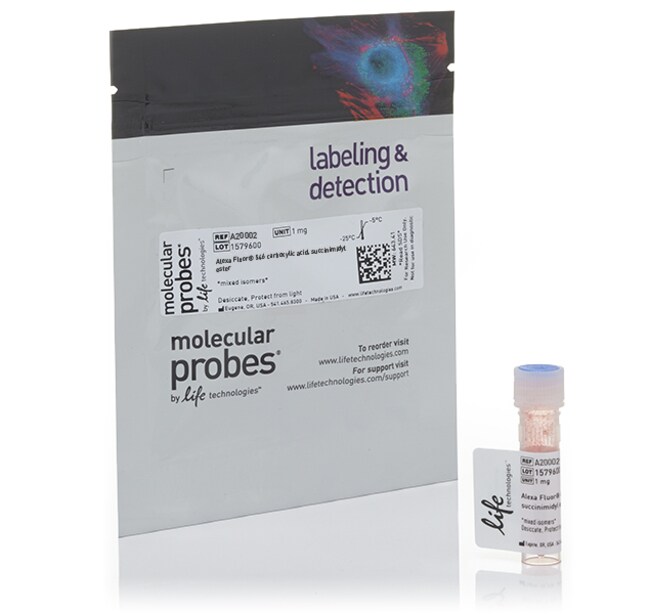
Alexa Fluor™546 NHS 酯(琥珀酰亚胺酯)
Alexa Fluor™ 546 是一种亮黄色染料。Alexa Fluor™ 546 染料用于成像和流式细胞分析,具有水溶性和 pH 值不敏感性了解更多信息
Have Questions?
更改视图

| 货号 | 数量 |
|---|---|
| A20002 | 1 mg |
| A20102 | 5 mg |
货号 A20002
价格(CNY)
6,378.00
Each
数量:
1 mg
价格(CNY)
6,378.00
Each
Alexa Fluor™ 546 是一种亮黄色染料。Alexa Fluor™ 546 染料用于成像和流式细胞分析,具有水溶性和 pH 值不敏感性(pH 值为 4 - 10 的范围内)。除反应性染料制剂外,我们还提供可与多种抗体、肽、蛋白、示踪剂和扩增底物偶联并且针对细胞标记和检测进行优化的 Alexa Fluor™ 546 染料(了解更多信息)。
Alexa Fluor™ 546 的 NHS 酯(或琥珀酰亚胺酯)是将该染料与蛋白或抗体偶联的较常用工具。NHS 酯可用于标记蛋白、胺修饰的寡核苷酸和其他含胺分子的伯胺 (R-NH2)。所得 Alexa Fluor™ 偶联物将显示出比其他光谱相似荧光基团的偶联物更亮的荧光和更高的光稳定性。
关于该 AlexaFluor™ NHS 酯的详细信息:
荧光基团标记:Alexa Fluor™ 546 染料
反应性基团:NHS 酯
反应性:蛋白和配体、胺修饰的寡核苷酸上的伯胺
偶联物的 Ex/Em:554/570 nm
消光系数:112,000 cm-1M-1
分子量:1159.6
典型偶联反应
您可以将胺反应性试剂与几乎任何蛋白或肽偶联(提供的方案针对 IgG 抗体进行了优化)。您可以针对任何量的蛋白按比例缩放反应,但为了获得最佳结果,蛋白的浓度应至少为 2 mg/mL。我们建议使用三种不同的反应性试剂/蛋白摩尔比进行三种不同程度的标记。
Alexa Fluor™ NHS 酯通常溶于高质量的无水二甲基甲酰胺 (DMF) 或二甲亚砜 (DMSO) (D12345) 中,并在 0.1–0.2 M 碳酸氢钠缓冲液(pH 值 8.3)中于室温下进行反应,持续 1 小时。由于末端胺的 pKa 低于赖氨酸 ε-氨基基团的 pKa,您可以使用接近中性 pH 值的缓冲液对胺末端进行更具选择性的标记。
偶联物纯化
通常使用凝胶过滤柱(如 Sephadex™ G-25、BioGel™ P-30 或等效柱)将标记抗体与游离 Alexa Fluor™ 染料分离。对于更大或更小的蛋白,选择具有适当分子量滤除点的凝胶过滤介质或通过透析纯化。我们提供了多种优化的纯化试剂盒,可用于不同量抗体偶联物:
0.5-1 mg 用抗体偶联物纯化试剂盒 (A33086)
20-50 µg 用抗体偶联物纯化试剂盒 (A33087)
50-100 µg 用抗体偶联物纯化试剂盒 (A33088)
了解关于蛋白和抗体标记的更多信息
我们提供一系列 Molecular Probes™ 抗体和蛋白标记试剂盒,旨在满足您的起始材料和实验设置需求。参见我们的抗体标记试剂盒或使用我们的标记化学选择工具进行其他选择。欲了解有关我们标记试剂盒的更多信息,请参阅 Molecular Probes™ 手册中第 1.2 节—蛋白和核酸标记试剂盒。
我们还’可为您定制偶联物
如果您’无法在我们的在线目录中找到’想要的产品,我们还’可为您定制抗体或蛋白偶联物。我们的定制偶联服务是高效和保密的,我们保证我们的工作质量。我们经过ISO 9001:2000认证。
Alexa Fluor™ 546 的 NHS 酯(或琥珀酰亚胺酯)是将该染料与蛋白或抗体偶联的较常用工具。NHS 酯可用于标记蛋白、胺修饰的寡核苷酸和其他含胺分子的伯胺 (R-NH2)。所得 Alexa Fluor™ 偶联物将显示出比其他光谱相似荧光基团的偶联物更亮的荧光和更高的光稳定性。
关于该 AlexaFluor™ NHS 酯的详细信息:
荧光基团标记:Alexa Fluor™ 546 染料
反应性基团:NHS 酯
反应性:蛋白和配体、胺修饰的寡核苷酸上的伯胺
偶联物的 Ex/Em:554/570 nm
消光系数:112,000 cm-1M-1
分子量:1159.6
典型偶联反应
您可以将胺反应性试剂与几乎任何蛋白或肽偶联(提供的方案针对 IgG 抗体进行了优化)。您可以针对任何量的蛋白按比例缩放反应,但为了获得最佳结果,蛋白的浓度应至少为 2 mg/mL。我们建议使用三种不同的反应性试剂/蛋白摩尔比进行三种不同程度的标记。
Alexa Fluor™ NHS 酯通常溶于高质量的无水二甲基甲酰胺 (DMF) 或二甲亚砜 (DMSO) (D12345) 中,并在 0.1–0.2 M 碳酸氢钠缓冲液(pH 值 8.3)中于室温下进行反应,持续 1 小时。由于末端胺的 pKa 低于赖氨酸 ε-氨基基团的 pKa,您可以使用接近中性 pH 值的缓冲液对胺末端进行更具选择性的标记。
偶联物纯化
通常使用凝胶过滤柱(如 Sephadex™ G-25、BioGel™ P-30 或等效柱)将标记抗体与游离 Alexa Fluor™ 染料分离。对于更大或更小的蛋白,选择具有适当分子量滤除点的凝胶过滤介质或通过透析纯化。我们提供了多种优化的纯化试剂盒,可用于不同量抗体偶联物:
0.5-1 mg 用抗体偶联物纯化试剂盒 (A33086)
20-50 µg 用抗体偶联物纯化试剂盒 (A33087)
50-100 µg 用抗体偶联物纯化试剂盒 (A33088)
了解关于蛋白和抗体标记的更多信息
我们提供一系列 Molecular Probes™ 抗体和蛋白标记试剂盒,旨在满足您的起始材料和实验设置需求。参见我们的抗体标记试剂盒或使用我们的标记化学选择工具进行其他选择。欲了解有关我们标记试剂盒的更多信息,请参阅 Molecular Probes™ 手册中第 1.2 节—蛋白和核酸标记试剂盒。
我们还’可为您定制偶联物
如果您’无法在我们的在线目录中找到’想要的产品,我们还’可为您定制抗体或蛋白偶联物。我们的定制偶联服务是高效和保密的,我们保证我们的工作质量。我们经过ISO 9001:2000认证。
仅供科研使用。不可用于诊断程序。
规格
化学反应性胺
发射570 nm
激发554 nm
标签或染料Alexa Fluor™ 546
产品类型染料
数量1 mg
反应一部分活性酯、琥珀酰亚胺酯
运输条件室温
标签类型Alexa Fluor 染料
产品线Alexa Fluor
Unit SizeEach
内容与储存
储存在冰箱(-5 至 -30°C)中并避光。
常见问题解答 (FAQ)
I am labeling a protein with Alexa Fluor 488 SDP ester. The manual recommends using a sodium bicarbonate buffer at pH 8.3. Can I use a different buffer instead?
I am not going to use all of my Alexa Fluor succinimidyl ester reactive dye. Can I just make it up in DMSO and store aliquots at -20 degrees C?
引用和文献 (57)
引用和文献
Abstract
A small-molecule approach to studying invasive mechanisms of Toxoplasma gondii.
Journal:Proc Natl Acad Sci U S A
PubMed ID:15123807
'Toxoplasma gondii is the most common protozoan parasite of humans. Infection with T. gondii can lead to life-threatening disease as a result of repeated cycles of host cell invasion, parasite replication, and host cell lysis. Relatively little is known about the invasive mechanisms of T. gondii and related parasites within
Alexa dyes, a series of new fluorescent dyes that yield exceptionally bright, photostable conjugates.
Journal:J Histochem Cytochem
PubMed ID:10449539
'Alexa 350, Alexa 430, Alexa 488, Alexa 532, Alexa 546, Alexa 568, and Alexa 594 dyes are a new series of fluorescent dyes with emission/excitation spectra similar to those of AMCA, Lucifer Yellow, fluorescein, rhodamine 6G, tetramethylrhodamine or Cy3, lissamine rhodamine B, and Texas Red, respectively (the numbers in the
Antibody interactions with the capsule of Cryptococcus neoformans.
Journal:Infect Immun
PubMed ID:10816523
'Monoclonal antibodies to the encapsulated fungus Cryptococcus neoformans produce different immunofluorescence (IF) patterns after binding to the polysaccharide capsule. To explore the relationship between the IF pattern and the location of antibody binding, two immunoglobulin M (IgM) monoclonal antibodies (MAbs) (12A1 and 13F1) that differ in protective efficacy and IF
CD24 is expressed by myofiber synaptic nuclei and regulates synaptic transmission.
Journal:Proc Natl Acad Sci U S A
PubMed ID:16606832
'The genes encoding several synaptic proteins, including acetylcholine receptors, acetylcholinesterase, and the muscle-specific kinase, MuSK, are expressed selectively by a small number of myofiber nuclei positioned near the synaptic site. Genetic analysis of mutant mice suggests that additional genes, expressed selectively by synaptic nuclei, might encode muscle-derived retrograde signals that
Optimizing antibody immobilization strategies for the construction of protein microarrays.
Journal:Anal Biochem
PubMed ID:12531195
'Antibody microarrays have the potential to revolutionize protein expression profiling. The intensity of specific signal produced on a feature of such an array is related to the amount of analyte that is captured from the biological mixture by the immobilized antibody (the "capture agent"). This in turn is a function