Search


引用和文献 (17)
Invitrogen™
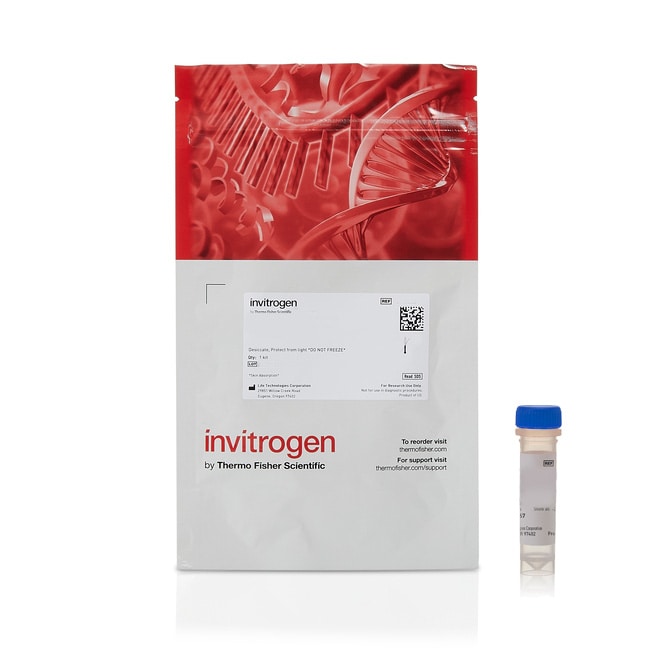
Alexa Fluor™532 NHS 酯(琥珀酰亚胺酯)
Alexa Fluor™ 532 is a bright yellow dye with excitation ideally suited for the frequency-doubled Nd:YAG laser line. Used for了解更多信息
Have Questions?
更改视图

| 货号 | 数量 |
|---|---|
| A20101MP 又称 A-20101MP | 5 mg |
| A20001 又称 A-20001 | 1 mg |
货号 A20101MP
又称 A-20101MP
价格(CNY)
24,224.00
Each
数量:
5 mg
价格(CNY)
24,224.00
Each
Alexa Fluor™ 532 is a bright yellow dye with excitation ideally suited for the frequency-doubled Nd:YAG laser line. Used for stable signal generation in imaging and flow cytometry, Alexa Fluor™ 532 dye is water soluble and pH-insensitive from pH 4 to pH 10. In addition to reactive dye formulations, we offer Alexa Fluor™ 532 dye conjugated to a variety of antibodies, peptides, proteins, tracers, and amplification substrates optimized for cellular labeling and detection (learn more).
The NHS ester (or succinimidyl ester) of Alexa Fluor™ 532 is the most popular tool for conjugating this dye to a protein or antibody. NHS esters can be used to label to the primary amines (R-NH2) of proteins, amine-modified oligonucleotides, and other amine-containing molecules. The resulting Alexa Fluor™ conjugate will exhibit brighter fluorescence and greater photostability than the conjugates of other spectrally similar fluorophores.
Detailed information about this AlexaFluor™ NHS ester:
- Fluorophore label: Alexa Fluor™ 532 dye
- Reactive group: NHS ester
- Reactivity: Primary amines on proteins and ligands, amine-modified oligonucleotides
- Ex/Em of the conjugate: 530/555 nm
- Extinction coefficient: 81,000 cm-1M-1
- Molecular weight: 723.8
Typical Conjugation Reaction
You can conjugate amine-reactive reagents with virtually any protein or peptide (the provided protocol is optimized for IgG antibodies). You can scale the reaction for any amount of protein, but the concentration of the protein should be at least 2 mg/mL for optimal results. We recommend trying three different degrees of labeling, using three different molar ratios of the reactive reagent to protein.
The Alexa Fluor™ NHS ester is typically dissolved in high-quality anhydrous dimethylformamide (DMF) or dimethylsulfoxide (DMSO) (D12345), and the reaction is carried out in 0.1–0.2 M sodium bicarbonate buffer, pH 8.3, at room temperature for 1 hour. Because the pKa of the terminal amine is lower than that of the lysine epsilon-amino group, you may achieve more selective labeling of the amine terminus using a buffer closer to neutral pH.
Conjugate Purification
Labeled antibodies are typically separated from free Alexa Fluor™ dye using a gel filtration column, such as Sephadex™ G-25, BioGel™ P-30, or equivalent. For much larger or smaller proteins, select a gel filtration media with an appropriate molecular weight cut-off or purify by dialysis. We offer several purification kits optimized for different quantities of antibody conjugate:
- Antibody Conjugate Purification Kit for 0.5-1 mg (A33086)
- Antibody Conjugate Purification Kit for 20-50 μg (A33087)
- Antibody Conjugate Purification kit for 50-100 μg (A33088)
Learn More About Protein and Antibody Labeling
We offer a wide selection of Molecular Probes™ antibody and protein labeling kits to fit your starting material and your experimental setup. See our Antibody Labeling kits or use our Labeling Chemistry Selection Tool for other choices. To learn more about our labeling kits, read Kits for Labeling Proteins and Nucleic Acids—Section 1.2 in The Molecular Probes™ Handbook.
We'll Make a Custom Conjugate for You
If you can't find what you're looking for in our online catalog, we'll prepare a custom antibody or protein conjugate for you. Our custom conjugation service is efficient and confidential, and we stand by the quality of our work. We are ISO 13485:2000 certified.
仅供科研使用。不可用于诊断程序。
规格
化学反应性胺
发射555 nm
激发530 nm
标签或染料Alexa Fluor™ 532
产品类型染料
数量5 mg
反应一部分活性酯、琥珀酰亚胺酯
运输条件室温
标签类型Alexa Fluor 染料
产品线Alexa Fluor
Unit SizeEach
内容与储存
储存在冰箱(-5 至 -30°C)中并避光。
常见问题解答 (FAQ)
I am labeling a protein with Alexa Fluor 488 SDP ester. The manual recommends using a sodium bicarbonate buffer at pH 8.3. Can I use a different buffer instead?
I am not going to use all of my Alexa Fluor succinimidyl ester reactive dye. Can I just make it up in DMSO and store aliquots at -20 degrees C?
引用和文献 (17)
引用和文献
Abstract
Benzodiazepine binding studies on living cells: application of small ligands for fluorescence correlation spectroscopy.
Journal:Biol Chem
PubMed ID:12530545
'We demonstrate the applicability of fluorescence correlation spectroscopy (FCS) for receptor binding studies using low molecular weight ligands on the membranes of living nerve cells. The binding of the benzodiazepine Ro 7-1986/602 (N-des-diethyl-fluorazepam), labeled with the fluorophore Alexa 532, to the benzodiazepine receptor was analyzed quantitatively at the membrane of
Lateral mobility and specific binding to GABA(A) receptors on hippocampal neurons monitored by fluorescence correlation spectroscopy.
Journal:Biochemistry
PubMed ID:12578381
'The binding behavior of a fluorescently labeled muscimol derivative to the GABA(A) receptor was analyzed at rat hippocampal neurons by fluorescence correlation spectroscopy. After muscimol had been labeled with the fluorophore Alexa Fluor 532, specific binding constants for binding of the dye-labeled ligand (Mu-Alexa) to the GABA(A) receptor were determined.
Dynamics of beta2-adrenergic receptor-ligand complexes on living cells.
Journal:Biochemistry
PubMed ID:15147203
'The agonist-induced dynamic regulation of the beta(2)-adrenergic receptor (beta(2)-AR) on living cells was examined by means of fluorescence correlation spectroscopy (FCS) using a fluorescence-labeled arterenol derivative (Alexa-NA) in hippocampal neurons and in alveolar epithelial type II cell line A549. Alexa-NA specifically bound to the beta(2)-AR of neurons with a K(D)
Quantitative screening of single copies of human papilloma viral DNA without amplification.
Journal:Anal Chem
PubMed ID:16970325
'We describe a novel quantitative viral screening method based on single-molecule detection that does not require amplification. DNA of human papilloma virus (HPV), the major etiological agent of cervical cancer, served as the screening target in this study. Eight 100-nucleotide single-stranded DNA probes were designed complementary to the E6-E7 gene
Plasma membrane cholesterol content affects nitric oxide diffusion dynamics and signaling.
Journal:J Biol Chem
PubMed ID:18445594
'Nitric oxide (NO) signaling is inextricably linked to both its physical and chemical properties. Due to its preferentially hydrophobic solubility, NO molecules tend to partition from the aqueous milieu into biological membranes. We hypothesized that plasma membrane ordering provided by cholesterol further couples the physics of NO diffusion with cellular