Search


引用和文献 (16)
Invitrogen™
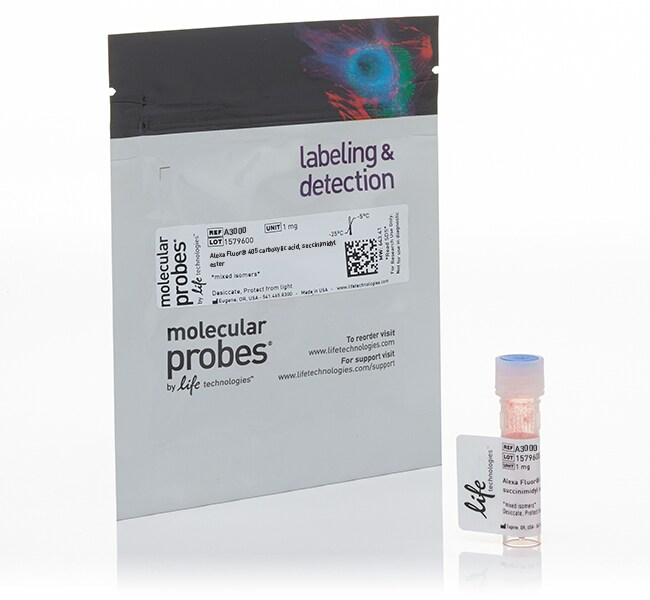
Alexa Fluor™ 405 NHS 酯(琥珀酰亚胺酯)
Alexa Fluor™ 405 是一种蓝色荧光染料,它非常适合与 405 nm 紫激光配合使用。Alexa Fluor™ 405了解更多信息
Have Questions?
更改视图

| 货号 | 数量 |
|---|---|
| A30000 | 1 mg |
| A30100 又称 A-30100 | 5 mg |
货号 A30000
价格(CNY)
6,740.00
Each
数量:
1 mg
价格(CNY)
6,740.00
Each
Alexa Fluor™ 405 是一种蓝色荧光染料,它非常适合与 405 nm 紫激光配合使用。Alexa Fluor™ 405 染料用于成像和流式细胞分析中稳定信号的生成,具有水溶性和 pH 值不敏感性 (pH 4 - pH 10)。除反应性染料制剂外,我们还提供可与多种抗体、肽、蛋白、示踪剂和扩增底物偶联并且针对细胞标记和检测进行优化的 Alexa Fluor™ 405 染料(了解更多信息)。
Alexa Fluor™ 405 的 NHS 酯(或琥珀酰亚胺酯)是将该染料与蛋白或抗体偶联的较常用工具。NHS 酯可用于标记蛋白、胺修饰的寡核苷酸和其他含胺分子的伯胺 (R-NH2)。所得 Alexa Fluor™ 偶联物将显示出比其他光谱相似荧光基团的偶联物更亮的荧光和更高的光稳定性。
关于该 AlexaFluor™ NHS 酯的详细信息:
荧光基团标记:Alexa Fluor™ 405 染料
反应性基团:NHS 酯
反应性:蛋白和配体、胺修饰的寡核苷酸上的伯胺
偶联物的 Ex/Em:400/424 nm
消光系数:35,000 cm-1M-1
光谱类似染料:Pacific Blue
分子量:1028.3
典型偶联反应
您可以将胺反应性试剂与几乎任何蛋白或肽偶联(提供的方案针对 IgG 抗体进行了优化)。您可以针对任何量的蛋白按比例缩放反应,但为了获得最佳结果,蛋白的浓度应至少为 2 mg/mL。我们建议使用三种不同的反应性试剂/蛋白摩尔比进行三种不同程度的标记。
Alexa Fluor™ NHS 酯通常溶于高质量的无水二甲基甲酰胺 (DMF) 或二甲亚砜 (DMSO) (D12345) 中,并在 0.1–0.2 M 碳酸氢钠缓冲液(pH 值 8.3)中于室温下进行反应,持续 1 小时。由于末端胺的 pKa 低于赖氨酸 ε-氨基基团的 pKa,您可以使用接近中性 pH 值的缓冲液对胺末端进行更具选择性的标记。
偶联物纯化
通常使用凝胶过滤柱(如 Sephadex™ G-25、BioGel™ P-30 或等效柱)将标记抗体与游离 Alexa Fluor™ 染料分离。对于更大或更小的蛋白,选择具有适当分子量滤除点的凝胶过滤介质或通过透析纯化。我们提供了多种优化的纯化试剂盒,可用于不同量抗体偶联物:
0.5-1 mg 用抗体偶联物纯化试剂盒 (A33086)
20-50 µg 用抗体偶联物纯化试剂盒 (A33087)
50-100 µg 用抗体偶联物纯化试剂盒 (A33088)
了解关于蛋白和抗体标记的更多信息
我们提供一系列 Molecular Probes™ 抗体和蛋白标记试剂盒,旨在满足您的起始材料和实验设置需求。参见我们的抗体标记试剂盒或使用我们的标记化学选择工具进行其他选择。欲了解有关我们标记试剂盒的更多信息,请参阅 Molecular Probes™ 手册中第 1.2 节—蛋白和核酸标记试剂盒。
我们还’可为您定制偶联物
如果您’无法在我们的在线目录中找到’想要的产品,我们还’可为您定制抗体或蛋白偶联物。我们的定制偶联服务是高效和保密的,我们保证我们的工作质量。我们经过ISO 9001:2000认证。
Alexa Fluor™ 405 的 NHS 酯(或琥珀酰亚胺酯)是将该染料与蛋白或抗体偶联的较常用工具。NHS 酯可用于标记蛋白、胺修饰的寡核苷酸和其他含胺分子的伯胺 (R-NH2)。所得 Alexa Fluor™ 偶联物将显示出比其他光谱相似荧光基团的偶联物更亮的荧光和更高的光稳定性。
关于该 AlexaFluor™ NHS 酯的详细信息:
荧光基团标记:Alexa Fluor™ 405 染料
反应性基团:NHS 酯
反应性:蛋白和配体、胺修饰的寡核苷酸上的伯胺
偶联物的 Ex/Em:400/424 nm
消光系数:35,000 cm-1M-1
光谱类似染料:Pacific Blue
分子量:1028.3
典型偶联反应
您可以将胺反应性试剂与几乎任何蛋白或肽偶联(提供的方案针对 IgG 抗体进行了优化)。您可以针对任何量的蛋白按比例缩放反应,但为了获得最佳结果,蛋白的浓度应至少为 2 mg/mL。我们建议使用三种不同的反应性试剂/蛋白摩尔比进行三种不同程度的标记。
Alexa Fluor™ NHS 酯通常溶于高质量的无水二甲基甲酰胺 (DMF) 或二甲亚砜 (DMSO) (D12345) 中,并在 0.1–0.2 M 碳酸氢钠缓冲液(pH 值 8.3)中于室温下进行反应,持续 1 小时。由于末端胺的 pKa 低于赖氨酸 ε-氨基基团的 pKa,您可以使用接近中性 pH 值的缓冲液对胺末端进行更具选择性的标记。
偶联物纯化
通常使用凝胶过滤柱(如 Sephadex™ G-25、BioGel™ P-30 或等效柱)将标记抗体与游离 Alexa Fluor™ 染料分离。对于更大或更小的蛋白,选择具有适当分子量滤除点的凝胶过滤介质或通过透析纯化。我们提供了多种优化的纯化试剂盒,可用于不同量抗体偶联物:
0.5-1 mg 用抗体偶联物纯化试剂盒 (A33086)
20-50 µg 用抗体偶联物纯化试剂盒 (A33087)
50-100 µg 用抗体偶联物纯化试剂盒 (A33088)
了解关于蛋白和抗体标记的更多信息
我们提供一系列 Molecular Probes™ 抗体和蛋白标记试剂盒,旨在满足您的起始材料和实验设置需求。参见我们的抗体标记试剂盒或使用我们的标记化学选择工具进行其他选择。欲了解有关我们标记试剂盒的更多信息,请参阅 Molecular Probes™ 手册中第 1.2 节—蛋白和核酸标记试剂盒。
我们还’可为您定制偶联物
如果您’无法在我们的在线目录中找到’想要的产品,我们还’可为您定制抗体或蛋白偶联物。我们的定制偶联服务是高效和保密的,我们保证我们的工作质量。我们经过ISO 9001:2000认证。
仅供科研使用。不可用于诊断程序。
规格
化学反应性胺
检测方法荧光
发射421 nm
激发401 nm
流式细胞仪激光线路405 nm
标签或染料Alexa Fluor™ 405
产品类型染料
数量1 mg
反应一部分活性酯、琥珀酰亚胺酯
运输条件室温
溶解度DMSO(二甲亚砜)
标签类型Alexa Fluor 染料
产品线Alexa Fluor
Unit SizeEach
内容与储存
含1瓶 (1 mg)。 在冷冻冰箱(-5 至 -30°C)中避光储存。
常见问题解答 (FAQ)
I am labeling a protein with Alexa Fluor 488 SDP ester. The manual recommends using a sodium bicarbonate buffer at pH 8.3. Can I use a different buffer instead?
I am not going to use all of my Alexa Fluor succinimidyl ester reactive dye. Can I just make it up in DMSO and store aliquots at -20 degrees C?
Is Alexa Fluor 405 dye the best dye for imaging with a 405 nm laser?
引用和文献 (16)
引用和文献
Abstract
3D multicolor super-resolution imaging offers improved accuracy in neuron tracing.
Journal:PLoS One
PubMed ID:22292051
'The connectivity among neurons holds the key to understanding brain function. Mapping neural connectivity in brain circuits requires imaging techniques with high spatial resolution to facilitate neuron tracing and high molecular specificity to mark different cellular and molecular populations. Here, we tested a three-dimensional (3D), multicolor super-resolution imaging method, stochastic
Preparation of photoswitchable labeled antibodies for STORM imaging.
Journal:
PubMed ID:23734027
'Stochastic optical reconstruction microscopy (STORM) is a method for superresolution fluorescence imaging based on the high accuracy localization of individual fluorophores. It uses optically switchable fluorophores: molecules that can be switched between a nonfluorescent and a fluorescent state by exposure to light. Many synthetic fluorescent dye molecules show photoswitchable fluorescence
CD8 T cell competition for dendritic cells in vivo is an early event in activation.
Journal:Proc Natl Acad Sci U S A
PubMed ID:16880405
'T cell responses against an antigen are often focused on a small fraction of potentially immunogenic determinants, a phenomenon known as immunodominance. Immunodominance can be established at several stages of antigen presentation, including antigen processing, binding of peptides to MHC, and competition between T cells for dendritic cells (DCs). The
Fast, three-dimensional super-resolution imaging of live cells.
Journal:Nat Methods
PubMed ID:21552254
'We report super-resolution fluorescence imaging of live cells with high spatiotemporal resolution using stochastic optical reconstruction microscopy (STORM). By labeling proteins either directly or via SNAP tags with photoswitchable dyes, we obtained two-dimensional (2D) and 3D super-resolution images of living cells, using clathrin-coated pits and the transferrin cargo as model
Superresolution imaging of chemical synapses in the brain.
Journal:Neuron
PubMed ID:21144999
'Determination of the molecular architecture of synapses requires nanoscopic image resolution and specific molecular recognition, a task that has so far defied many conventional imaging approaches. Here, we present a superresolution fluorescence imaging method to visualize the molecular architecture of synapses in the brain. Using multicolor, three-dimensional stochastic optical reconstruction