Search


引用和文献 (6)
Invitrogen™
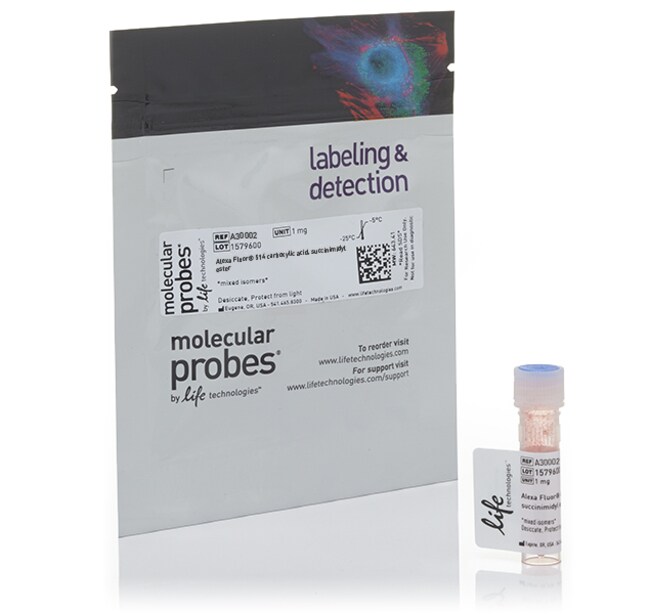
Alexa Fluor™514 NHS 酯(琥珀酰亚胺酯)
Alexa Fluor™ 514 是一种明亮的绿色荧光染料。Alexa Fluor™ 514 染料用于成像和流式细胞分析中稳定信号的生成,具有水溶性和 pH 值不敏感性了解更多信息
| 货号 | 数量 |
|---|---|
| A30002 又称 A-30002 | 1 mg |
货号 A30002
又称 A-30002
价格(CNY)
6,571.00
Each
数量:
1 mg
价格(CNY)
6,571.00
Each
Alexa Fluor™ 514 是一种明亮的绿色荧光染料。Alexa Fluor™ 514 染料用于成像和流式细胞分析中稳定信号的生成,具有水溶性和 pH 值不敏感性(pH 值 4 至 pH 值 10)。除反应性染料配方外,我们还提供可与多种抗体、肽、蛋白、示踪剂和扩增底物偶联并且针对细胞标记和检测进行优化的 Alexa Fluor™ 514 染料。
Alexa Fluor™ 514 的 NHS 酯(或琥珀酰亚胺酯)是将该染料与蛋白或抗体偶联的较常用工具。NHS 酯可用于标记蛋白、胺修饰的寡核苷酸和其他含胺分子的伯胺 (R-NH2)。所得 Alexa Fluor™ 偶联物将显示出比其他光谱相似荧光基团的偶联物更亮的荧光和更高的光稳定性。
关于该 AlexaFluor™ NHS 酯的详细信息:
荧光基团标记:Alexa Fluor™ 514 染料
反应性基团:NHS 酯
反应性:蛋白和配体、胺修饰的寡核苷酸上的伯胺
偶联物的 Ex/Em:517/542 nm
消光系数:80,000 cm-1M-2
典型偶联反应
您可以将胺反应性试剂与几乎任何蛋白或肽偶联(提供的方案针对 IgG 抗体进行了优化)。您可以针对任何量的蛋白按比例缩放反应,但为了获得最佳结果,蛋白的浓度应至少为 2 mg/mL。我们建议使用三种不同的反应性试剂/蛋白摩尔比进行三种不同程度的标记。
Alexa Fluor™ NHS 酯通常溶于高质量的无水二甲基甲酰胺 (DMF) 或二甲亚砜 (DMSO) (D12345) 中,并在 0.1–0.2 M 碳酸氢钠缓冲液(pH 值 8.3)中于室温下进行反应,持续 1 小时。由于末端胺的 pKa 低于赖氨酸 ε-氨基基团的 pKa,您可以使用接近中性 pH 值的缓冲液对胺末端进行更具选择性的标记。
偶联物纯化
通常使用凝胶过滤柱(如 Sephadex™ G-25、BioGel™ P-30 或等效柱)将标记抗体与游离 Alexa Fluor™ 染料分离。对于更大或更小的蛋白,选择具有适当分子量滤除点的凝胶过滤介质或通过透析纯化。我们提供了多种优化的纯化试剂盒,可用于不同量抗体偶联物:
0.5-1 mg 用抗体偶联物纯化试剂盒 (A33086)
20-50 µg 用抗体偶联物纯化试剂盒 (A33087)
50-100 µg 用抗体偶联物纯化试剂盒 (A33088)
了解关于蛋白和抗体标记的更多信息
我们提供一系列 Molecular Probes™ 抗体和蛋白标记试剂盒,旨在满足您的起始材料和实验设置需求。参见我们的抗体标记试剂盒或使用我们的标记化学选择工具进行其他选择。欲了解有关我们标记试剂盒的更多信息,请参阅 Molecular Probes™ 手册中第 1.2 节—蛋白和核酸标记试剂盒。
我们还’可为您定制偶联物
如果您’无法在我们的在线目录中找到’想要的产品,我们还’可为您定制抗体或蛋白偶联物。我们的定制偶联服务是高效和保密的,我们保证我们的工作质量。我们经过ISO 9001:2000认证。
Alexa Fluor™ 514 的 NHS 酯(或琥珀酰亚胺酯)是将该染料与蛋白或抗体偶联的较常用工具。NHS 酯可用于标记蛋白、胺修饰的寡核苷酸和其他含胺分子的伯胺 (R-NH2)。所得 Alexa Fluor™ 偶联物将显示出比其他光谱相似荧光基团的偶联物更亮的荧光和更高的光稳定性。
关于该 AlexaFluor™ NHS 酯的详细信息:
荧光基团标记:Alexa Fluor™ 514 染料
反应性基团:NHS 酯
反应性:蛋白和配体、胺修饰的寡核苷酸上的伯胺
偶联物的 Ex/Em:517/542 nm
消光系数:80,000 cm-1M-2
典型偶联反应
您可以将胺反应性试剂与几乎任何蛋白或肽偶联(提供的方案针对 IgG 抗体进行了优化)。您可以针对任何量的蛋白按比例缩放反应,但为了获得最佳结果,蛋白的浓度应至少为 2 mg/mL。我们建议使用三种不同的反应性试剂/蛋白摩尔比进行三种不同程度的标记。
Alexa Fluor™ NHS 酯通常溶于高质量的无水二甲基甲酰胺 (DMF) 或二甲亚砜 (DMSO) (D12345) 中,并在 0.1–0.2 M 碳酸氢钠缓冲液(pH 值 8.3)中于室温下进行反应,持续 1 小时。由于末端胺的 pKa 低于赖氨酸 ε-氨基基团的 pKa,您可以使用接近中性 pH 值的缓冲液对胺末端进行更具选择性的标记。
偶联物纯化
通常使用凝胶过滤柱(如 Sephadex™ G-25、BioGel™ P-30 或等效柱)将标记抗体与游离 Alexa Fluor™ 染料分离。对于更大或更小的蛋白,选择具有适当分子量滤除点的凝胶过滤介质或通过透析纯化。我们提供了多种优化的纯化试剂盒,可用于不同量抗体偶联物:
0.5-1 mg 用抗体偶联物纯化试剂盒 (A33086)
20-50 µg 用抗体偶联物纯化试剂盒 (A33087)
50-100 µg 用抗体偶联物纯化试剂盒 (A33088)
了解关于蛋白和抗体标记的更多信息
我们提供一系列 Molecular Probes™ 抗体和蛋白标记试剂盒,旨在满足您的起始材料和实验设置需求。参见我们的抗体标记试剂盒或使用我们的标记化学选择工具进行其他选择。欲了解有关我们标记试剂盒的更多信息,请参阅 Molecular Probes™ 手册中第 1.2 节—蛋白和核酸标记试剂盒。
我们还’可为您定制偶联物
如果您’无法在我们的在线目录中找到’想要的产品,我们还’可为您定制抗体或蛋白偶联物。我们的定制偶联服务是高效和保密的,我们保证我们的工作质量。我们经过ISO 9001:2000认证。
仅供科研使用。不可用于诊断程序。
规格
化学反应性胺
发射542 nm
激发517 nm
标签或染料Alexa Fluor™ 514
产品类型染料
数量1 mg
反应一部分活性酯、琥珀酰亚胺酯
运输条件室温
标签类型Alexa Fluor 染料
产品线Alexa Fluor
Unit SizeEach
内容与储存
储存在冰箱(-5 至 -30°C)中并避光。
常见问题解答 (FAQ)
I am labeling a protein with Alexa Fluor 488 SDP ester. The manual recommends using a sodium bicarbonate buffer at pH 8.3. Can I use a different buffer instead?
I am not going to use all of my Alexa Fluor succinimidyl ester reactive dye. Can I just make it up in DMSO and store aliquots at -20 degrees C?
引用和文献 (6)
引用和文献
Abstract
Toxicity of organic fluorophores used in molecular imaging: literature review.
Journal:Mol Imaging
PubMed ID:20003892
'Fluorophores are potentially useful for in vivo cancer diagnosis. Using relatively inexpensive and portable equipment, optical imaging with fluorophores permits real-time detection of cancer. However, fluorophores can be toxic and must be investigated before they can be administered safely to patients. A review of published literature on the toxicity of
Robust approaches to quantitative ratiometric FRET imaging of CFP/YFP fluorophores under confocal microscopy.
Journal:J Microsc
PubMed ID:19196425
'Ratiometric quantification of CFP/YFP FRET enables live-cell time-series detection of molecular interactions, without the need for acceptor photobleaching or specialized equipment for determining fluorescence lifetime. Although popular in widefield applications, its implementation on a confocal microscope, which would enable sub-cellular resolution, has met with limited success. Here, we characterize sources
Glioblastoma cellular architectures are predicted through the characterization of two-cell interactions.
Journal:
PubMed ID:24733941
To understand how pairwise cellular interactions influence cellular architectures, we measured the levels of functional proteins associated with EGF receptor (EGFR) signaling in pairs of U87EGFR variant III oncogene receptor cells (U87EGFRvIII) at varying cell separations. Using a thermodynamics-derived approach we analyzed the cell-separation dependence of the signaling stability, and
O-glycosylation as a novel control mechanism of peptidoglycan hydrolase activity.
Journal:
PubMed ID:23760506
Acm2, the major autolysin of Lactobacillus plantarum, is a tripartite protein. Its catalytic domain is surrounded by an O-glycosylated N-terminal region rich in Ala, Ser, and Thr (AST domain), which is of low complexity and unknown function, and a C-terminal region composed of five SH3b peptidoglycan (PG) binding domains. Here,
Programmable in situ amplification for multiplexed imaging of mRNA expression.
Journal:Nat Biotechnol
PubMed ID:21037591
In situ hybridization methods enable the mapping of mRNA expression within intact biological samples. With current approaches, it is challenging to simultaneously map multiple target mRNAs within whole-mount vertebrate embryos, representing a significant limitation in attempting to study interacting regulatory elements in systems most relevant to human development and disease.