Search


引用和文献 (35)
Invitrogen™
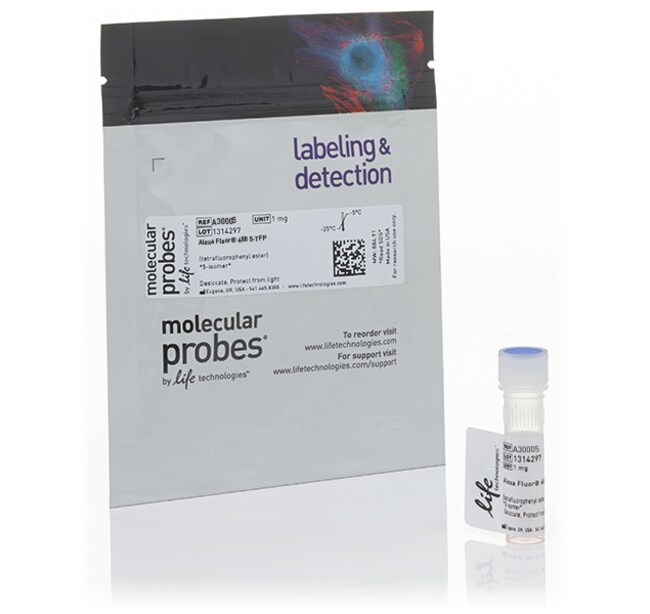
Alexa Fluor™ 488 5-TFP(Alexa Fluor™ 488 羧酸,2,3,5,6-四氟苯基酯),5 异构体
Alexa Fluor™ 488 5-TFP(Alexa Fluor™ 488 羧酸,2,3,5,6-四氟苯基酯),5 异构体
| 货号 | 数量 |
|---|---|
| A30005 | 1 mg |
货号 A30005
价格(CNY)
6,449.00
Each
数量:
1 mg
价格(CNY)
6,449.00
Each
Tetrafluorophenyl (TFP) esters are an improvement over the succinimidyl ester (SE or NHS-ester) chemistry typically used to attach fluorophores or haptens to the primary amines of biomolecules. Both reactive chemistries produce the same strong amide bond between the dye or hapten and the compound of interest, but TFP esters are less susceptible to spontaneous hydrolysis during conjugation reactions. Alexa Fluor TFP esters are stable for several hours at the basic pH typically used for reactions – far outlasting succinimidyl esters.
四氟苯基 (TFP) 酯是对琥珀酰亚胺酯(SE 或 NHS 酯)的化学改进,通常用于将荧光基团或半抗原连接到生物分子的伯胺上。两种反应性化学基团均可在染料或半抗原与目标化合物之间产生相同的强酰胺键,但在偶联反应过程中,TFP 酯不易自发水解。Alexa Fluor TFP 酯在通常用于反应的碱性 pH 值下可稳定数小时 – 远超过琥珀酰亚胺酯。
仅供科研使用。不可用于诊断程序。
规格
化学反应性胺
标签或染料Alexa Fluor™ 488
产品类型羧酸四氟苯基酯
数量1 mg
反应一部分活性酯,TFP 酯
运输条件室温
标签类型Alexa Fluor 染料
产品线Alexa Fluor
Unit SizeEach
内容与储存
储存在冰箱(-5 至 -30°C)中并避光。
常见问题解答 (FAQ)
I am labeling a protein with Alexa Fluor 488 SDP ester. The manual recommends using a sodium bicarbonate buffer at pH 8.3. Can I use a different buffer instead?
I am not going to use all of my Alexa Fluor succinimidyl ester reactive dye. Can I just make it up in DMSO and store aliquots at -20 degrees C?
引用和文献 (35)
引用和文献
Abstract
Identification, cloning, and characterization of two N-acetylgalactosamine-binding lectins from the albumen gland of Helix pomatia.
Journal:J Biol Chem
PubMed ID:21372134
Helix pomatia agglutinin (HPA), the lectin from the albumen gland of the Roman snail, has been used in histochemical studies relating glycosylation changes to the metastatic potential of solid tumors. To facilitate the use of HPA in a clinical (diagnostic) setting, detailed analysis of the lectin, including cloning and recombinant
Heterogeneous nuclear ribonucleoprotein (hnRNP) E1 binds to hnRNP A2 and inhibits translation of A2 response element mRNAs.
Journal:Mol Biol Cell
PubMed ID:16775011
'Heterogeneous nuclear ribonucleoprotein (hnRNP) A2 is a trans-acting RNA-binding protein that mediates trafficking of RNAs containing the cis-acting A2 response element (A2RE). Previous work has shown that A2RE RNAs are transported to myelin in oligodendrocytes and to dendrites in neurons. hnRNP E1 is an RNA-binding protein that regulates translation of
Photolithographic patterning of polyethylene glycol hydrogels.
Journal:Biomaterials
PubMed ID:16375965
'A simple, inexpensive photolithographic method for surface patterning deformable, solvated substrates is demonstrated using photoactive poly(ethylene glycol) (PEG)-diacrylate hydrogels as model substrates. Photolithographic masks were prepared by printing the desired patterns onto transparencies using a laser jet printer. Precursor solutions containing monoacryloyl-PEG-peptide and photoinitiator were layered onto hydrogel surfaces. The
Physical interactions of the peroxisomal targeting signal 1 receptor pex5p, studied by fluorescence correlation spectroscopy.
Journal:J Biol Chem
PubMed ID:12930827
'We have studied Hansenula polymorpha Pex5p and Pex8p using fluorescence correlation spectroscopy (FCS). Pex5p is the Peroxisomal Targeting Signal 1 (PTS1) receptor and Pex8p is an intraperoxisomal protein. Both proteins are essential for PTS1 protein import and have been shown to physically interact. We used FCS to analyze the molecular
Pathway of actin filament branch formation by Arp2/3 complex revealed by single-molecule imaging.
Journal:Proc Natl Acad Sci U S A
PubMed ID:23292935
'Actin filament nucleation by actin-related protein (Arp) 2/3 complex is a critical process in cell motility and endocytosis, yet key aspects of its mechanism are unknown due to a lack of real-time observations of Arp2/3 complex through the nucleation process. Triggered by the verprolin homology, central, and acidic (VCA) region