Search


引用和文献 (5)
Invitrogen™
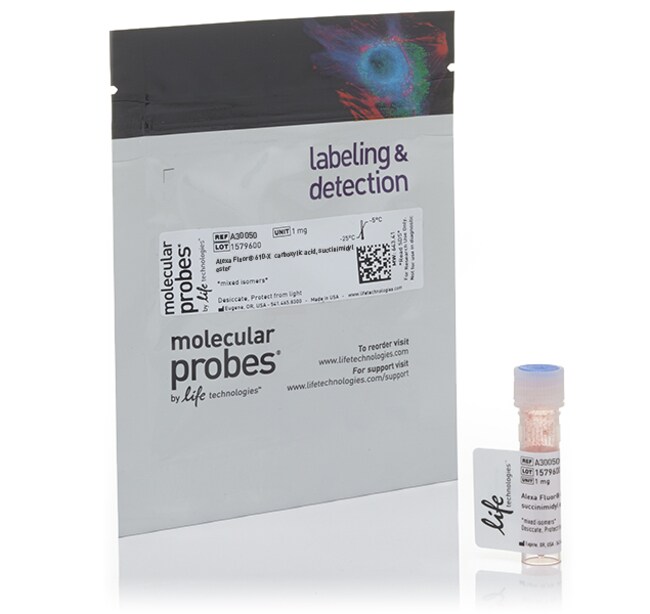
Alexa Fluor™ 610-X NHS 酯(琥珀酰亚胺酯)
Alexa Fluor™ 610-X 是一种明亮且光稳定的 Texas Red™ 染料替代品。Alexa Fluor™ 610-X了解更多信息
| 货号 | 数量 |
|---|---|
| A30050 | 1 mg |
货号 A30050
价格(CNY)
6,359.00
Each
数量:
1 mg
价格(CNY)
6,359.00
Each
Alexa Fluor™ 610-X 是一种明亮且光稳定的 Texas Red™ 染料替代品。Alexa Fluor™ 610-X 染料用于成像和流式细胞分析中稳定信号的生成,具有水溶性和 pH 值不敏感性(pH 值 4 至 pH 值 10)。除反应性染料制剂外,我们还提供用于流式细胞分析的 Alexa Fluor™ 610–R-藻红蛋白串联抗体偶联物。Alexa Fluor™ 610-X 的 NHS 酯(或琥珀酰亚胺酯)是将该染料偶联至蛋白或抗体的常用工具。NHS 酯可用于标记蛋白、胺修饰的寡核苷酸和其他含胺分子的伯胺 (R-NH2)。所得 Alexa Fluor™ 偶联物将显示出比其他光谱相似荧光基团的偶联物更亮的荧光和更高的光稳定性。
关于该 AlexaFluor™ NHS 酯的详细信息:
荧光基团标记:Alexa Fluor™ 610-X 染料
反应性基团:NHS 酯
反应性:蛋白和配体、胺修饰的寡核苷酸上的伯胺
偶联物的 Ex/Em:603/623 nm
消光系数:144,000 cm-1M-1
光谱类似染料:Texas Red™
分子量:1284.8
典型偶联反应
您可以将胺反应性试剂与几乎任何蛋白或肽偶联(提供的方案针对 IgG 抗体进行了优化)。您可以针对任何量的蛋白按比例缩放反应,但为了获得最佳结果,蛋白的浓度应至少为 2 mg/mL。我们建议使用三种不同的反应性试剂/蛋白摩尔比进行三种不同程度的标记。
Alexa Fluor™ NHS 酯通常溶于高质量的无水二甲基甲酰胺 (DMF) 或二甲亚砜 (DMSO) (D12345) 中,并在 0.1–0.2 M 碳酸氢钠缓冲液(pH 值 8.3)中于室温下进行反应,持续 1 小时。由于末端胺的 pKa 低于赖氨酸 ε-氨基基团的 pKa,您可以使用接近中性 pH 值的缓冲液对胺末端进行更具选择性的标记。
偶联物纯化
通常使用凝胶过滤柱(如 Sephadex™ G-25、BioGel™ P-30 或等效柱)将标记抗体与游离 Alexa Fluor™ 染料分离。对于更大或更小的蛋白,选择具有适当分子量滤除点的凝胶过滤介质或通过透析纯化。我们提供了多种优化的纯化试剂盒,可用于不同量抗体偶联物:
0.5-1 mg 用抗体偶联物纯化试剂盒 (A33086)
20-50 µg 用抗体偶联物纯化试剂盒 (A33087)
50-100 µg 用抗体偶联物纯化试剂盒 (A33088)
了解关于蛋白和抗体标记的更多信息
我们提供一系列 Molecular Probes™ 抗体和蛋白标记试剂盒,旨在满足您的起始材料和实验设置需求。参见我们的抗体标记试剂盒或使用我们的标记化学选择工具进行其他选择。欲了解有关我们标记试剂盒的更多信息,请参阅 Molecular Probes™ 手册中第 1.2 节—蛋白和核酸标记试剂盒。
我们还’可为您定制偶联物
如果您’无法在我们的在线目录中找到’想要的产品,我们还’可为您定制抗体或蛋白偶联物。我们的定制偶联服务是高效和保密的,我们保证我们的工作质量。我们经过ISO 9001:2000认证。
关于该 AlexaFluor™ NHS 酯的详细信息:
荧光基团标记:Alexa Fluor™ 610-X 染料
反应性基团:NHS 酯
反应性:蛋白和配体、胺修饰的寡核苷酸上的伯胺
偶联物的 Ex/Em:603/623 nm
消光系数:144,000 cm-1M-1
光谱类似染料:Texas Red™
分子量:1284.8
典型偶联反应
您可以将胺反应性试剂与几乎任何蛋白或肽偶联(提供的方案针对 IgG 抗体进行了优化)。您可以针对任何量的蛋白按比例缩放反应,但为了获得最佳结果,蛋白的浓度应至少为 2 mg/mL。我们建议使用三种不同的反应性试剂/蛋白摩尔比进行三种不同程度的标记。
Alexa Fluor™ NHS 酯通常溶于高质量的无水二甲基甲酰胺 (DMF) 或二甲亚砜 (DMSO) (D12345) 中,并在 0.1–0.2 M 碳酸氢钠缓冲液(pH 值 8.3)中于室温下进行反应,持续 1 小时。由于末端胺的 pKa 低于赖氨酸 ε-氨基基团的 pKa,您可以使用接近中性 pH 值的缓冲液对胺末端进行更具选择性的标记。
偶联物纯化
通常使用凝胶过滤柱(如 Sephadex™ G-25、BioGel™ P-30 或等效柱)将标记抗体与游离 Alexa Fluor™ 染料分离。对于更大或更小的蛋白,选择具有适当分子量滤除点的凝胶过滤介质或通过透析纯化。我们提供了多种优化的纯化试剂盒,可用于不同量抗体偶联物:
0.5-1 mg 用抗体偶联物纯化试剂盒 (A33086)
20-50 µg 用抗体偶联物纯化试剂盒 (A33087)
50-100 µg 用抗体偶联物纯化试剂盒 (A33088)
了解关于蛋白和抗体标记的更多信息
我们提供一系列 Molecular Probes™ 抗体和蛋白标记试剂盒,旨在满足您的起始材料和实验设置需求。参见我们的抗体标记试剂盒或使用我们的标记化学选择工具进行其他选择。欲了解有关我们标记试剂盒的更多信息,请参阅 Molecular Probes™ 手册中第 1.2 节—蛋白和核酸标记试剂盒。
我们还’可为您定制偶联物
如果您’无法在我们的在线目录中找到’想要的产品,我们还’可为您定制抗体或蛋白偶联物。我们的定制偶联服务是高效和保密的,我们保证我们的工作质量。我们经过ISO 9001:2000认证。
仅供科研使用。不可用于诊断程序。
规格
化学反应性胺
发射623 nm
激发603 nm
标签或染料Alexa Fluor™ 610
产品类型染料替代品
数量1 mg
反应一部分活性酯、琥珀酰亚胺酯
运输条件室温
标签类型Alexa Fluor 染料
产品线Alexa Fluor
Unit SizeEach
内容与储存
储存在冰箱(-5 至 -30°C)中并避光。
常见问题解答 (FAQ)
I am labeling a protein with Alexa Fluor 488 SDP ester. The manual recommends using a sodium bicarbonate buffer at pH 8.3. Can I use a different buffer instead?
I am not going to use all of my Alexa Fluor succinimidyl ester reactive dye. Can I just make it up in DMSO and store aliquots at -20 degrees C?
引用和文献 (5)
引用和文献
Abstract
Oral instillation with surfactant phospholipid: a reliable alternative to intratracheal injection in mouse studies.
Journal:Lab Anim
PubMed ID:18625584
'The intratracheal (IT) injection technique has been widely used in the mouse studies of pulmonary diseases. Here, we describe a non-invasive technique using oral instillation challenge with the surfactant phospholipid that may advantageously replace the traditional IT technique. We performed comparative studies between oral instillation and IT injection of both
Biochemical and proteomic analysis of 'Dixiland' peach fruit (Prunus persica) upon heat treatment.
Journal:J Exp Bot
PubMed ID:19734260
'Shipping of peaches to distant markets and storage require low temperature; however, cold storage affects fruit quality causing physiological disorders collectively termed ''chilling injury'' (CI). In order to ameliorate CI, different strategies have been applied before cold storage; among them heat treatment (HT) has been widely used. In this work,
New evidence for differential roles of l10 ribosomal proteins from Arabidopsis.
Journal:
PubMed ID:23886624
'The RIBOSOMAL PROTEIN L10 (RPL10) is an integral component of the eukaryotic ribosome large subunit. Besides being a constituent of ribosomes and participating in protein translation, additional extraribosomal functions in the nucleus have been described for RPL10 in different organisms. Previously, we demonstrated that Arabidopsis (Arabidopsis thaliana) RPL10 genes are
Carbon metabolism of peach fruit after harvest: changes in enzymes involved in organic acid and sugar level modifications.
Journal:J Exp Bot
PubMed ID:19264753
'Peach (Prunus persica L. Batsch) is a climacteric fruit that ripens after harvest, prior to human consumption. Organic acids and soluble sugars contribute to the overall organoleptic quality of fresh peach; thus, the integrated study of the metabolic pathways controlling the levels of these compounds is of great relevance. Therefore,
Plant L10 ribosomal proteins have different roles during development and translation under ultraviolet-B stress.
Journal:Plant Physiol
PubMed ID:20516338
Ribosomal protein L10 (RPL10) proteins are ubiquitous in the plant kingdom. Arabidopsis (Arabidopsis thaliana) has three RPL10 genes encoding RPL10A to RPL10C proteins, while two genes are present in the maize (Zea mays) genome (rpl10-1 and rpl10-2). Maize and Arabidopsis RPL10s are tissue-specific and developmentally regulated, showing high levels of