Search


引用和文献 (12)
Invitrogen™
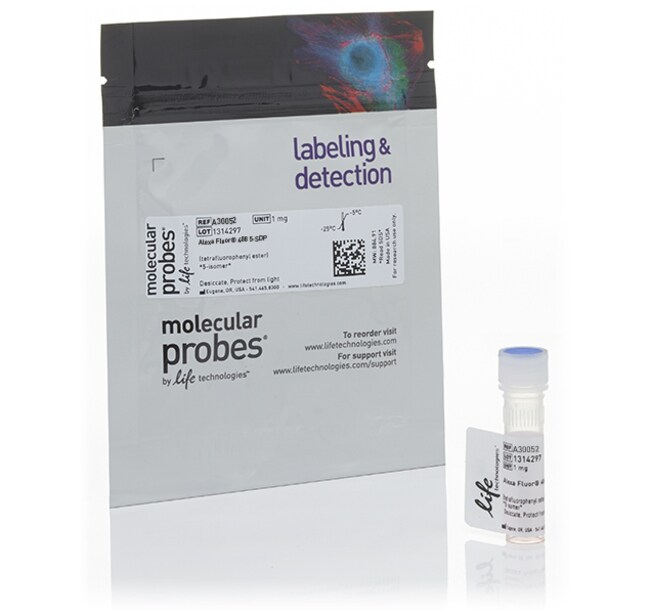
Alexa Fluor™ 488 5-SDP 酯(Alexa Fluor™ 488 Sulfodichlorophenol 酯)
Alexa Fluor™ 488 5-SDP 酯(Alexa Fluor™ 488 sulfodichlorophenol 酯)
| 货号 | 数量 |
|---|---|
| A30052 | 1 mg |
货号 A30052
价格(CNY)
6,323.00
Each
数量:
1 mg
价格(CNY)
6,323.00
Each
The SDP (sulfodicholorphenol) ester is currently the most hydrolytically stable amine-reactive moiety available from Invitrogen. Conjugates produced with the Alexa Fluor™ 488 5-SDP ester produce the same strong amide bond between the dye and the compound of interest as succinimidyl (SE or NHS) and tetrafluorophenyl (TFP) esters, but with the improved stability in water and buffers, the SDP ester can potentially offer increased control and consistency in these reactions compared to the NHS and TFP esters.
SDP (sulfodicholorphenol) 酯是目前为止 Invitrogen 提供的水解时最稳定的胺反应性部分。通过 Alexa Fluor™ 488 5-SDP 酯生成的偶联物产生的染料和目标化合物间酰胺键的强度与琥珀酰亚胺(SE 或 NHS)和四氟苯基 (TFP) 酯间酰胺键的强度相同,但是与 NHS 和 TFP 酯相比,随着 SDP 酯在水和缓冲液中的稳定性得到改善,其可能会增强对这些反应的控制和这些反应的一致性。
仅供科研使用。不可用于诊断程序。
规格
化学反应性胺
标签或染料Alexa Fluor™ 488
产品类型Sulfodichlorophenol 酯
数量1 mg
反应一部分活性酯,SDP 酯
运输条件室温
标签类型Alexa Fluor 染料
产品线Alexa Fluor
Unit SizeEach
内容与储存
储存在冰箱(-5 至 -30°C)中并避光。
常见问题解答 (FAQ)
I am labeling a protein with Alexa Fluor 488 SDP ester. The manual recommends using a sodium bicarbonate buffer at pH 8.3. Can I use a different buffer instead?
I am not going to use all of my Alexa Fluor succinimidyl ester reactive dye. Can I just make it up in DMSO and store aliquots at -20 degrees C?
引用和文献 (12)
引用和文献
Abstract
Evidence that viral RNAs have evolved for efficient, two-stage packaging.
Journal:Proc Natl Acad Sci U S A
PubMed ID:23019360
'Genome packaging is an essential step in virus replication and a potential drug target. Single-stranded RNA viruses have been thought to encapsidate their genomes by gradual co-assembly with capsid subunits. In contrast, using a single molecule fluorescence assay to monitor RNA conformation and virus assembly in real time, with two
Toxicity of organic fluorophores used in molecular imaging: literature review.
Journal:Mol Imaging
PubMed ID:20003892
'Fluorophores are potentially useful for in vivo cancer diagnosis. Using relatively inexpensive and portable equipment, optical imaging with fluorophores permits real-time detection of cancer. However, fluorophores can be toxic and must be investigated before they can be administered safely to patients. A review of published literature on the toxicity of
Optical properties of Alexa 488 and Cy5 immobilized on a glass surface.
Journal:Biotechniques
PubMed ID:15679095
'The absorption and emission spectra were measured for Cy5 and Alexa 488 fluorophores confined on a glass surface. The data were obtained using fluorometry and spectroscopic ellipsometry. Red shifts of the surface-immobilized fluorophore absorption spectra relative to the fluorophore spectra in aqueous solution were observed using both methods. We interpret
Modulation of the Pyrococcus abyssi NucS endonuclease activity by replication clamp at functional and structural levels.
Journal:J Biol Chem
PubMed ID:22431731
'Pyrococcus abyssi NucS is the founding member of a new family of structure-specific DNA endonucleases that interact with the replication clamp proliferating cell nuclear antigen (PCNA). Using a combination of small angle x-ray scattering and surface plasmon resonance analyses, we demonstrate the formation of a stable complex in solution, in
Milatuzumab-conjugated liposomes as targeted dexamethasone carriers for therapeutic delivery in CD74+ B-cell malignancies.
Journal:Clin Cancer Res
PubMed ID:23209030
'Corticosteroids are widely used for the treatment of B-cell malignancies, including non-Hodgkin lymphoma, chronic lymphocytic leukemia (CLL), and acute lymphoblastic leukemia; however, this class of drug is associated with undesirable off-target effects. Herein, we developed novel milatuzumab-conjugated liposomes as a targeted dexamethasone carrier for therapeutic delivery in CD74(+) B-cell malignancies