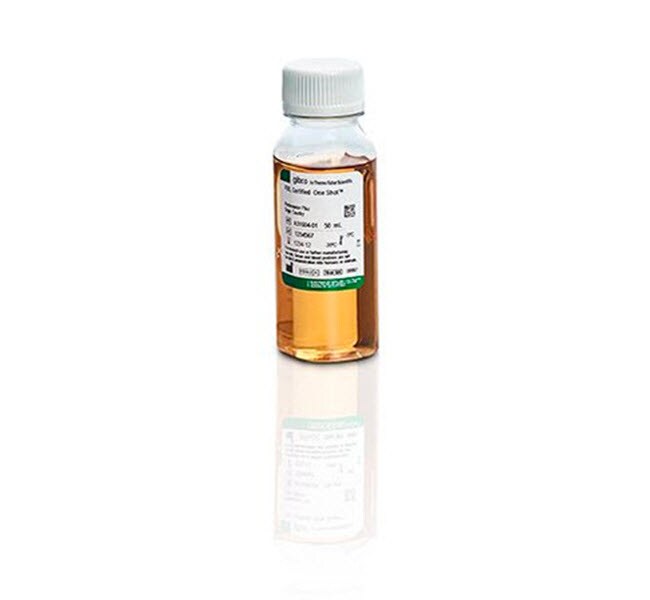
Why would I heat inactivate serum?
Heating inactivates complement. Active complement can participate in cytolytic events, contract smooth muscle, release histamine from mast cells and platelets, and activate lymphocytic and macrophage cells. Applications where heat inactivated serum is recommended include immunological studies and culturing ES cells, insect cells, and smooth muscle cells.
Find additional tips, troubleshooting help, and resources within our Cell Culture Support Center.
How do I heat inactivate serum?
Heat at 56 degrees C in a water bath for 30 minutes. Swirl bottle every 10 minutes or so. For accuracy, use a second bottle of similar size and add the equivalent volume of water to this bottle. Place a thermometer in this control bottle in order to see when 56 degrees C is reached. Set your timer for 30 minutes at this point.
Find additional tips, troubleshooting help, and resources within our Cell Culture Support Center.
What are the benefits and disadvantages of using heat-inactivated FBS in cell culture?
- Heating inactivates complement. Active complement can participate in cytolytic events, contract smooth muscle, release histamine from mast cells and platelets, and activate lymphocytic and macrophage cells. Applications where heat-inactivated serum is recommended include immunological studies and culturing of embryonic stem cells (ESCs), insect cells, and smooth muscle cells.
- Heat inactivation helps to achieve bottle-to-bottle and lot-to-lot stability by neutralizing many factors that can vary largely from lot to lot.
- There aren't necessarily disadvantages to heat inactivation of FBS, but there is some evidence that suggests there may be no added benefit to it unless you are carrying out immune studies.
Note: Heat inactivation is performed in a 56 degrees C water bath for 30 min with swirling every 10 min or so for heat distribution and to lower the degree of protein aggregation/flocculant precipitation. Note: If the time or temperature is exceeded, the serum may thicken to a gel. If this occurs, the serum is no longer usable. Unnecessary heat inactivation can take up time and potentially lead to wasted reagents if a mistake is made during the protocol1.
1. Pellerin, et al., Bioengineering, published in 2021.
Find additional tips, troubleshooting help, and resources within our Mammalian Cell Culture Basics Support Center.
What is the difference between "qualified" versus "certified" purity grade FBS?
The main difference is in the Quality Control (QC) test specifications. “Qualified” and “Certified” FBS go through the same QC tests but “Certified” FBS has additional QC tests as well as more stringent QC test specifications for endotoxin and hemoglobin levels. The additional QC tests in “Certified” FBS include biochemical and hormonal profiling.
Find additional tips, troubleshooting help, and resources within our Cell Culture Support Center.