Search

Invitrogen™
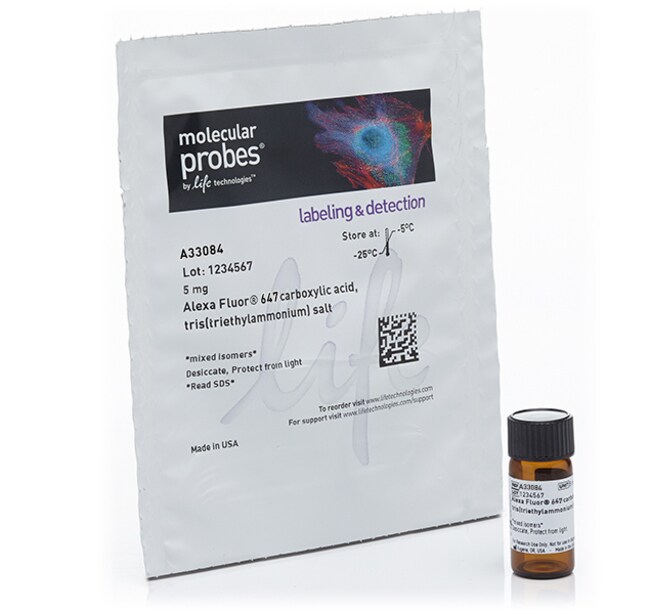
Alexa Fluor™ Carboxylic Acid, tris(triethylammonium) salts
Alexa Fluor Carboxylic Acid tris(triethylammonium) salts are non-reactive forms of the Alexa Fluor dye that can be used as a reference standard for dye-conjugates. Choose from ten different Alexa Fluor free acid dyes that span the spectrum, from 350 to 750 nm, to meet your research needs.
Have Questions?
更改视图

| 货号 | 激发 | 发射 |
|---|---|---|
| A33084 | 651 nm | 672 nm |
| A33076 | 346 nm | 442 nm |
| A33077 | 490 nm | 514 nm |
| A33078 | 528 nm | 548 nm |
| A33079 | 554 nm | 570 nm |
| A33080 | 555 nm | 572 nm |
| A33081 | 571 nm | 596 nm |
| A33082 | 585 nm | 610 nm |
| A33083 | 620 nm | 640 nm |
| A33085 | 753 nm | 783 nm |
货号 A33084
价格(CNY)
5,915.00
Each
激发:
651 nm
发射:
672 nm
价格(CNY)
5,915.00
Each
Alexa Fluor Carboxylic Acid tris(triethylammonium) salts are non-reactive, free acid forms of Alexa Fluor dyes. These carboxylic acid derivatives can be converted to an amine-reactive ester using standard chemical techniques or coupled to hydrazines, hydroxylamines, and amines in aqueous solution using EDAC.
Discover the benefits of the Alexa Fluor dye series
Compared to traditional dyes, Alexa Fluor dyes are brighter, more photostable, and more pH-resistant between pH 4 and 10. Generally when using Alexa Fluor dyes, higher degrees of labeling can be achieved without intramolecular quenching.
Thermo Fisher Scientific offers a variety of free acid dyes using carboxylic acid tris(triethylammonium) salts to provide non-reactive forms of various Alexa Fluor dyes. These Alexa Fluor dyes are offered as a free acid, where you can choose from ten different colors and wavelength excitations across the fluorophore spectrum.
Being unconjugated and non-reactive, Alexa Fluor free acid dyes cannot be used for labeling. However, Alexa Fluor free acid molecules are useful for injection site visualization in vivo and can be used as reference standards for corresponding dye-conjugates in any fluorescent labeling experiment. Free acid formats of Alexa Fluor dyes can be useful controls for confocal imaging, ICC/IHC, HCS, flow cytometry and live cell imaging.
To reconstitute, dissolve the Alexa Fluor carboxylic acid compound in aqueous buffer (e.g. PBS), or high-quality, anhydrous dimethylsulfoxide (DMSO) or dimethylformamide (DMF) at a final concentration of 1–10 mg/mL. Once reconstituted, this solution is stable for 1 year, when stored at 2–8°C and protected from light.
Alexa Fluor free acid dye options:
• Blue-fluorescent Alexa Fluor 350—excitation and emission maxima of 346/442 nm; excited using a 355-nm laser line and detected under standard DAPI filters. Alexa Fluor 350 is commonly used with Alexa Fluor 488, 594, and 647 dyes for multiplexing.
• Green-fluorescent Alexa Fluor 488—excitation and emission maxima of 490/514 nm; excited using a 488-nm argon laser line and detected under standard FITC/Cy2 filters. Alexa Fluor 488 is commonly used with DAPI, Alexa Fluor 594 and 647 dyes for multiplexing.
• Yellow-green fluorescent Alexa Fluor 532—excitation and emission maxima of 528/548 nm; excited using a 532-nm Nd:YAG laser line and detected under standard rhodamine 6G filters. Alexa Fluor 532 free acid dye has excitation and emission spectra between those of the green-fluorescent Alexa Fluor 488 dye and the orange-fluorescent Alexa Fluor 546 dye.
• Yellow-fluorescent Alexa Fluor 546—excitation and emission maxima of 554/570 nm; excited using a 543-nm He-Ne laser line and detected under standard TRITC/Cy3 filters. Alexa Fluor 546 serves as an alternative for tetramethylrhodamine or Cy3 dye.
• Orange-fluorescent Alexa Fluor 555—excitation and emission maxima of 555/572 nm; excited using a 543-nm He-Ne laser line and detected under standard TRITC/Cy3 filters. Alexa Fluor 555 is a recommended replacement for Cy3 dye or tetramethylrhodamine, with greater photostability than Cy3. Alexa Fluor 555 dye is commonly used with DAPI, Alexa Fluor 488 and 647 dyes for multiplexing.
• Orange-red-fluorescent Alexa Fluor 568—excitation and emission maxima of 571/596 nm; excited using a 568-nm Ar-Kr mixed-gas laser and detected under standard RFP/Rhodamine Red/Cy3.5/Texas Red filters. Alexa Fluor 568 dye is commonly used with DAPI, Alexa Fluor 488 and 647 dyes for multiplexing.
• Red-fluorescent Alexa Fluor 594—excitation and emission maxima of 585/610 nm; excited using a 594-nm Kr or He-Ne laser line and detected under standard Texas Red filters. Alexa Fluor 594 is a direct replacement for Texas Red dye with bright signal and excellent photostability. Alexa Fluor 594 dye is commonly used with DAPI, Alexa Fluor 488 and 647 dyes for multiplexing.
• Deep-red-fluorescent Alexa Fluor 633—excitation and emission maxima of 620/640 nm; excited by the 633 nm spectra line of the He-Ne laser or the 635 nm spectral line of red diode lasers. This and other far-red fluorescent Alexa Fluor dyes are important for fluorescence imaging because their spectra are beyond the range of most sample autofluorescence.
• Deep-red-fluorescent Alexa Fluor 647—excitation and emission maxima of 651/672 nm; excited using a 633- or 635-nm Kr or He-Ne laser line and detected under standard APC/Cy5 filters. Alexa Fluor 647 dye is commonly used with DAPI, and Alexa Fluor 488 and 594 dyes for multiplexing.
• Near-IR Alexa Fluor 750—excitation and emission maxima of 753/783 nm; excited using 750 nm laser line and detected under standard Cy7 filters. Alexa Fluor 750 is well separated from commonly used far-red fluorophores such as Alexa Fluor 647 or APC.
Carboxylic acid derivatives can be converted to an amine-reactive ester using standard chemical techniques or coupled to hydrazines, hydroxylamines, and amines in aqueous solution using EDAC (Cat. No. E2247). EDAC is a water-soluble carbodiimide that can be used to crosslink biological substances that contain carboxylate acids and primary amines.
仅供科研使用。不可用于诊断程序。
规格
发射672 nm
激发651 nm
标签或染料Alexa Fluor™ 647
产品类型染料
数量5 mg
反应一部分Free acid
标签类型Alexa Fluor 染料
产品线Alexa Fluor
Unit SizeEach
内容与储存
冷冻储存(-5 至 -30°C)。避光。