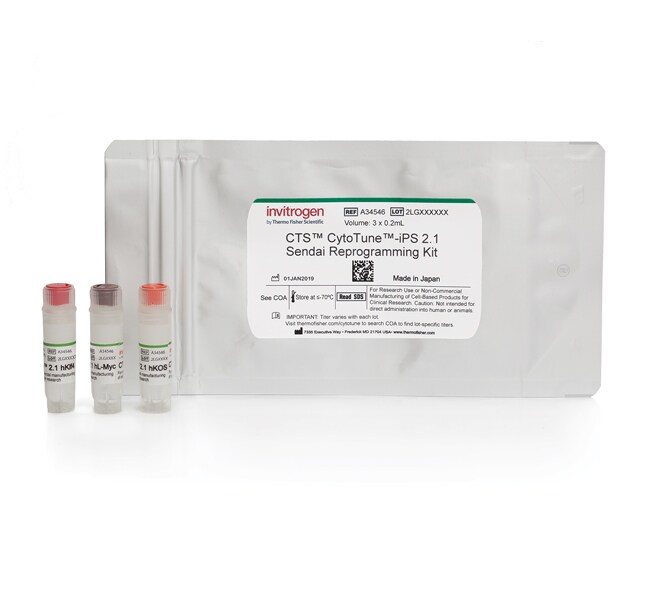
CTS™ CytoTune™-iPS 2.1 Sendai Reprogramming Kit
Invitrogen17万+抗体限时买二赠一,靶点广,灵活用!
CTS™ CytoTune™-iPS 2.1 Sendai Reprogramming Kit
Invitrogen™

CTS™ CytoTune™-iPS 2.1 Sendai Reprogramming Kit

The CTS CytoTune-iPS 2.1 Sendai Reprogramming Kit is the first off-the-shelf reprogramming system designed for clinical and translational research. It delivers efficient, integration-free reprogramming of somatic cells into induced pluripotent stem cells.
Have Questions?
Catalog NumberQuantity
A345461 Kit
Catalog number A34546
Price (CNY)
199,641.60
Online Exclusive
Ends: 31-Dec-2025
253,794.00
Save 54,152.40 (21%)
Each
Add to cart
Quantity:
1 Kit
Price (CNY)
199,641.60
Online Exclusive
Ends: 31-Dec-2025
253,794.00
Save 54,152.40 (21%)
Each
Add to cart

The CTS CytoTune-iPS 2.1 Sendai Reprogramming Kit is the first off-the-shelf reprogramming system designed for clinical and translational research. It delivers efficient, integration-free reprogramming of somatic cells into induced pluripotent stem cells. Like the CytoTune-iPS 2.0 Sendai kit, the CTS CytoTune-iPS 2.1 Sendai kit uses Sendai particles to deliver Yamanaka factors that are critical for efficient generation of induced pluripotent stem cells (iPSCs). This kit includes three vector preparations: polycistronic Klf4–Oct3/4–Sox2 (KOS), L-Myc, and Klf4 and is sufficient to reprogram a minimum of six wells of a six-well plate.

Supports a xeno-free workflow for the generation of iPSC lines

The bovine serum albumin carrier protein was removed from the CTS CytoTune-iPS 2.1 Sendai vector formulation. The preparation contains no animal-derived components at the primary component level, enabling the xeno-free generation of iPSCs from both fibroblasts and blood.

Facilitates customer regulatory filings with extensive testing and traceability documentation

The CTS CytoTune-iPS 2.1 Sendai kit is manufactured at a site with a process that was audited for conformity with current Good Manufacturing Practices for medical devices, 21 CFR Part 820 of the regulation. Full traceability documentation such as Certificate of Origin and Certificate of Analysis are available.

Specifications
Delivery TypeSendai
For Use With (Application)Cell and Gene Therapy Research, Development, and Manufacturing
Product LineCTS™
Product TypeiPSC Reprogramming Kit
Quantity1 Kit
Shelf Life24 months from date of manufacture
Shipping ConditionDry Ice
Unit SizeEach
Contents & Storage
• 0.2 mL CTS CytoTune KOS
• 0.2 mL CTS CytoTune Klf4
• 0.2 mL CTS CytoTune L-myc

Store at -70°C.

Frequently asked questions (FAQs)

What is CTS?

The Gibco Cell Therapy Systems (CTS) portfolio of cell and gene therapy products are GMP manufactured, safety tested, and backed by regulatory documentation to support your transition from discovery through clinical and commercial manufacturing. Through our CTS solutions, we are committed to helping customers streamline therapeutic development, minimize risk, and ease the burden on their quality systems. Learn more here.

Find additional tips, troubleshooting help, and resources within our Cell Culture Support Center.

How many transductions can I perform with one CTS CytoTune-iPS 2.1 Sendai Reprogramming Kit?

The CTS CytoTune-iPS 2.1 Sendai Reprogramming Kit is sufficient to reprogram a minimum of six wells in a six-well plate. One well has a surface area of approximately 10 cm2.

Find additional tips, troubleshooting help, and resources within our Cell Culture Support Center.

Are the reprogramming steps in the CTS CytoTune-iPS 2.1 Sendai Reprogramming Kit different compared to CytoTune-iPS 2.0 Sendai Reprogramming Kit?

No, the reprogramming steps are in principle the same but it is important to consider the difference in titer between the two kits when transducing cells at certain MOIs.

Find additional tips, troubleshooting help, and resources within our Cell Culture Support Center.

Why is the CTS CytoTune-iPS 2.1 Sendai Reprogramming Kit so much more expensive than the CytoTune-iPS 2.0 Sendai Reprogramming Kit?

It is more expensive because of its label use statement: For research use and non-commercial manufacturing of cell based products for clinical research. CAUTION: Not intended for direct administration into animals or humans. The kit is manufactured according to GMP requirements and the drug master file is available for submission to FDA upon customer request, for use in clinical research.

Find additional tips, troubleshooting help, and resources within our Cell Culture Support Center.

Why does the CTS CytoTune-iPS 2.1 Sendai Reprogramming Kit contain L-Myc virus instead of c-Myc virus?

The L-Myc virus was chosen over the c-Myc virus because it is considered superior from a safety perspective, for clinical applications (L-myc is reported to have lower transformation/oncogenic potential than c-myc).

Find additional tips, troubleshooting help, and resources within our Cell Culture Support Center.