Search

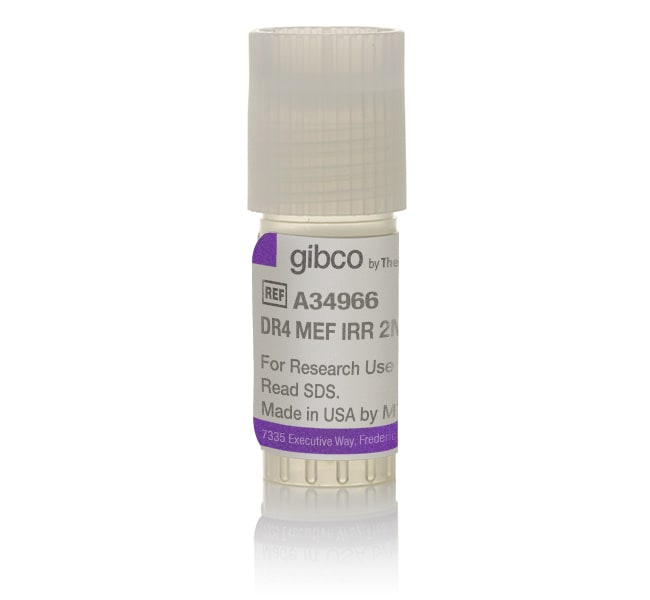
Gibco™
经过辐照处理的 DR4 小鼠胚胎成纤维细胞
Irradiated Gibco DR4 Mouse Embryonic Fibroblasts (MEFs) are multidrug-resistant feeder cells that support the culture of healthy undifferentiated human and了解更多信息
| 货号 | 数量 |
|---|---|
| A34966 | 2 x 10⁶ cells |
货号 A34966
价格(CNY)
-
数量:
2 x 10⁶ cells
Irradiated Gibco DR4 Mouse Embryonic Fibroblasts (MEFs) are multidrug-resistant feeder cells that support the culture of healthy undifferentiated human and mouse embryonic stem cells (ESCs) and induced pluripotent stem cells (iPSCs). Manufactured by MTI-GlobalStem and equivalent to MTI-GlobalStem Cat. No. GSC-6204G, these MEF cells are isolated from DR4 x CF1 hybrid mice, mitotically arrested by irradiation, and tested to help ensure safety and performance. For other variants of drug-resistant MEFs, see CF6-Neo Mouse Embryonic Fibroblasts, Irradiated or CF6-Neo Mouse Embryonic Fibroblasts, MitC-Treated. You may also choose from our selection of non-drug-resistant MEFs to suit your application.
• Help save precious time with pre-inactivated, ready-to-use MEFs
• Culture ESCs and iPSCs with confidence using meticulously tested feeder cells
• Perform drug selection with MEFs that are resistant to neomycin/geneticin, puromycin, hygromycin, and 6-thioguanine
Help save time with ready-to-use MEFs
Irradiated DR4 MEFs help save time and trouble dealing with an animal facility, performing tedious, time-consuming dissections, as well as expanding and testing cells day after day, week after week. Focus on your research with these pre-inactivated, ready-to-use feeders.
Culture with meticulously tested feeder cells
Each lot of DR4 MEFs is tested for bacteria, fungi, mycoplasma, and various mouse pathogens to minimize the risk of contamination. Each lot is also tested for post-thaw viability (typically greater than 95%) and ability to support mouse and human ESCs to help ensure robust and consistent performance. These MEFs have successfully been used with ESC/iPSC lines from other species, but should be tested for compatibility if used for such an application.
Perform drug selection with multidrug-resistant cells
DR4 MEFs express transgenes that make them resistant to four different drugs: geneticin (G418), puromycin, hygromycin, and 6-thioguanine. Each lot is tested for tolerance to various concentrations of these drugs and the threshold range for survival is reported in the certificate of analysis to aid in designing experiments. Use these feeder cells to support undifferentiated ESC or iPSC culture while performing drug selection.
• Help save precious time with pre-inactivated, ready-to-use MEFs
• Culture ESCs and iPSCs with confidence using meticulously tested feeder cells
• Perform drug selection with MEFs that are resistant to neomycin/geneticin, puromycin, hygromycin, and 6-thioguanine
Help save time with ready-to-use MEFs
Irradiated DR4 MEFs help save time and trouble dealing with an animal facility, performing tedious, time-consuming dissections, as well as expanding and testing cells day after day, week after week. Focus on your research with these pre-inactivated, ready-to-use feeders.
Culture with meticulously tested feeder cells
Each lot of DR4 MEFs is tested for bacteria, fungi, mycoplasma, and various mouse pathogens to minimize the risk of contamination. Each lot is also tested for post-thaw viability (typically greater than 95%) and ability to support mouse and human ESCs to help ensure robust and consistent performance. These MEFs have successfully been used with ESC/iPSC lines from other species, but should be tested for compatibility if used for such an application.
Perform drug selection with multidrug-resistant cells
DR4 MEFs express transgenes that make them resistant to four different drugs: geneticin (G418), puromycin, hygromycin, and 6-thioguanine. Each lot is tested for tolerance to various concentrations of these drugs and the threshold range for survival is reported in the certificate of analysis to aid in designing experiments. Use these feeder cells to support undifferentiated ESC or iPSC culture while performing drug selection.
仅供科研使用。不可用于诊断程序。
规格
供体混合供体
池数量2 x 10⁶
数量2 x 10⁶ cells
运输条件用于干冰运输
年龄胚胎
细胞类型Feeder Cells (Mouse Embryonic Fibroblast)
形式冻存
种属小鼠
Unit SizeEach
内容与储存
冻存小鼠胚胎成纤维细胞
储存于液氮中。
储存于液氮中。