Search


引用和文献 (4)
Invitrogen™
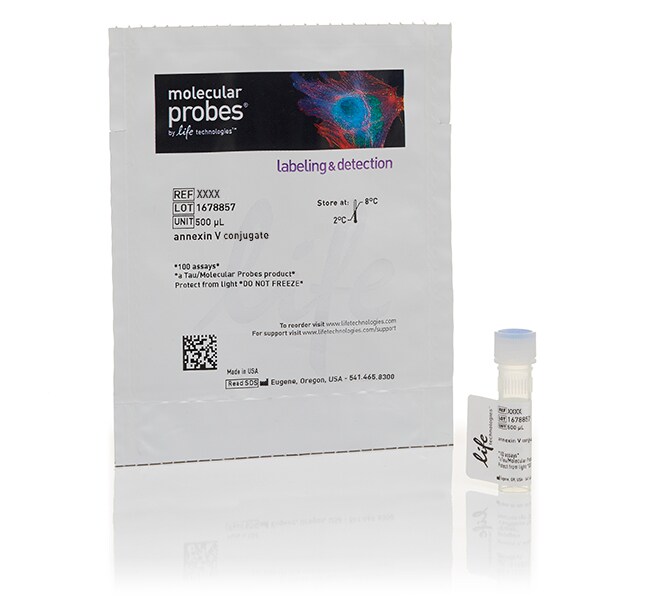
用于细胞凋亡检测的 Annexin V 偶联物
采用流式细胞分析利用 Annexin V 独立 Alexa Fluor、APC、Pacific Blue、PE、FITC 和生物素偶联物检测早期细胞凋亡。
Have Questions?
更改视图

| 货号 | 激发/发射 | 流式细胞仪激光线路 | 偶联物 |
|---|---|---|---|
| A35109 | 679/702 | 633-637 | Alexa Fluor 680 |
| A13201 | 495/519 | 488 | Alexa Fluor 488 |
| A13199 | 494/518 | 488 | FITC |
| A13202 | 578/603 | 532、561 | Alexa Fluor 568 |
| A13203 | 590/617 | 532 | Alexa Fluor 594 |
| A13204 | 生物素-X | ||
| A23202 | 346/442 | UV | Alexa Fluor 350 |
| A23204 | 650/665 | 633-637 | Alexa Fluor 647 |
| A35108 | 555/565 | 532、561 | Alexa Fluor 555 |
| A35110 | 650/660 | 633-637 | APC(别藻蓝素) |
| A35111 | 565/578 | 488, 532, 561 | PE |
| A35122 | 410/455 | 405 | Pacific Blue |
货号 A35109
价格(CNY)
3,780.00
飞享价
Ends: 31-Dec-2026
5,022.00共减 1,242.00 (25%)
Each
激发/发射:
679/702
流式细胞仪激光线路:
633-637
偶联物:
Alexa Fluor 680
价格(CNY)
3,780.00
飞享价
Ends: 31-Dec-2026
5,022.00共减 1,242.00 (25%)
Each
采用用于细胞凋亡检测的 Annexin V 独立偶联物,可快速而可靠地检测早期细胞凋亡。使用流式细胞分析,Annexin V 偶联物在凋亡细胞与非凋亡细胞之间提供达 100 倍的荧光信号强度差异。
膜联蛋白 V 对磷脂酰丝氨酸 (PS) 具有高亲和力,PS 可暴露于正在凋亡的细胞的外叶上。由于具有这种亲和力,荧光标记的膜联蛋白 V 试剂是细胞凋亡研究中常用的试剂。
Annexin V 偶联物为研究磷脂酰丝氨酸(是细胞凋亡中期标志)的外化提供了快速而可靠的检测方法。经我们的荧光膜联蛋白V偶联物染色后,凋亡细胞和未凋亡细胞显示出不同的荧光强度,流式细胞分析它们的差异通常约为 100 倍。
与 Nexins Research BV 合作,我们提供了较佳且较亮的膜联蛋白 V 偶联物,包括 Alexa Fluor 350、488、555、568、594、647 和 680 膜联蛋白 V 偶联物以及 Annexin V APC、生物素-X、FITC、Pacific Blue 和 PE 偶联物。高荧光性膜联蛋白 V 偶联物为研究磷酯酰丝氨酸的外翻提供了快速而可靠的检测方法,它是细胞凋亡早期指标之一。
Annexin V Pacific Blue 偶联物具有紫色可激发性,这使其成为紫色激光仪器和包括绿色或红色荧光染料的多色实验的理想选择。
我们的膜联蛋白V偶联物的优势包括:
• 与 Invitrogen Alexa Fluor 和 eFluor 染料偶联可产生较亮信号
• 偶联物适用于所有可用激光
• 可用作独立试剂或易于使用的试剂盒
Annexin V 染色检测凋亡细胞仅可在活细胞和组织上进行。如果样品染色后被固定,则需要特定的条件来保留信号。包括使用不含酒精的乙醛固定方法、使用含 Ca2+ 但不含表面活性剂/去污剂的缓冲液。为方便您使用,我们还提供了浓缩膜联蛋白结合缓冲液,用于在细胞凋亡检测中促进膜联蛋白 V 与磷脂酰丝氨酸结合。
Annexin V 偶联物为研究磷脂酰丝氨酸(是细胞凋亡中期标志)的外化提供了快速而可靠的检测方法。经我们的荧光膜联蛋白V偶联物染色后,凋亡细胞和未凋亡细胞显示出不同的荧光强度,流式细胞分析它们的差异通常约为 100 倍。
与 Nexins Research BV 合作,我们提供了较佳且较亮的膜联蛋白 V 偶联物,包括 Alexa Fluor 350、488、555、568、594、647 和 680 膜联蛋白 V 偶联物以及 Annexin V APC、生物素-X、FITC、Pacific Blue 和 PE 偶联物。高荧光性膜联蛋白 V 偶联物为研究磷酯酰丝氨酸的外翻提供了快速而可靠的检测方法,它是细胞凋亡早期指标之一。
Annexin V Pacific Blue 偶联物具有紫色可激发性,这使其成为紫色激光仪器和包括绿色或红色荧光染料的多色实验的理想选择。
我们的膜联蛋白V偶联物的优势包括:
• 与 Invitrogen Alexa Fluor 和 eFluor 染料偶联可产生较亮信号
• 偶联物适用于所有可用激光
• 可用作独立试剂或易于使用的试剂盒
Annexin V 染色检测凋亡细胞仅可在活细胞和组织上进行。如果样品染色后被固定,则需要特定的条件来保留信号。包括使用不含酒精的乙醛固定方法、使用含 Ca2+ 但不含表面活性剂/去污剂的缓冲液。为方便您使用,我们还提供了浓缩膜联蛋白结合缓冲液,用于在细胞凋亡检测中促进膜联蛋白 V 与磷脂酰丝氨酸结合。
仅供科研使用。不可用于诊断程序。
规格
颜色近红外
描述Annexin V Alexa Fluor 680 偶联物
激发/发射679/702
流式细胞仪激光线路633-637
适用于(设备)流式细胞仪
反应次数100
产品类型膜联蛋白V偶联
数量500 μL
运输条件湿冰
偶联物Alexa Fluor 680
Unit SizeEach
内容与储存
含 1 小瓶 Annexin V Alexa Fluor 680 偶联物。在冰箱(2°C 至 8°C)中避光储存。
常见问题解答 (FAQ)
我想用膜联蛋白V标记贴壁细胞,结果发现所有细胞都被标记了,该如何解决这一问题?
流式细胞术的优势有哪些?
我能在流式细胞仪上进行哪些应用?
I want to study apoptosis using an Annexin V conjugate, but with adherent cells via microscopy instead of flow cytometry. Can this be done?
I am trying to label adherent cells with annexin V and am finding that everything is getting labeled. How can I fix this?
引用和文献 (4)
引用和文献
Abstract
Hormone-dependent placental manipulation of breast cancer cell migration.
Journal:Hum Reprod
PubMed ID:22048988
'Breast cancer during pregnancy is often more advanced than in non-pregnant women. Nevertheless, no case of metastasis inside the placenta has been reported. Previously, we showed that placental-explants eliminated breast cancer cells from their surroundings, due to cell-death and elevated migration. Our objective was to find the underlying mechanisms of
Targeting specific regions of the Notch3 ligand-binding domain induces apoptosis and inhibits tumor growth in lung cancer.
Journal:Cancer Res
PubMed ID:20068176
Like many signaling pathways in development, the Notch receptor pathway plays an important role in cancer pathobiology when it is dysregulated. Potential ligand-binding sites within the epidermal growth factor (EGF)-like repeats of Notch1 have been identified, but the ligand-binding domains in Notch3, which is implicated in lung cancer, are not
Suppression of 1-methyl-4-phenyl-1,2,3,6-tetrahydropyridine-induced nitric-oxide synthase 2 expression in astrocytes by a novel diindolylmethane analog protects striatal neurons against apoptosis.
Journal:Mol Pharmacol
PubMed ID:18840677
The progressive debilitation of motor functions in Parkinson's disease (PD) results from degeneration of dopaminergic neurons within the substantia nigra pars compacta of the midbrain. Long-term inflammatory activation of microglia and astrocytes plays a central role in the progression of PD and is characterized by activation of the nuclear factor-kappaB
Transmembrane voltage regulates binding of annexin V and lactadherin to cells with exposed phosphatidylserine.
Journal:BMC Biochem
PubMed ID:19222854
BACKGROUND: Cells expose phosphatidylserine during apoptosis. The voltage across the plasma membrane also decreases or disappears during apoptosis, but the physiological significance of this is unknown. RESULTS: Here we show that transmembrane potential regulates membrane binding of two unrelated proteins that recognize exposed phosphatidylserine on apoptotic cells. In Jurkat T