Search


引用和文献 (15)
Invitrogen™
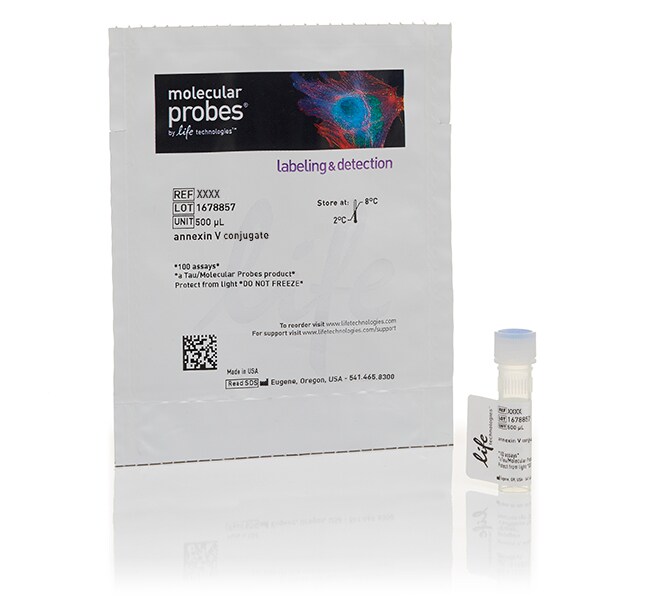
用于细胞凋亡检测的 Annexin V 偶联物
采用流式细胞分析利用 Annexin V 独立 Alexa Fluor、APC、Pacific Blue、PE、FITC 和生物素偶联物检测早期细胞凋亡。
Have Questions?
更改视图

| 货号 | 激发/发射 | 流式细胞仪激光线路 | 偶联物 |
|---|---|---|---|
| A35110 | 650/660 | 633-637 | APC(别藻蓝素) |
| A13201 | 495/519 | 488 | Alexa Fluor 488 |
| A13199 | 494/518 | 488 | FITC |
| A13202 | 578/603 | 532、561 | Alexa Fluor 568 |
| A13203 | 590/617 | 532 | Alexa Fluor 594 |
| A13204 | 生物素-X | ||
| A23202 | 346/442 | UV | Alexa Fluor 350 |
| A23204 | 650/665 | 633-637 | Alexa Fluor 647 |
| A35108 | 555/565 | 532、561 | Alexa Fluor 555 |
| A35109 | 679/702 | 633-637 | Alexa Fluor 680 |
| A35111 | 565/578 | 488, 532, 561 | PE |
| A35122 | 410/455 | 405 | Pacific Blue |
货号 A35110
价格(CNY)
4,219.00
飞享价
Ends: 31-Dec-2026
5,605.00共减 1,386.00 (25%)
Each
激发/发射:
650/660
流式细胞仪激光线路:
633-637
偶联物:
APC(别藻蓝素)
价格(CNY)
4,219.00
飞享价
Ends: 31-Dec-2026
5,605.00共减 1,386.00 (25%)
Each
采用用于细胞凋亡检测的 Annexin V 独立偶联物,可快速而可靠地检测早期细胞凋亡。使用流式细胞分析,Annexin V 偶联物在凋亡细胞与非凋亡细胞之间提供达 100 倍的荧光信号强度差异。
膜联蛋白 V 对磷脂酰丝氨酸 (PS) 具有高亲和力,PS 可暴露于正在凋亡的细胞的外叶上。由于具有这种亲和力,荧光标记的膜联蛋白 V 试剂是细胞凋亡研究中常用的试剂。
Annexin V 偶联物为研究磷脂酰丝氨酸(是细胞凋亡中期标志)的外化提供了快速而可靠的检测方法。经我们的荧光膜联蛋白V偶联物染色后,凋亡细胞和未凋亡细胞显示出不同的荧光强度,流式细胞分析它们的差异通常约为 100 倍。
与 Nexins Research BV 合作,我们提供了较佳且较亮的膜联蛋白 V 偶联物,包括 Alexa Fluor 350、488、555、568、594、647 和 680 膜联蛋白 V 偶联物以及 Annexin V APC、生物素-X、FITC、Pacific Blue 和 PE 偶联物。高荧光性膜联蛋白 V 偶联物为研究磷酯酰丝氨酸的外翻提供了快速而可靠的检测方法,它是细胞凋亡早期指标之一。
Annexin V Pacific Blue 偶联物具有紫色可激发性,这使其成为紫色激光仪器和包括绿色或红色荧光染料的多色实验的理想选择。
我们的膜联蛋白V偶联物的优势包括:
• 与 Invitrogen Alexa Fluor 和 eFluor 染料偶联可产生较亮信号
• 偶联物适用于所有可用激光
• 可用作独立试剂或易于使用的试剂盒
Annexin V 染色检测凋亡细胞仅可在活细胞和组织上进行。如果样品染色后被固定,则需要特定的条件来保留信号。包括使用不含酒精的乙醛固定方法、使用含 Ca2+ 但不含表面活性剂/去污剂的缓冲液。为方便您使用,我们还提供了浓缩膜联蛋白结合缓冲液,用于在细胞凋亡检测中促进膜联蛋白 V 与磷脂酰丝氨酸结合。
Annexin V 偶联物为研究磷脂酰丝氨酸(是细胞凋亡中期标志)的外化提供了快速而可靠的检测方法。经我们的荧光膜联蛋白V偶联物染色后,凋亡细胞和未凋亡细胞显示出不同的荧光强度,流式细胞分析它们的差异通常约为 100 倍。
与 Nexins Research BV 合作,我们提供了较佳且较亮的膜联蛋白 V 偶联物,包括 Alexa Fluor 350、488、555、568、594、647 和 680 膜联蛋白 V 偶联物以及 Annexin V APC、生物素-X、FITC、Pacific Blue 和 PE 偶联物。高荧光性膜联蛋白 V 偶联物为研究磷酯酰丝氨酸的外翻提供了快速而可靠的检测方法,它是细胞凋亡早期指标之一。
Annexin V Pacific Blue 偶联物具有紫色可激发性,这使其成为紫色激光仪器和包括绿色或红色荧光染料的多色实验的理想选择。
我们的膜联蛋白V偶联物的优势包括:
• 与 Invitrogen Alexa Fluor 和 eFluor 染料偶联可产生较亮信号
• 偶联物适用于所有可用激光
• 可用作独立试剂或易于使用的试剂盒
Annexin V 染色检测凋亡细胞仅可在活细胞和组织上进行。如果样品染色后被固定,则需要特定的条件来保留信号。包括使用不含酒精的乙醛固定方法、使用含 Ca2+ 但不含表面活性剂/去污剂的缓冲液。为方便您使用,我们还提供了浓缩膜联蛋白结合缓冲液,用于在细胞凋亡检测中促进膜联蛋白 V 与磷脂酰丝氨酸结合。
仅供科研使用。不可用于诊断程序。
规格
颜色红色
描述Annexin V APC 偶联物(APC 膜联蛋白 V)(替代膜联蛋白产品 - AnnexinV05)
激发/发射650/660
流式细胞仪激光线路633-637
适用于(设备)流式细胞仪
反应次数50
产品类型膜联蛋白V偶联
数量250 μL
运输条件湿冰
偶联物APC(别藻蓝素)
Unit SizeEach
内容与储存
包含 1 瓶膜联蛋白 V APC 偶联物。在冰箱(2°C 至 8°C)中避光储存。
常见问题解答 (FAQ)
我用胰蛋白酶消化贴壁细胞并用膜联蛋白V标记,现在甚至在对照的未处理细胞中,流式数据结果都显示出高比例的细胞凋亡,这是什么原因所致?
我能在成像实验中检测膜联蛋白V染色么?
流式细胞仪分析时,我应该在什么时候用膜联蛋白V染色粘连细胞?在胰蛋白酶消化前或后?
我能固定膜联蛋白V标记的细胞么?
我想用膜联蛋白V标记贴壁细胞,结果发现所有细胞都被标记了,该如何解决这一问题?
引用和文献 (15)
引用和文献
Abstract
Simultaneous detection of apoptosis and mitochondrial superoxide production in live cells by flow cytometry and confocal microscopy.
Journal:Nat Protoc
PubMed ID:17853886
'Annexin V and Sytox Green are widely used markers to evaluate apoptosis in various cell types using flow cytometry and fluorescent microscopy. Recently, a novel fluoroprobe MitoSOX Red was introduced for selective detection of superoxide in the mitochondria of live cells and was validated for confocal microscopy and flow cytometry.
Cathepsin D and H2O2 stimulate degradation of thioredoxin-1: implication for endothelial cell apoptosis.
Journal:J Biol Chem
PubMed ID:16263712
'Cathepsin D (CatD) is a lysosomal aspartic proteinase and plays an important role in the degradation of proteins and in apoptotic processes induced by oxidative stress, cytokines, and aging. All of these stimuli are potent inducers of endothelial cell apoptosis. Therefore, we investigated the role of CatD in endothelial cell
Role of superoxide, nitric oxide, and peroxynitrite in doxorubicin-induced cell death in vivo and in vitro.
Journal:Am J Physiol Heart Circ Physiol
PubMed ID:19286953
'Doxorubicin (DOX) is a potent available antitumor agent; however, its clinical use is limited because of its cardiotoxicity. Cell death is a key component in DOX-induced cardiotoxicity, but its mechanisms are elusive. Here, we explore the role of superoxide, nitric oxide (NO), and peroxynitrite in DOX-induced cell death using both
FTY720 increases CD74 expression and sensitizes mantle cell lymphoma cells to milatuzumab-mediated cell death.
Journal:Blood
PubMed ID:22042694
'Mantle cell lymphoma (MCL) is an aggressive B-cell malignancy with a short median survival despite multimodal therapy. FTY720, an immunosuppressive drug approved for the treatment of multiple sclerosis, promotes MCL cell death concurrent with down-modulation of phospho-Akt and cyclin D1 and subsequent cell-cycle arrest. However, the mechanism of FTY720-mediated MCL
Flow cytometry-based apoptosis detection.
Journal:Methods Mol Biol
PubMed ID:19609746
'An apoptosing cell demonstrates multitude of characteristic morphological and biochemical features, which vary depending on the stimuli and the cell type. The gross majority of classical apoptotic hallmarks can be rapidly examined by flow and image cytometry. Cytometry thus became a technology of choice in diverse studies of cellular demise.