Search

Thermo Scientific™
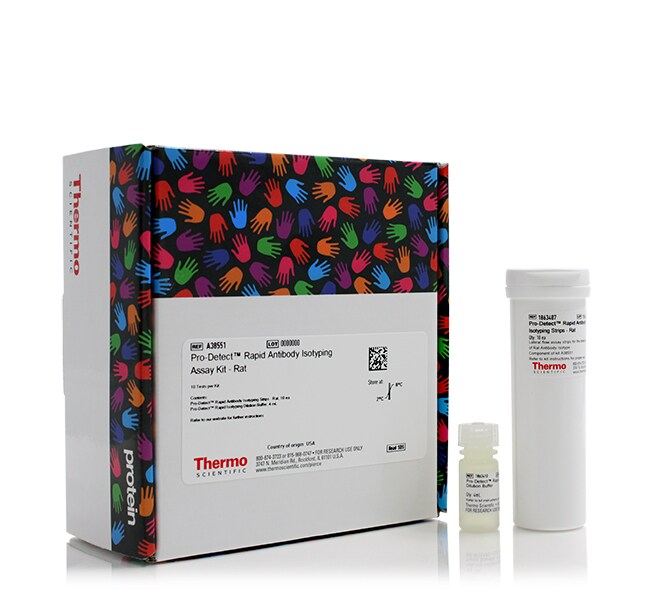
Pro-Detect™ 快速抗体分型检测试剂盒(大鼠)
The Thermo Scientific Pro-Detect Rapid Antibody Isotyping Assay Kit - Rat is a single-use, dipstick lateral flow kit for quick,了解更多信息
| 货号 | 数量 |
|---|---|
| A38551 | 10 次测试 |
货号 A38551
价格(CNY)
1,721.00
飞享价
Ends: 31-Dec-2026
2,716.00共减 995.00 (37%)
Each
数量:
10 次测试
价格(CNY)
1,721.00
飞享价
Ends: 31-Dec-2026
2,716.00共减 995.00 (37%)
Each
The Thermo Scientific Pro-Detect Rapid Antibody Isotyping Assay Kit - Rat is a single-use, dipstick lateral flow kit for quick, easy determination of rat monoclonal antibody class and subclass identity. This antibody isotyping assay uses membrane-based strips coated with dye-bound conjugated antibodies that provide a visual, color readout of the monoclonal antibody isotype within ten minutes. The kit determines rat IgG1, IgG2a, IgG2b , and IgG2c.
Features of the Pro-Detect Rapid Antibody Isotyping Assay Kit:
• Long shelf life—stable for at least one year at 4°C
• Simple workflow—dilute antibody sample using provided diluent and dip in the lateral flow strip
• Fast—within 5–10 minutes a band appears that indicates the antibody isotype
• Sensitive—detect antibodies in tissue culture media or ascites fluid samples down to low ng/mL concentrations
• Specific—assay does not cross-react with fetal bovine serum (FBS)
• Reliable—results are similar to standard ELISA-based isotyping assays
Each Pro-Detect Rapid Antibody Isotyping assay is performed by simply adding a properly diluted tissue culture supernatant or mouse ascites sample to a test tube or microplate well and dipping in a lateral flow strip. Gold conjugates embedded in the strip membrane form specific class- and subclass-soluble complexes with the antibodies in the sample. These complexes travel the length of the membrane and are resolved on the anti-isotype and class-specific antibody-impregnated regions of the membrane. Results are displayed as a red band above the printed class or sub-class description, indicating the antibody isotype present.
Determining the subclass of a rat antibody is important when selecting the best purification method. IgG2a, IgG2b, and IgG2c can be purified with Protein A columns at a pH of 7–8. IgG1 isotypes bind best to Protein A at a slightly higher pH of 8–9.
The Pro-Detect Rapid Antibody Isotyping Assay Kit is compatible with both tissue culture supernatant and mouse ascites fluid, and is more sensitive than conventional latex bead-based dipstick assays and much faster than ELISA-based isotyping assays. The kit requires only 0.5 μL ascites fluid, 2–22 μL of cell culture supernatant or 1.5 ng of purified antibody.
Features of the Pro-Detect Rapid Antibody Isotyping Assay Kit:
• Long shelf life—stable for at least one year at 4°C
• Simple workflow—dilute antibody sample using provided diluent and dip in the lateral flow strip
• Fast—within 5–10 minutes a band appears that indicates the antibody isotype
• Sensitive—detect antibodies in tissue culture media or ascites fluid samples down to low ng/mL concentrations
• Specific—assay does not cross-react with fetal bovine serum (FBS)
• Reliable—results are similar to standard ELISA-based isotyping assays
Each Pro-Detect Rapid Antibody Isotyping assay is performed by simply adding a properly diluted tissue culture supernatant or mouse ascites sample to a test tube or microplate well and dipping in a lateral flow strip. Gold conjugates embedded in the strip membrane form specific class- and subclass-soluble complexes with the antibodies in the sample. These complexes travel the length of the membrane and are resolved on the anti-isotype and class-specific antibody-impregnated regions of the membrane. Results are displayed as a red band above the printed class or sub-class description, indicating the antibody isotype present.
Determining the subclass of a rat antibody is important when selecting the best purification method. IgG2a, IgG2b, and IgG2c can be purified with Protein A columns at a pH of 7–8. IgG1 isotypes bind best to Protein A at a slightly higher pH of 8–9.
The Pro-Detect Rapid Antibody Isotyping Assay Kit is compatible with both tissue culture supernatant and mouse ascites fluid, and is more sensitive than conventional latex bead-based dipstick assays and much faster than ELISA-based isotyping assays. The kit requires only 0.5 μL ascites fluid, 2–22 μL of cell culture supernatant or 1.5 ng of purified antibody.
仅供科研使用。不可用于诊断程序。
规格
检测同种型测定
可检测分析物IgG1、IgG2a、IgG2b;IgG2c
适用于(应用)侧向层析快速检测
产品线Pro-Detect
产品类型检测
数量10 次测试
运输条件湿冰
特异性抗体
足够用于10 个反应
检测方法发色
目标种属大鼠
Unit SizeEach
内容与储存
• 10 条快速抗体分型检测试纸条 1
• 10 条快速抗体分型检测试纸条 2
• 样品稀释液,15 mL
足以进行 10 次同种型测定
在 2-8°C 下储存。
• 10 条快速抗体分型检测试纸条 2
• 样品稀释液,15 mL
足以进行 10 次同种型测定
在 2-8°C 下储存。