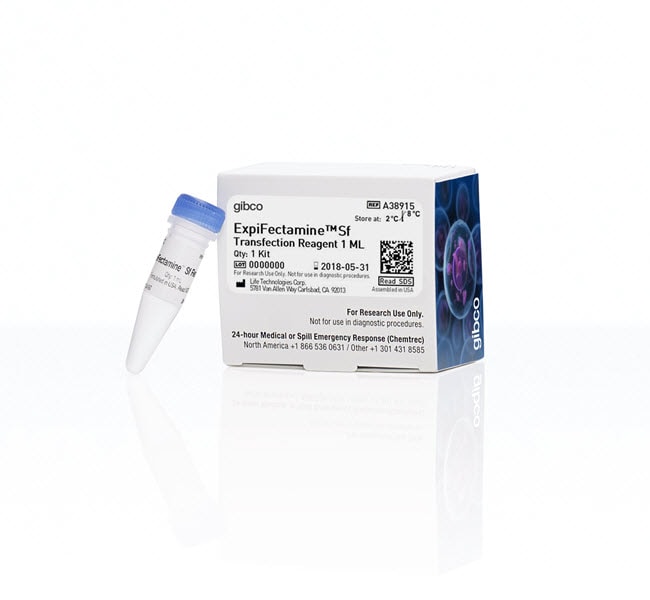
I am getting lower protein yield than expected with the ExpiSf Expression System. What should I do to improve my results?
Protein yield can vary greatly from protein to protein. We strongly recommend using the pFastBac 1 - Gus positive control vector (included in the ExpiSf Expression System Starter Kit as well as sold separately - Cat. No. 10360014) to generate Gus-expressing baculovirus and express Gus recombinant protein. The typical yield of Gus protein using the ExpiSf Expression System is approximately 250,000 activity units/mL following the recommended quantification protocol described in the ExpiSf Expression System User Guide (https://assets.thermofisher.com/TFS-Assets/LSG/manuals/MAN0017532_ExpiSfExpressionSystem_UG.pdf). Quantification of the Gus positive control protein will help determine if the low protein yield is due to a low expressing protein, low baculovirus titer/MOI used, poor baculovirus stock quality, a problem with the system components, or transfection and cell culturing conditions. If the expected protein yield is not being achieved with the Gus positive control, we recommend checking the following:
1. Ensure that you have a healthy ExpiSf9 cell culture:
- Cells are >90% viable during normal passaging and at the time of transfection and infection.
- Cells exhibit a doubling time of approximately 24 hrs.
- Cells recover rapidly post-thaw (i.e., reach a cell density of 5 x 10E6 cells/mL with ≥80% viability within 4-5 days post thaw); if not, verify that the culturing guidelines provided in the product manual (https://assets.thermofisher.com/TFS-Assets/LSG/manuals/MAN0017532_ExpiSfExpressionSystem_UG.pdf) are being followed, and thaw a new vial of cells if necessary.
- Verify that the incubator temperature is set at 27 degrees C for your cultures as temperatures higher than 28 degrees C may cause cells to overgrow and display reduced yield capacity overtime. Verify that the shake speed is 125±5 rpm for shakers with a 19 mm or 25 mm orbital diameter and 95±5 rpm for shakers with a 50 mm orbital diameter. All of our shake speed recommendations are provided for Nalgene PETG non-baffled Erlenmeyer flasks; if a different culture vessel is being used, additional shake speed and/or other culture parameter(s) optimization may be required.
2. Ensure that you have a high-quality baculovirus stock:
a. Ensure that pure and high-quality bacmid DNA is used:
- Check the quality of the recombinant bacmid by agarose gel electrophoresis to confirm DNA integrity.
- Ensure that a single white colony is picked during bacmid preparation to avoid a mixture of recombinant and non-recombinant baculovirus.
- Confirm that pure bacmid DNA is used (i.e., contains only recombinant bacmid and no empty bacmid), consider screening other DH10Bac transformants (i.e., white colonies).
- Look for the typical signs of a good transfection reaction: When ExpiSf9 Cells are efficiently transfected and baculovirus is being produced, viable cell density is between 80-90% at Day 3 post-transfection and will decrease to <80% at Day 4 post-transfection.
b. Ensure that the recombinant baculovirus contains the gene of interest:
- Verify transposition of bacmid DNA by PCR analysis using the pUC/M13 Forward and Reverse primers.
- Re-transfect ExpiSf9 Cells with new recombinant bacmid DNA, if necessary.
c. We recommend using the suspension-based transfection protocol for generation of high-quality P0 virus, as multiple rounds of viral amplification following the classical adherent format can result in spontaneous excision of the gene of interest as well as the formation of defective viral particles.
d. Ensure that the baculovirus stock is stored properly: Baculovirus stock should be stored at 4 degrees C, protected from light for up to 12 weeks. Alternatively, baculovirus stocks can be frozen and stored at -80 degrees C or in liquid nitrogen (no DMSO or cryopreservative) for longer periods. We do not recommend repeated freeze/thaw cycles of your virus stock. Frozen virus should be stored in small aliquots and not re-frozen once thawed.
3. Ensure that the cells are seeded at 5 x 10E6 viable cells/mL at the time of ExpiSf Enhancer addition.
4. Ensure that the correct amount of ExpiSf Enhancer is added 18-24 hrs prior to infection. Incubating enhancer-treated cells for longer than 24 hrs may result in decreased infection efficiency and low protein yields.
5. Ensure that the cell density at the time of virus infection is at 5-7 x 10E6 viable cells/mL. Infecting cells at higher densities will lead to sub-optimal infection conditions and poor protein yields.
6. Ensure that the optimal volume of baculovirus stock is used to infect cells. We recommend starting with an MOI of 5 and further optimizing the MOI (from 3-10), if necessary.
7. If baculovirus titer wasn't determined, we recommend testing a series of virus stock dilutions to determine the optimal volume to use for virus infections. A starting dilution range of 1:50 - 1:100 (virus stock : culture volume) is a good starting point.
Find additional tips, troubleshooting help, and resources within our Protein Expression Support Center.
Where can I find hands-on training for the ExpiSf Expression System?
We offer LabCoat Live: SmartStart Training for the ExpiSf Expression System (/content/lifetech/global/en/home/global/forms/labcoat-live-smartstart-training-expisf.html). LabCoat Live is a unique learning environment that allows you to gain hands-on experience in your lab by providing the necessary reagents and protocols, and offering lectures through a flexible and affordable online environment with a self-paced lab experiment.
Find additional tips, troubleshooting help, and resources within our Protein Expression Support Center.
I'm new to the ExpiSf Expression System and would like additional information to help me get started. Are there any online resources to assist me?
Yes. There is a system page at www.thermofisher.com/expisf with comprehensive product information. We also offer our ExpiSf LabCoat Live virtual training course that provides interactive online lectures. For a thorough understanding of the system, experiment setup, and data analysis, sign up at www.thermofisher.com/labcoatlive (check for availability in your region). These are excellent resources for getting started or for troubleshooting.
Find additional tips, troubleshooting help, and resources within our Protein Expression Support Center.
How can I get started with the ExpiSf Expression System?
The easiest way to get started is by purchasing the ExpiSf Expression System Starter Kit (Cat. No. A38841). This is an all-in-one kit that contains all of the reagents necessary to generate recombinant baculovirus and express your proteins. Reagents for cloning your gene of interest into the pFastBac Expression Vector are sold separately and can easily be found at www.thermofisher.com/expisf .
Find additional tips, troubleshooting help, and resources within our Protein Expression Support Center.
What is the advantage of ExpiFectamine Sf Transfection Reagent compared to other lipid-based reagents?
ExpiFectamine Sf Transfection Reagent typically exhibits lower toxicity and a faster complexation time and has a simpler protocol compared to other DNA transfection reagents. Lower toxicity means that no media change is required post-transfection. Shorter complexation time and simpler protocol means that DNA:lipid complexes are formed in only 5 mins and undiluted DNA is added directly to diluted ExpiFectamine Sf solution. This translates to time savings and the streamlining of your transfection reactions. This can be particularly advantageous where a higher throughput is required.
Find additional tips, troubleshooting help, and resources within our Protein Expression Support Center.