Search


引用和文献 (4)
Gibco™
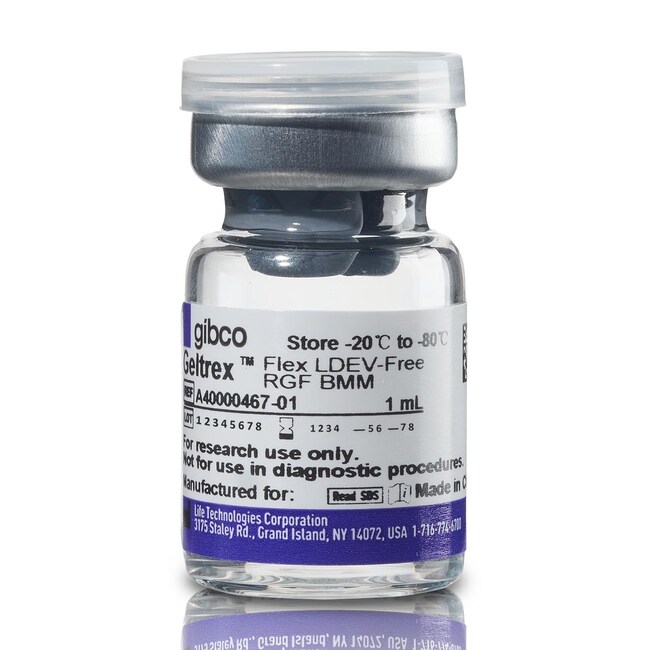
Geltrex™ Flex LDEV-Free Reduced Growth Factor Basement Membrane Matrix
Geltrex Flex LDEV-Free Reduced Growth Factor Basement Membrane Matrix is a soluble basement membrane matrix purified from EHS tumors. Supports culture of epithelial, endothelial, smooth muscle cells, angiogenesis, neurite outgrowth, bile canaliculi formation assays with polarized hepatocytes.
Have Questions?
更改视图

| 货号 | 数量 |
|---|---|
| A4000046701 | 1 mL |
| A4000046702 | 5 mL |
| A4000046703 | 10 mL |
货号 A4000046701
价格(CNY)
506.00
Each
数量:
1 mL
价格(CNY)
506.00
Each
Gibco Geltrex Flex LDEV-Free Reduced Growth Factor Basement Membrane Matrix is a soluble form of basement membrane that is purified from Engelbreth-Holm-Swarm (EHS) tumor cells. The major components of Geltrex Flex matrix include laminin, collagen IV, entactin, and heparan sulfate proteoglycan.
The solution, which gels at 37°C, can be used for promotion and maintenance of a differentiated phenotype in various cell cultures, including primary epithelial cells, primary neurons, and smooth muscle cells. Geltrex Flex matrix has been used in 3D and 2D cell culture, including angiogenesis assays, neurite outgrowth assays, and bile canaliculi formation assays in polarized hepatocytes for ADME applications.
Features of Geltrex Flex LDEV-Free Reduced Growth Factor Basement Membrane Matrix
- Each lot tested for the absence of lactose dehydrogenase elevating virus (LDEV), mycoplasma, and a broad panel of viruses and microorganisms
- Lots tested for endotoxin, maintenance of gel stability, and HUVEC tube formation
- Growth factor–reduced to improve lot-to-lot consistency
- Formulated without phenol red to minimize potential for estrogen-like effects
- Provided in recyclable glass vials
- 1-mL, 5-mL, and 10-mL sizes for maximum flexibility. Use only what you need. Reduce need for extensive aliquoting and unwanted freeze-thaws.
Gain reliability and consistency with hESC/iPSC-qualified and organoid-qualified Geltrex Flex matrix
For culturing hESCs or iPSCs, it is recommended to use Geltrex Flex LDEV-Free hESC-Qualified Reduced Growth Factor Basement Membrane Matrix. hESC-qualified Geltrex Flex matrix provides all the benefits of standard Geltrex Flex matrix, with added quality controls for each lot. Each lot is tested with iPSCs and H9 hESCs for at least five passages to help ensure reliability and consistency in hESC/iPSC studies.
For culturing tumoroids and other organoids, Geltrex Flex LDEV-Free Organoid-Qualified Reduced Growth Factor Basement Membrane Matrix is recommended. Organoid-qualified Geltrex Flex matrix provides all the benefits of standard Geltrex Flex matrix, with added quality controls for each lot. Each lot is tested and supports culture of mouse intestinal organoids, mouse liver ductal organoids, and mouse airway organoids, as well as expansion of mouse small intestinal organoids for more than five passages with typical organoid budding morphology.
For Research Use Only. Not for use in diagnostic procedures.
规格
细胞类型Variety of cultured cells, including HUVEC, primary epithelial cells, neurons, endothelial cells, smooth muscle cells, hepatocytes.
最大浓度9 to 13 mg/mL
内毒素水平≤ 4.5 EU/mL
产品类型Basement Membrane Matrix
纯度或质量等级Cell Culture Grade
数量1 mL
有效期2 Years
运输条件干冰
种属Mouse
分类Reduced Growth Factor
培养类型Adherent Cell Culture, Mammalian Cell Culture, Neuronal Cell Culture
形式Frozen
血清水平Serum-free
无菌Sterile
不加添加剂No Phenol Red
Unit SizeEach
引用和文献 (4)
引用和文献
Abstract
Ethanol Alters DNMT1/3a/3b Expression Profile, Promotes Persistent DNA Hypomethylation in Human Brain Endothelial Cells and Impairs Late Cortical Angiogenesis.
Journal:Journal of neurochemistry
PubMed ID:41668336
Exposure of the embryonic central nervous system (CNS) to drugs of abuse, such as ethanol, induces severe and persistent damage to neural cells, contributing to the development of fetal alcohol spectrum disorders (FASD). Previously, using a mouse model of FASD, we showed that prenatal alcohol exposure (PAE) directly impairs blood–brain
Generation of hiPSCs (JUCGRMi008-A) from a β-propeller protein-associated neurodegeneration patient with WDR45 mutation.
Journal:Stem cell research
PubMed ID:42119323
Harnessing intermediate-scale bioreactors for next-generation macrophage production and application.
Journal:Nature protocols
PubMed ID:41709011
Macrophages are crucial in immune responses, tissue repair, homeostasis, making them prime candidates for translational applications. Induced pluripotent stem cell (iPSC) derived-macrophages hold significant promise for regenerative medicine, cancer therapy, inflammatory disease treatment and in vitro bioassays. However, cost-effective, standardized intermediate-scale bioreactor systems tailored for early-stage research and drug discovery
ILC2s regulate a fibroblast progenitor niche in the pancreas.
Journal:Science (New York, N.Y.)
PubMed ID:42391385
Local fibroblast development and densities influence organ health and disease, although it remains unclear how tissue fibroblast topography is controlled in situ. Here we defined group 2 innate lymphoid cells (ILC2) as key regulators of fibroblast homeostasis in the pancreas. ILC2 co-localised with fibroblasts expressing the genes Pi16( )Dpp4( )Ly6c(