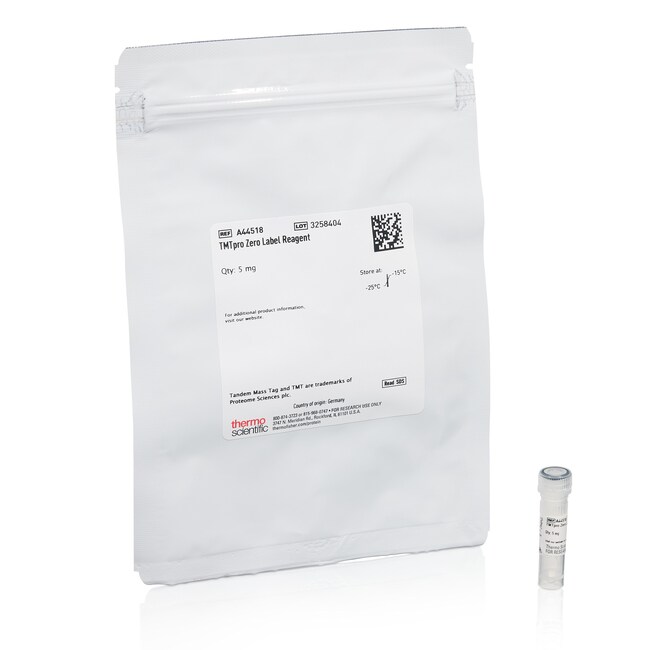
TMTpro™ Zero Label Reagent
Product Image
Thermo Scientific™

TMTpro™ Zero Label Reagent

Thermo Scientific TMTpro Zero Label Reagent serves as a 'light' tag for MS-level peptide quantitation for method optimization or useRead more
Have Questions?
Change viewbuttonViewtableView
Catalog NumberQuantity
A445181 x 5 mg
A445195 x 0.5 mg
Catalog number A44518
Price (CNY)
3,608.00
Each
Add to cart
Quantity:
1 x 5 mg
Price (CNY)
3,608.00
Each
Add to cart

Thermo Scientific TMTpro Zero Label Reagent serves as a 'light' tag for MS-level peptide quantitation for method optimization or use with the TMTpro 16plex Label Reagent Set.

Features of TMTpro Zero Label Reagent include:
Economical—“light” version may be used for optimization and method development of TMTpro-labeled samples
Efficient—amine-reactive, NHS ester-activated reagents ensure efficient labeling of all peptides regardless of protein sequence or proteolytic enzyme specificity
Compatible—optimized for use with high resolution Thermo Scientific MS/MS platforms, such as the Q Exactive and Orbitrap Fusion Tribrid instrument series, including the Orbitrap Eclipse Tribrid and Orbitrap Exploris 480 mass spectrometers with data analysis fully supported by Proteome Discoverer 2.3

TMTpro label reagents are the next generation of tandem mass tags, designed to increase the level of sample multiplexing without compromising on protein identification and quantitation. The TMTpro tag structure is similar to the TMT tag structure in that the tags remain isobaric and amine reactive, but differs in the longer spacer region and isobutyl proline mass reporter region. After MS/MS fragmentation, each TMTpro tag generates a unique reporter mass (i.e., TMTpro 126-134Da) in the low-mass region of the high-resolution MS/MS spectrum that is used for relative quantitation of protein expression levels. TMTpro Zero Label Reagent is a “light” version of the TMTpro tag that may be used for method development or in conjunction with the set or subset of “heavy” TMTpro reagents.

For high resolution analysis of TMTpro-labeled peptides, the recommended LC column for the Nanospray Flex source is the Acclaim PepMap 100 C18 LC Column (Cat. No. 164942 or 164939). For the EASY-Spray source, the recommended LC column is the EASY-Spray C18 LC Column (Cat. No. ES802 or ES803).

These products are subject to a limited use label license.

For Research Use Only. Not for use in diagnostic procedures.
Specifications
DescriptionTMTpro™ Zero Label Reagent, 1 x 5 mg
Final Product TypePeptide
For Use With (Equipment)Mass Spectrometer
Label or DyeTandem Mass Tag™ (TMT) Labels
Quantity1 x 5 mg
Shipping ConditionDry Ice
Workflow StepProtein Labeling
Detection MethodMass Spectrometry
Product LineTMT™
Starting MaterialPeptides
Unit SizeEach
Contents & Storage
Store in freezer (–5 to –30°C).

Frequently asked questions (FAQs)

At which step should I label my mass spec samples with TMT reagents?

TMT labeling can be performed after reduction, alkylation, digestion, or prior to cleanup, if the sample is buffered at appropriate pH (8-8.5) in a suitable buffer without primary amines (e.g., Tris, glycine). TMT labeling can also be performed after peptide clean-up. Labeling of peptides after clean-up enables measuring and normalizing of the peptide samples for equal mixing.

Find additional tips, troubleshooting help, and resources within our Mass Spectrometry Support Center.

Do I have to apply correction factors for analyzing data for TMT/TMTpro-labeled samples?

Applying correction factors is required for more accurate relative protein quantitation as the isotopic impurity is variable among the tags, ranging from 5-10%.

Find additional tips, troubleshooting help, and resources within our Mass Spectrometry Support Center.

How do I bridge the data from different sample sets for TMT-based quantitation?

This is most often done with the utilization of a "pool channel" for each multiplex set. This reference channel typically contains an equimolar mixture of all samples which is labeled with one of the TMT tags that is shared among the sets. The pool channel can be used to then normalize relative protein abundance measurements across multiplexed sets.

Find additional tips, troubleshooting help, and resources within our Mass Spectrometry Support Center.

In the EasyPep sample preparation workflow, it is mentioned that TMT/TMTpro reagent can be added to peptides before or after the clean-up step. Are there any differences between these two methods, regarding the labeling efficiency or relative quantitation?

The EasyPep kit chemistry is fully compatible with TMT/TMTpro reagents. Most commonly, TMT/TMTpro reagents are used to label peptides immediately after digestion and before peptide cleanup. This enables combining samples for a single cleanup step which reduces variability for more reproducible quantitative measurements. Another option is to label samples after peptide cleanup. This approach provides efficient labeling of the samples but may require the use of a peptide quantification assay to ensure that samples are equally mixed before LC-MS analysis. Both the workflows should provide high labelling efficiencies using our recommended TMT/TMTpro reagent to sample ratios.

Find additional tips, troubleshooting help, and resources within our Mass Spectrometry Support Center.

What type of mass spectrometer can I use for Tandem Mass Tag (TMT) analysis?

We recommend using high-resolution Orbitrap Tribrid (e.g., Fusion, Lumos, Eclipse), Orbitrap Exploris (e.g., 240, 480), or Q Exactive (e.g,. Plus, HF, HFX) series of instruments.

Find additional tips, troubleshooting help, and resources within our Mass Spectrometry Support Center.