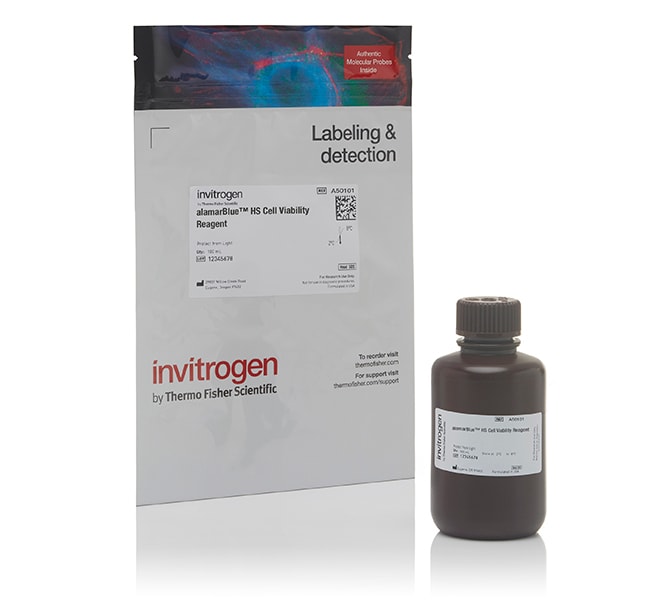
alamarBlue™ and alamarBlue™ HS Cell Viability Reagents
Invitrogen17万+抗体限时买二赠一,靶点广,灵活用!
alamarBlue™ and alamarBlue™ HS Cell Viability Reagents
Invitrogen™

alamarBlue™ and alamarBlue™ HS Cell Viability Reagents

The alamarBlue cell viability reagents are ready-to-use resazurin-based solutions that function as cell health indicators by using the reducing power of living cells to quantitatively measure viability.
Have Questions?
Change viewbuttonViewtableView
Catalog NumberQuantityPurity or Quality Grade
A50101100 mLHS Purified
DAL102525 mLStandard
DAL1100100 mLStandard
A5010025 mLHS Purified
Catalog number A50101
Price (CNY)
4,360.00
Online Exclusive
Ends: 31-Dec-2025
5,869.00
Save 1,509.00 (26%)
Each
Add to cart
Quantity:
100 mL
Purity or Quality Grade:
HS Purified
Price (CNY)
4,360.00
Online Exclusive
Ends: 31-Dec-2025
5,869.00
Save 1,509.00 (26%)
Each
Add to cart

alamarBlue and alamarBlue HS cell viability reagents are ready-to-use, non-toxic, solutions based on resazurin. These reagents function as cell health indicators, enabling quantitative measurement of cell viability and proliferation using absorbance- or fluorescence-based microplate readers. alamarBlue uses the natural reducing power of living cells to convert resazurin to fluorescent resorufin. alamarBlue HS (High Sensitivity) Cell Viability Reagent is an improved version of alamarBlue that retains all the key alamarBlue reagent characteristics, but also provides increased sensitivity.

Features of the alamarBlue cell viability reagents include:

  • Robust and reliable performance—results in a large, highly reproducible dynamic range
  • Highly sensitive reagent with a linear response—detects as few as 50 cells per well for alamarBlue and as few as 20 cells per well for alamarBlue HS
  • Convenient add-and-read format—no mixing, no washing, no cell lysis
  • Compatible with either fluorescence- or absorbance-based microplate readers and instrumentation
  • Measures viability from many diverse cell types—including mammalian cells, bacteria, plants, and fungi
  • Provides a non-destructive assay platform, allowing for continuous monitoring of cell viability and proliferation over extended periods

Measuring changes in cell viability is a fundamental method for assessing cell health, determining genotoxicity, and evaluating anti-cancer drugs. Cell health can be monitored by detecting changes in several key indicators, including changes to plasma membrane integrity, DNA synthesis, DNA content, enzyme activity, presence of ATP, and cellular reducing environment. alamarBlue cell viability reagents are indigo-colored, non-toxic reagents that detect metabolically active cells and are used for the quantitative analysis of cell viability and proliferation. These alamarBlue reagents have broad applicability and can be used with various human and animal cell lines, bacteria, plants, and fungi. They are recommended for extended viability studies or when using a high cell density.

Mechanism of action

When added to cells, the alamarBlue cell viability reagents are modified by the reducing environment of viable cells and turn red in color and become highly fluorescent. This color change and increased fluorescence can be detected using absorbance (detected at 570 and 600 nm) or fluorescence (using an excitation between 530–560 and an emission at 590 nm).

Easy and reliable viability assay

To assay for viability, simply add the pre-mixed alamarBlue reagent to cells in complete medium (no wash or cell lysis steps required), incubate for 1–4 hours, and read using either an absorbance- or fluorescence-based plate reader. If necessary, longer incubation times may be used for greater sensitivity without compromising cell health. Since no lysis is required, the diluted alamarBlue solution can be removed and replaced with complete growth medium for further culturing of the cells. The assay can be performed using Thermo Scientific microplate readers such as Multiscan FC, Multiscan SkyHigh, Varioskan ALF, and Varioskan LUX, offering versatility for diverse research needs such as evaluation of compound effects, cytotoxicity, and cell proliferation in various experimental settings.

alamarBlue HS—a highly purified version of alamarBlue with improved performance

High background fluorescence caused by various contaminants reduces the performance of resazurin-based reagents. To improve the performance, an innovative purification process was developed that removes the contaminating resorufin, resulting in the highly pure resazurin used in the alamarBlue HS Cell Viability Reagent. alamarBlue HS has improved performance, which results in a >50% decrease in background fluorescence and a >100% increase in the signal-to-background ratio. Furthermore, the alamarBlue HS reagent displays an extended viability detection time window for a wide variety of organisms and thus can be used with various human and animal cell lines, bacteria, plants, and fungi, resulting in quantitative measurement of cell viability and proliferation.

Benefits of the alamarBlue HS Cell Viability Reagent over alamarBlue include:

  • Removal of contaminants from resazurin—displays a >50% reduction in background fluorescence
  • Signal-to-background ratio increased by >100%—results in large assay signal window
  • Highly sensitive reagent with a linear response—detects as few as 20 cells per well

alamarBlue HS reagent provides a high-sensitivity, non-toxic, and versatile solution for measuring cell viability and proliferation across various research applications. Its enhanced sensitivity makes it particularly valuable in contexts where detecting small changes in cell activity is essential.

High-throughput compatibility and automation potential

The homogeneous, add-and-read format of the alamarBlue cell viability reagents makes them exceptionally well-suited for high-throughput screening applications and automation platforms. The simplicity of the protocol, combined with the elimination of wash and lysis steps, facilitates rapid and efficient processing of large sample sets. This feature is particularly valuable for drug discovery, toxicity screening, and other applications requiring the analysis of multiple compounds or conditions simultaneously.

Evaluate cell proliferation and viability in diverse applications

alamarBlue cell viability reagents are widely used in diverse research applications. They are ideal for drug screening and cytotoxicity testing, allowing researchers to assess the effects of potential drug candidates on cell viability. In cancer research, alamarBlue is used to evaluate the efficacy of anti-cancer compounds and monitor cell proliferation. alamarBlue reagents are also employed in environmental testing to assess the toxicity of chemicals and pollutants, as well as in microbial viability studies for antibiotic testing.

For Research Use Only. Not for use in diagnostic procedures.
Specifications
Cell PermeabilityCell-permeant
Cell TypeMammalian Cells, Eukaryotic Cells, Bacteria, Fungal Cells
Concentration10X
DescriptionalamarBlue™ HS Cell Viability Reagent
Detection MethodColorimetric, Fluorescence
Dye TypeResorufin
FormLiquid
Format96-well plate, 384-well plate, Cuvettes
Purity or Quality GradeHS Purified
Quantity100 mL
Shipping ConditionWet Ice
ColorBlue
Emission590
Excitation Wavelength Range560 nm
For Use With (Application)Viability Assay
For Use With (Equipment)Microplate Reader, Spectrophotometer, HTS Reader
Product LinealamarBlue
Product TypeCell Viability Reagent
Unit SizeEach
Contents & Storage
Store in refrigerator at 2°C to 8°C
Protect from light.

Frequently asked questions (FAQs)

What viability or cytotoxicity reagents would you recommend for a high throughput assay with multiple time points?

We recommend alamarBlue HS Cell Viability Reagent (Cat. No. A50101) or prestoBlue HS Cell Viability Reagent (Cat. Nos. P50200, P50201) for experiments with multiple time points or longer incubation time. We recommend that you add the reagent at each time-point at the end of each incubation period rather than continuous measurement. This prevents the reagent from being converted by metabolically active cells, which could confound results.

Use the link below to help you decide which reagent is most suitable for your purpose:

Microplate Assays for Cell Viability

Find additional tips, troubleshooting help, and resources within our Cell Analysis Support Center.

Why would I use alamarBlue HS Cell Viability Reagent instead of the original alamarBlue Cell Viability Reagent?

alamarBlue HS Cell Viability Reagent provides a lower background, suitable for analyzing a lower number of cells per well. Also, the removal of impurities in the 'HS' reagent limits any artifacts that may be critical to your cells' viability.

Find additional tips, troubleshooting help, and resources within our Cell Analysis Support Center.

Does alamarBlue HS Cell Viability Reagent have the same properties as the original alamarBlue Cell Viability Reagent?

Yes and in addition, alamarBlue HS Cell Viability Reagent has a higher purity which results in a lower background.

Find additional tips, troubleshooting help, and resources within our Cell Analysis Support Center.

What is the difference between the original alamarBlue Cell Viability Reagent (Cat. Nos. DAL1025, DAL1100) and alamarBlue HS Cell Viability Reagent (Cat. Nos. A50100, A50101)?

Both products utilize resazurin as the indicator dye. alamarBlue HS Cell Viability Reagent undergoes a purification process that removes any residual resorufin that may be present from the standard manufacturing process for resazurin. This purification results in a product that has very low background. alamarBlue HS Cell Viability Reagent may be used on samples with as few as 20 cells/well, compared to a minimum of 50 cells/well for the original alamarBlue Cell Viability Reagent.
Note: Minimum cell number/well is also dependent upon reducing activity of the cell type. Results may vary.

Find additional tips, troubleshooting help, and resources within our Cell Analysis Support Center.