Search


引用和文献 (7)
Applied Biosystems™
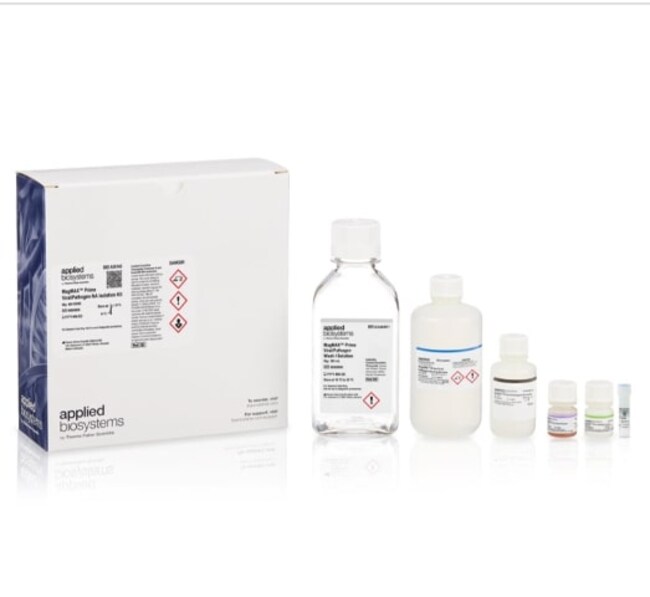
MagMAX™ Prime 病毒/病原体核酸分离试剂盒
MagMAX Prime 病毒/病原体核酸分离试剂盒是一种基于磁珠的核酸纯化试剂盒,用于从人类生物样本中分离和纯化病毒、细菌、寄生虫和真菌的核酸。 MagMAX 病毒/病原体核酸分离试剂盒的特点包括:•设计用于从一系列生物样品中分离和纯化微生物核酸,例如转运培养基中的拭子,唾液,粪便,尿液,血浆和血清等 •工作流程灵活,可在一个平板上批量处理各种类型的样品 •简化的自动化即用型方案,专为基础和进阶裂解以及粪便工作流程而设计了解更多信息
| 货号 | 数量 |
|---|---|
| A58145 | Up to 600 Reactions |
货号 A58145
价格(CNY)
7,464.00
飞享价
Ends: 31-Dec-2026
9,693.00共减 2,229.00 (23%)
Each
数量:
Up to 600 Reactions
价格(CNY)
7,464.00
飞享价
Ends: 31-Dec-2026
9,693.00共减 2,229.00 (23%)
Each
MagMAX Prime 病毒/病原体核酸分离试剂盒是一种基于磁珠的核酸纯化试剂盒,用于从人类生物样本中分离和纯化病毒、细菌、寄生虫和真菌的核酸。
MagMAX 病毒/病原体核酸分离试剂盒的特点包括:
•设计用于从一系列生物样品中分离和纯化微生物核酸,例如转运培养基中的拭子,唾液,粪便,尿液,血浆和血清等
•工作流程灵活,可在一个平板上批量处理各种类型的样品
•简化的自动化即用型方案,专为基础和进阶裂解以及粪便工作流程而设计
•快速自动 KingFisher Flex、KingFisher Apex、KingFisher Apex Dx(RUO 模式)程序,可在 60 分钟内处理 96 个样本
•灵活的方案可容纳 200 – 400 μL 的样品起始量
•粪便样品的洗脱体积为 200 μL ,所有其他类型样品的洗脱体积为 60 μL
•可用裂解缓冲液和珠磨管配件从具有挑战性的生物体和原始/稳定的粪便样本中提取核酸
该试剂盒供受过自动磁珠纯化技术培训的合格临床实验室人员使用。
经验证可与赛默飞传染病研究测定兼容
确保核酸提取试剂盒将与下游应用配合使用,并享受赛默飞世尔科技提供的完整解决方案。
MagMAX 磁珠法纯化的优势
与其他分离核酸的技术相比,磁珠具备许多优势。与玻璃纤维过滤柱相比,磁珠可更高效地结合核酸,从而获得更高且更稳定的产量。此外,由于不使用过滤柱和真空歧管,不存在样品中的细胞颗粒堵塞过滤柱的风险。这种堵塞问题对于通常用于病毒检测的富含蛋白的大量样品(如全血或血浆)特别重要。
可用于进阶工作流程的配件
进阶裂解工作流程
MagMAX Prime G+ 细菌和真菌裂解缓冲液
进阶粪便工作流程
MagMAX Prime 粪便裂解缓冲液
MagMAX Prime珠磨管
单组分试剂
MagMAX Prime 病毒/病原体结合磁珠
MagMAX Prime 病毒/病原体洗脱缓冲液
MagMAX Prime 病毒/病原体清洗 I 溶液
MagMAX Prime 病毒/病原体结合溶液
MagMAX Prime 病毒/病原体蛋白酶 K
MagMAX Prime 病毒/病原体蛋白酶 K 染料
MagMAX 病毒/病原体核酸分离试剂盒的特点包括:
•设计用于从一系列生物样品中分离和纯化微生物核酸,例如转运培养基中的拭子,唾液,粪便,尿液,血浆和血清等
•工作流程灵活,可在一个平板上批量处理各种类型的样品
•简化的自动化即用型方案,专为基础和进阶裂解以及粪便工作流程而设计
•快速自动 KingFisher Flex、KingFisher Apex、KingFisher Apex Dx(RUO 模式)程序,可在 60 分钟内处理 96 个样本
•灵活的方案可容纳 200 – 400 μL 的样品起始量
•粪便样品的洗脱体积为 200 μL ,所有其他类型样品的洗脱体积为 60 μL
•可用裂解缓冲液和珠磨管配件从具有挑战性的生物体和原始/稳定的粪便样本中提取核酸
该试剂盒供受过自动磁珠纯化技术培训的合格临床实验室人员使用。
经验证可与赛默飞传染病研究测定兼容
确保核酸提取试剂盒将与下游应用配合使用,并享受赛默飞世尔科技提供的完整解决方案。
MagMAX 磁珠法纯化的优势
与其他分离核酸的技术相比,磁珠具备许多优势。与玻璃纤维过滤柱相比,磁珠可更高效地结合核酸,从而获得更高且更稳定的产量。此外,由于不使用过滤柱和真空歧管,不存在样品中的细胞颗粒堵塞过滤柱的风险。这种堵塞问题对于通常用于病毒检测的富含蛋白的大量样品(如全血或血浆)特别重要。
可用于进阶工作流程的配件
进阶裂解工作流程
MagMAX Prime G+ 细菌和真菌裂解缓冲液
进阶粪便工作流程
MagMAX Prime 粪便裂解缓冲液
MagMAX Prime珠磨管
单组分试剂
MagMAX Prime 病毒/病原体结合磁珠
MagMAX Prime 病毒/病原体洗脱缓冲液
MagMAX Prime 病毒/病原体清洗 I 溶液
MagMAX Prime 病毒/病原体结合溶液
MagMAX Prime 病毒/病原体蛋白酶 K
MagMAX Prime 病毒/病原体蛋白酶 K 染料
仅供研究使用。
规格
适用于(应用)下一代测序、RT-PCR(终点法)、实时荧光定量 PCR
高通量能力高通量兼容性、自动化方案
关键功能分离并纯化病毒、细菌、寄生虫和真菌核酸
反应次数多达600个反应
核酸类型DNA/RNA
产品类型试剂名称
数量Up to 600 Reactions
样品类型运输培养基中的拭子, 唾液, 尿液, 血清, 血浆
样品体积200-400 μL
运输条件室温
靶标病毒、细菌、寄生虫和真菌核酸
产品规格试剂盒
分离技术Magnetic Bead
Unit SizeEach
内容与储存
• 160 mL 结合溶液
• 300 mL洗涤 I 溶液
• 6 mL 结合磁珠
• 3 mL 蛋白酶 K
• 36 mL 洗脱缓冲液
• 30 μL 蛋白酶 K 染料
在 15 – 25°C 下储存
引用和文献 (7)
引用和文献
Abstract
Microbiota-derived short-chain fatty acids mediate Candida albicans gastrointestinal colonization resistance.
Journal:Cell host & microbe
PubMed ID:42242208
The gut microbiota plays critical roles in constraining Candida albicans colonization of the gastrointestinal (GI) tract, which is a key precursor to disseminated fungal infection in immunocompromised hosts. Depletion of commensal microbiota, such as by antibiotic treatment, increases C. albicans burden and promotes dissemination, yet the mechanisms of colonization resistance
Streamlined CRISPR-based assays for detection and subtyping of avian influenza.
Journal:medRxiv : the preprint server for health sciences
PubMed ID:40909817
Avian influenza viruses (AIVs) are zoonotic pathogens that pose an increasing global threat due to their potential for significant economic losses in agriculture, spillover into humans, and the risk of a pandemic should human-to-human transmission occur. These concerns underscore the need for rapid, sensitive and specific tools to detect and
Establishing Methods to Monitor Influenza (A)H5N1 Virus in Dairy Cattle Milk, Massachusetts, USA.
Journal:Emerging infectious diseases
PubMed ID:40138725
Highly pathogenic avian influenza A(H5N1) virus has caused a multistate outbreak among US dairy cattle, spreading across 16 states and infecting hundreds of herds since its onset. We rapidly developed and optimized PCR-based detection assays and sequencing protocols to support H5N1 molecular surveillance. Using 214 retail milk samples from 20
Evaluation of Self-Collected Mouth Rinse Specimens for Coronavirus Disease 2019 Testing: A Pilot Study
Journal:COVID
PubMed ID:
Saliva specimens are widely used for coronavirus disease 2019 (COVID-19) testing using RT-qPCR due to their advantages over nasopharyngeal swabs of being non-invasive and self-collectable. However, saliva collection can be time-consuming in individuals with reduced saliva secretion, including those with diabetes, diseases involving salivary glands such as Sjögren’s syndrome, and
Interdependent RNA structural motifs at the 3'-terminus of the West Nile virus genome regulate viral growth.
Journal:bioRxiv : the preprint server for biology
PubMed ID:41959387
The RNA genome of West Nile Virus (WNV) folds into an elaborate series of RNA structural elements that are crucial for viral function. Among these elements, four pseudoknots (PKs) at the viral 3’-terminus, designated as SLII, SLIV, DBI, and DBII, are among the most crucial players in the overall flaviviral