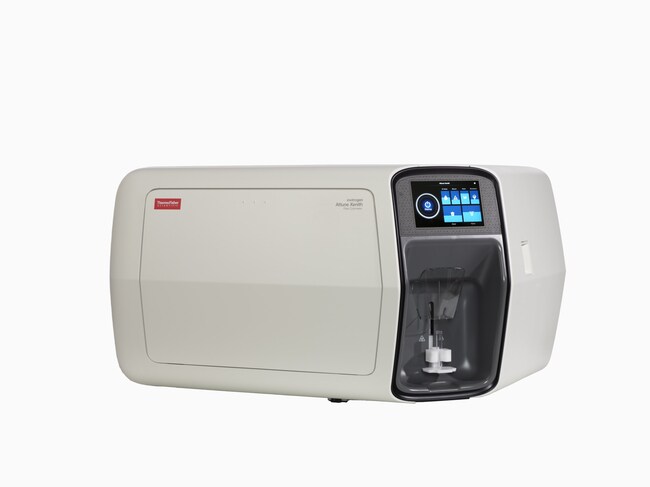
Attune™ Xenith™ Flow Cytometer
Invitrogen™

Attune™ Xenith™ Flow Cytometer

Designed for the rigorous demands of researchers the Attune Xenith Flow Cytometer leverages our legacy acoustic focusing technology with advanced spectral capabilities and expanded optical capabilities so users can evaluate more parameters faster.
Have Questions?
货号Quantity
A59358
货号 A59358
价格(CNY)
-
申请报价
The Attune Xenith Flow Cytometer is a reliable flow-cytometry solution designed to help meet the rigorous demands of researchers. Leveraging our legacy Attune core acoustic focusing technology, this innovative instrument combines acoustic-assisted hydrodynamic focusing with advanced spectral capabilities to help you evaluate more parameters faster. With expanded optical capabilities, including UV and NIR lasers, this system supports both traditional compensation and spectral unmixing analysis.

Features of the Attune Xenith Flow Cytometer include:

  • Remarkable speed—operates up to 5X faster than most flow cytometers
  • Versatility and flexibility—supports both spectral unmixing and conventional compensation workflows, enabling optimization of experimental design and exploration of new research possibilities
  • Compatibility with complex samples—designed to handle challenging sample types, such as tumor and tissue samples, with reduced clogging for smooth sample acquisition and reliable data analysis
  • Productivity and reliability—designed with increased uptime and simplified operation in mind, enabled by streamlined maintenance, intuitive touchscreen operation, and advanced remote diagnostics
  • Extensive detection range—includes 6 lasers, 51 fluorescent detectors, and 6 scatter channels.

Reduced time to results

Acoustic-assisted hydrodynamic focusing technology leverages ultrasonic waves to precisely align cells, delivering exceptional speed and flexibility in flow cytometry. This enables faster flow rates, while enabling uniform cell alignment in the flow cell, that help reduce the time to results for experiments and the flexibility to dilute concentrated samples without the need to spend longer times on data acquisition.

Expanded optical detection

The system includes 6 spatially separated, flat-top lasers (349, 405, 488, 561, 637, and 781 nm) and 51 fluorescent detectors with user-changeable filters as standard. It also includes 6 scatter detectors for enhanced resolution (488 nm standard FSC and SSC, 405 nm FSC and SSC for small-particle resolution, and 488 nm FSC and SSC for expanded range/polarized detection). The system can easily switch between spectral unmixing and conventional compensation workflows, making it exceptional for high-parameter analysis.

Designed to handle difficult samples

Positive displacement fluidics help reduce risk of system downtime due to clogs from sticky tumor and tissue digests. Specified volume delivery rate applies over pressure to the system that can displace clogs from the system should they occur and allow sample runs to continue.

Maintain uptime through simplified maintenance and exceptional service and support

The Attune Xenith Flow Cytometer has advanced diagnostic tools, including onboard service cameras, for assessment of flow cell cleanliness and laser alignment and onboard diagnostics and telemetry for enhanced system service logging. The integrated touchscreen can be used for easy running and monitoring of automated maintenance functions. The system includes a standard one-year warranty period. Also available are additional service plans to help take the guess work out of ensuring instrument uptime. Basic training is also provided with a member of our experienced flow cytometry support team to cover use and maintenance of the system.

仅供科研使用。不可用于诊断程序。
规格
适用于(设备)Attune Xenith Flow Cytometer
产品规格5 mL, 2 mL and 1.5 mL Tubes
频率50/60 Hz
包括Attune Xenith Flow Cytometer, Attune Xenith Fluid Cart, Minitower Windows 11 computer with instrument software, 32 inch monitor, Power cords with adapters, Fiber Ethernet cable, Attune Shutdown solution, Attune Wash solution, Attune Focusing Fluid, Attune NxT Flow cell cleaning solution, Attune Debubble solution, Attune Xenith Quality Control Beads
激光功能Excitation lasers: 349nm, 405 nm, 488 nm, 561 nm, 637 nm, 781 nm
产品线Attune™
运输条件Room Temperature
电压100/240 V
Unit Size1 Ea.

常见问题解答 (FAQ)

Can the Attune Xenith Flow Cytometer run no-lyse/no wash assays in the same way as the Attune NxT Flow Cytometer?

Yes, the Attune Xenith Flow Cytometer has built in FSC and SSC channels off the violet laser so that no-lyse/no-wash assays, which exploit the difference in violet light-scattering properties between red blood cells and leukocytes, can be easily run without the need for any changes in filters or need for purchase of additional accessory kits. This integrated capability helps make the process straightforward and efficient.

Find additional tips, troubleshooting help, and resources within our Cell Analysis Support Center.

With the Attune Xenith Flow Cytometer, how do I determine whether I need to run spectral unmixing vs conventional compensation?

Choosing between spectral and conventional flow cytometry depends on your experimental needs and the complexity of your panels. Spectral flow cytometry offers significant advantages for high-parameter detection, improved data resolution, flexibility, simplified panel design, and the ability to handle complex samples. It is also beneficial for sample types with multiple auto fluorescent populations to be explored and for panels where a user may not be familiar with the best peak channel to choose. Conventional flow cytometry remains a robust and effective option for simpler applications and lower-parameter analyses. Conventional compensation can be beneficial for panels of smaller size and/or limited single-channel overlap. It can also be beneficial for panels that include very bright dyes such as functional dyes which often require individual detector adjustments (adjusting the full spectral signature to keep these dyes on scale in bright samples may lead to confusing spectral signatures). By considering these factors, you can select the flow cytometry method that best aligns with your research goals and requirements.

Find additional tips, troubleshooting help, and resources within our Cell Analysis Support Center.

Do you recommend using beads or cells as controls in spectral unmixing with the Attune Xenith Flow Cytometer? Why would one be chosen over the other?

Both beads and cells can be used as controls in spectral unmixing, and the choice between them depends on the specific requirements and goals of the experiment. Beads offer consistency, reproducibility, and ease of use, making them ideal for calibration and routine quality control. Cells, on the other hand, provide biological relevance and allow for the characterization of complex spectra and autofluorescence, which can be crucial for certain applications. Therefore, the decision to use beads or cells should be based on the specific needs of the spectral unmixing process and the experimental context. Cells are a good choice if you have plenty of sample, the antibody in use will stain a large and distinct positive population, and there will be an internal negative population. Beads are a good choice if your sample is limited, the antibody would only stain a very small subset of cells, or the population of cells that would stain would not be distinct. Beads are also only a good choice if the spectral characteristics of the fluorophore are maintained on beads. We recommend that when establishing a panel, a full set of single-stain controls of both beads and cells be prepared. After recording the controls, the user should check the signature of the beads vs cells and decide on the best choice for each fluorophore. For example, if the spectral signatures are different on beads, then cells will be needed; and if cells are brighter than beads, then the cells would need to be used for the controls. It is likely that a mixture of cells and beads for controls will be the optimal choice.

Find additional tips, troubleshooting help, and resources within our Cell Analysis Support Center.

How does the Attune Xenith Flow Cytometer perform spectral unmixing?

The Attune Xenith Flow Cytometer performs spectral unmixing by capturing the emission spectrum of each fluorophore across multiple detectors. It uses advanced spectral unmixing algorithms to accurately deconvolute overlapping spectra, helping ensure precise identification and quantification of each fluorophore. Specifically, the Attune Xenith Flow Cytometer employs the Ordinary Least Squares (OLS) algorithm for spectral unmixing, which is a widely used method in spectral systems. This approach allows for accurate separation of signals, even when spectra overlap significantly, helping ensure high-quality data for complex multi-parameter analyses.

Find additional tips, troubleshooting help, and resources within our Cell Analysis Support Center.

Why does the Attune Xenith Flow Cytometer have Photomultiplier Tubes (PMTs) rather than Avalanche Photodiodes (APDs)?

The Attune Xenith Flow Cytometer uses Photomultiplier Tubes (PMTs) instead of Avalanche Photodiodes (APDs) due to several critical advantages. PMTs offer high sensitivity, allowing them to detect very low levels of light, which is essential for precise and accurate measurements in flow cytometry. They also provide a wide dynamic range, capable of measuring a broad range of signal intensities from very dim to very bright, thus enabling detailed quantification across various sample conditions. Additionally, PMTs have a fast response time, quickly reacting to changes in light intensity, which is crucial for the rapid data acquisition required in flow cytometry. Their spectral flexibility allows the use of various optical filters to detect different wavelengths of light, enhancing their versatility in multi-parameter analysis. Moreover, PMTs are highly reliable and compatible with advanced optical systems, helping ensure consistent and high-quality data collection. In contrast, while some APDs may offer higher quantum efficiency, they suffer from a higher noise floor and limited linearity for bright signals, which negatively impacts the flexibility and accuracy needed to run both compensation and spectral panels on the same instrument. These attributes make PMTs an excellent choice for achieving precise, accurate, and high-quality data in both spectral and conventional flow cytometry applications.

Find additional tips, troubleshooting help, and resources within our Cell Analysis Support Center.