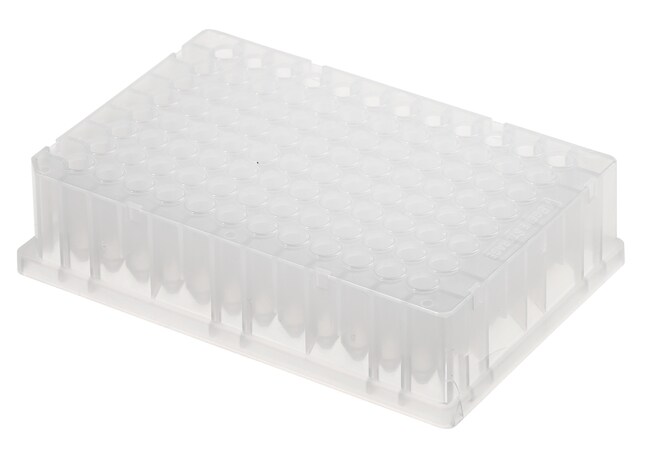
Abgene™ 96 Well 0.8mL Polypropylene DeepWell™ Sample Processing & Storage Plate for Genomics and NGS library preparation

Abgene™ 96 Well 0.8mL Polypropylene DeepWell™ Sample Processing & Storage Plate for Genomics and NGS library preparation

0.8 mL DeepWell™ sample processing and storage plates for automation, NGS and genomic library prep, cell culture and sample storage applications. Specifically designed for use with liquid handlers, and magnetic bead extraction
Have Questions?
Change viewbuttonViewtableView
Catalog NumberColorPackagingFit for Purpose
AB0859NaturalBulkPCR Ready
AB0765NaturalIndividually WrappedPCR Ready
Catalog number AB0859
Price (CNY)
2,368.99
Online Exclusive
Ends: 31-Dec-2025
5,509.29
Save 3,140.30 (57%)
Case of 50
Add to cart
Color:
Natural
Packaging:
Bulk
Fit for Purpose:
PCR Ready
Price (CNY)
2,368.99
Online Exclusive
Ends: 31-Dec-2025
5,509.29
Save 3,140.30 (57%)
Case of 50
Add to cart

Thermo Scientific™ Abgene™ polypropylene microplates and DeepWell plates offer storage security for assays, compound libraries or storing samples for either intermediate or long term use and have molded slots and pads for automated sample processing and preparation workflows. Abgene microtiter plates are manufactured to exacting specifications in our Class 100,000 clean room ISO 9001 conditions using USP <661.1> high quality medical grade virgin polypropylene resins, which ensure confidence in the quality and performance of the storage plates. Designed to ANSI standards these microplates and DeepWell plates are compatible with a variety of automated liquid handling for high throughput workflows. The polypropylene storage plates are offered with spindle, pyramidal, U and V bottom wells along with a wide range of volumes to accommodate most applications.

All Thermo Scientific plates are manufactured in our cleanroom facility to ensure molecular grade quality. Our wide range of polypropylene plates provides excellent solutions for sample storage and assay set-up, allowing dilutions and aliquots to be handled, stored, or transported easily. The Virgin medical grade resin passes requirements for USP <661.1> and USP <665> reports have been completed for both CapMat sealed and Heat Sealed plates.


Highlights

  • Certified free from DNAse, RNAse, PCR Inhibitor, and human DNA
  • 0.8 mL maximum well volume when sealed with adhesive or heat seal
  • 0.70 mL working volume when sealed with Storage Plate Cap Strip
  • 0.55 mL working volume when sealed with a 96-well Sealing Mat
  • Conical well bottom for ease of sample retrieval

Compatible Sealing: Adhesive and Heat seals
Hazardous: No
Max Centrifugal Force: 2000 g
Max Vol (Cap Seal): 0.7 mL
Max Vol (Film Seal): 0.8 mL
Max Vol (Mat Seal): 0.55 mL
Storage Condition: Ambient

All Thermo Scientific Abgene plates are manufactured in our cleanroom facility to ensure molecular grade quality. Our wide range of polypropylene plates provides excellent solutions for sample processing and storage and assay set-up, allowing dilutions and aliquots to be handled, stored, or transported easily.

All plates are ANSI format for compatibility with automated systems.

To further assist in sample storage and tracking, all plates can be customized with non-repeating barcoding and labelling. OEM options for custom logos, colors and full packaging support are available.

Specifications
AutoclavableAutoclavable
Binding TypeLow binding PP
Certifications/ComplianceCertified RNase, DNase, PCR Inhibitors, and human DNA Free. ANSI Compliant
Dnase FreeYes
Description96-well Polypropylene Sample Processing & Storage Plates
For Use With (Application)Automation Liquid Handlers, Biobanking, Genomics, Sample Prep, NGS, Sequencing, Long and Short Term Storage, Drug Discovery, Vaccine Research, PCR and qPCR sample preparation
For Use With (Equipment)ALPS5000, ALPS3000, and ALPS50V Heat Sealers, Automated Liquid Handlers, Multidrop Combi, Centrifuges, Ultralow Freezers, Liquid Handlers
Max. RCF2000 x g
No. per Case50
No. per Pack50
PackagingBulk
Plate SizeANSI/ SLAS Standard
Product Type96-well plate
RNase FreeYes
Regulatory StatusFor Research Use Only. Not for use in diagnostic procedures.
Volume (Metric) Working700 μL
Array8 x 12
BarcodeCustom Barcoding Available
ColorNatural
Fit for PurposePCR Ready
FormatStandard
MaterialPolypropylene
No. of Wells96
Product LineAbgene
SterilityCleanroom
Surface TreatmentNon-treated
Volume (Metric) Well800 μL
Well ShapeRound, Conical Bottom (V-well)
Unit SizeCase of 50

Frequently asked questions (FAQs)

Are Thermo Scientific ABgene plastics endotoxin-free?

They are not certified endotoxin-free. However, their entire production process, from molding to final packaging, is carried out in a Class 100,000 clean room under ISO 9001 guidelines. All Thermo Scientific PCR plastics are certified free from RNase, DNase and human DNA.

Find additional tips, troubleshooting help, and resources within our Real-Time PCR and Digital PCR Instruments Support Center.

Are Thermo Scientific ABgene plastics sterile?

Thermo Scientific Abgene plastics are not typically sterilized as their entire production process, from molding to final packaging, is carried out in a Class 100,000 clean room under ISO 9001 guidelines. All Thermo Scientific PCR plastics are certified free from RNase, DNase and human DNA. In contrast, during typical non-clean room production, plastics are exposed to many contaminants including dust, bacterial cells, and DNA. The plastics are then sterilized to kill bacteria and inactivate RNases and DNases, but sterilization does not remove dust or DNA contamination. The dust particles left behind can inhibit PCR, and the damaged DNA fragments can still act as templates, leading to non-specific amplification.

Find additional tips, troubleshooting help, and resources within our Real-Time PCR and Digital PCR Instruments Support Center.