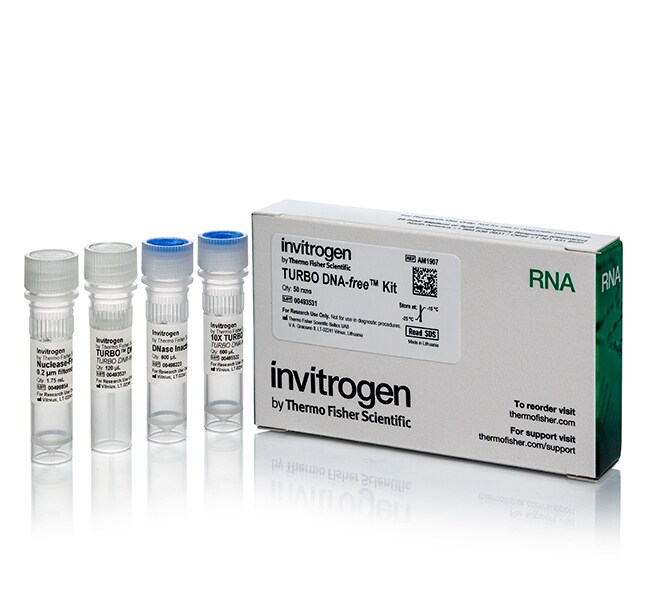
TURBO DNA-free™ 试剂盒
Invitrogen17万+抗体限时买二赠一,靶点广,灵活用!
TURBO DNA-<i>free</i>&trade; 试剂盒
Invitrogen™

TURBO DNA-free™ 试剂盒

TURBO DNA-free™ 试剂盒含有的试剂可高效、完全酶切 DNA,并可在酶切后去除酶和二价阳离子。注:如果您想单独购买酶,而不需要灭活和阳离子去除试剂,请参见TURBO™ DNAase。TURBO DNA-free™ 试剂盒的特点包括:•与野生型了解更多信息
Have Questions?
货号数量
AM190750 Reactions
货号 AM1907
价格(CNY)
1,471.00
飞享价
Ends: 31-Dec-2025
2,303.00
共减 832.00 (36%)
Each
添加至购物车
数量:
50 Reactions
请求批量或定制报价
价格(CNY)
1,471.00
飞享价
Ends: 31-Dec-2025
2,303.00
共减 832.00 (36%)
Each
添加至购物车
TURBO DNA-free™ 试剂盒含有的试剂可高效、完全酶切 DNA,并可在酶切后去除酶和二价阳离子。

注:如果您想单独购买酶,而不需要灭活和阳离子去除试剂,请参见TURBO™ DNAase

TURBO DNA-free™ 试剂盒的特点包括:

•与野生型 DNase I 相比,高活性 TURBO™ DNase 具有更强的催化能力
• 可去除可能干扰 RT-PCR 的痕量 DNA
• 所含试剂可完全去除 DNase,无需苯酚处理或加热

特别适用于在 RT-PCR 前去除基因组 DNA
TURBO™ DNase 是重组工程改造形式的 DNase I,在酶切痕量不需要的 DNA 方面比野生型 DNase I 更有效TURBO™ DNase 与 DNA 底物结合的紧密程度是传统 DNase I 的 6 倍,因此该酶是清除 RT-PCR 应用中可产生假阳性信号的残留 DNA 的较好选择。TURBO™ DNase 现在包含一种增强剂,将有效性提高了两个数量级。

可高效去除 DNase 和二价阳离子,无需有机提取或沉淀
在 RT-PCR 前对 RNA 样品进行常规 DNase 处理通常需要通过苯酚:CHCl3 提取或加热来灭活 DNase,然后进行沉淀步骤浓缩 RNA苯酚:CHCl3 提取过程繁琐且耗时。加热样品灭活 DNase 可能会因 DNase 缓冲液中存在的二价阳离子导致 RNA 化学降解。TURBO DNA-free™ 试剂盒使用了新型 DNase 灭活试剂,可避免这些问题。除了可去除反应中的 TURBO™ DNase,灭活试剂还可结合并去除 TURBO™ DNase 反应缓冲液中的二价阳离子。
仅供科研使用。不可用于诊断程序。
规格
兼容缓冲液反应缓冲液
产品类型TURBO DNA Free 试剂盒
数量50 Reactions
运输条件干冰
DNase
产品线Ambion™,DNA-free
Unit SizeEach
内容与储存
包含:
TURBO DNase
10X TURBO DNase 缓冲液
DNase 灭活试剂
无核酸酶水

组分储存在 -20°C 下(无核酸酶水可以储存在室温下)

常见问题解答 (FAQ)

我是否可以使用TURBO DNA-free试剂盒进行二次消化?

可以,虽然单次DNase处理通常可以满足绝大部分DNA去除需求,但也可以选择进行二次处理。请点击此处(https://www.thermofisher.com/us/en/home/references/ambion-tech-support/nuclease-enzymes/turbo-dna-free-second-digest-protocol.html),查看实验方案。

我该如何从RNA样品中去除DNase?

以下方法可去除DNase:酸性苯酚:氯仿抽提、氯化锂沉淀、EDTA和热灭活,或使用我们的MegaClear 转录回收试剂盒(货号AM1908)。
此外,我们的Ambion TURBO DNA-free试剂盒(货号AM1907)包含DNase灭活试剂,可用于去除DNase以及镁和钙等二价阳离子,这些物质在RNA随样品一起加热时可催化RNA降解。

Can I perform a second digest by treating with the TURBO DNA-free Kit?

Yes, while a single DNase treatment is typically sufficient for the vast majority of DNA removal needs, a second treatment option is available. Please note that sequential TURBO DNA-free treatments require a special buffer for the second digestion step; the 10X TURBO DNase buffer provided in the kit cannot be used for this purpose. A unique digestion buffer for the second DNase reaction must be used to minimize the carryover of salt into the PCR step of RT-PCR. Otherwise, the limit of detection of targets in RT-PCR may be compromised.

Please see the second digest protocol below:

Before you begin:
Prepare the 10X TURBO DNA-free Second Digest Buffer. This buffer contains: 200 mM Tris-HCl pH 7.5, 100 mM MgCl2, and 5 mM CaCl2, prepared with nuclease-free H2O. The final pH of the solution should be 7.5. If the pH is not 7.5, add NaOH or HCl as necessary, but do not introduce more than 50 mM of total monovalent salt to the 10X buffer when adjusting the pH in this way.

Protocol:
After the DNase Inactivation Reagent treatment step in Section E.5 of the TURBO DNA-free Kit manual (https://assets.thermofisher.com/TFS-Assets/LSG/manuals/1907M_turbodnafree_UG.pdf), remove a volume of the RNA sample without disturbing the pellet, and transfer it to a new 0.5 mL tube.

Add 0.1 volume of 10X TURBO DNA-free Second Digest Buffer, and 1 µL TURBO DNase to the RNA sample, mix gently, then continue with the standard protocol as described in Section E.2.

The RNA sample is now ready for downstream applications. However, we recommend consideration of the following points:

- For RT-PCR applications, we recommend that the volume of RNA that has been sequentially treated with TURBO DNA-free comprise no more than 20% of the final one-step RT-PCR reaction volume. If the amount of RNA passed into the RT-PCR reaction is too low, then consider increasing the RT-PCR volume to 50 µL or more, or performing a two-step reaction. For example, the RNA volume can be increased up to 40% of the final reverse transcription reaction volume in two-step applications.

- We have observed in-house that some RT-PCR amplicons are more sensitive to salt than others. Restricting the volume of the treated RNA sample to <20% can help to minimize these effects.

How do I remove DNase from an RNA sample?

DNase can be removed by the following methods: acid phenol:choloform extraction, lithium chloride precipitation, EDTA, and heat inactivation, or using our MegaClear Transcription Clean-Up Kit (Cat. No. AM1908).

Alternatively, our Invitrogen TURBO DNA-free Kit (Cat. No. AM1907) is supplied with a DNase inactivation reagent that can be used to remove the DNase, as well as divalent cations such as magnesium and calcium, which can catalyze RNA degradation when RNA is heated with the sample.

How can I inactivate DNase I?

Add of 1 µL of 25 mM EDTA solution to the reaction mixture in 10 µL reaction with 1 unit DNase I, Amplification Grade (or 1:1 molar ratio of Mg++ ions:EDTA) to chelate the Mg++ ions in the DNase I buffer. Heat for 10 min at 65 degrees C.

Note: It is vital that the EDTA be at least at 2 mM prior to heat-inactivation to avoid Mg-dependent RNA hydrolysis.

DNA-free and Turbo-free versions of DNase I can be inactivated with included DNase Inactivation Reagent.